Tuesday, August 20, 2013

Innovators in E-Learning Series: Interview with Paige Johnson, Intel Education Strategist

The appropriate use of educational technology can be challenging, particularly in a time of rapid change and disruptive technologies. It can be difficult to find the best fit and to select the correct technology for a college, university, school, or organization. Further, while many feel they're in a constant game of "catch up," others are excited about the road ahead, and are looking at ways that technology is being used in other uses and industries can be applied to education.

Welcome to an interview with Paige Johnson, Intel Education Strategist (@IntelK12Edu), who matches the educational need with the appropriate technology.

Paige Johnson, Intel Education Strategist


1. What is your name and relation to e-learning and technology-facilitated learning?
My name is Paige Johnson and I’m Intel’s K-12 education strategist. My goal is to ensure schools get the return on their technology investments in terms of students’ achievement and performance.

2. What constitutes today's "technology-rich classroom" and what are some of the “must-haves”?
The most important thing in a technology-rich classroom is a great teacher. You can have the best resources in the world, but without an inspired, innovative educator you won’t get excellent learning outcomes. One new form factor that is coming out now is called a 2-in-1; it’s a notebook when you need it and a tablet when you want it. These devices are still a little expensive for schools, but look for them to come down in price in the coming year. A lot of these devices will have full pen enablement so students can accurately make diagrams, concept maps and write out complex mathematical equations. I also think you will see a lot of work in the adaptive learning space in the next few years. Right now, most “adaptive learning” products use very structured data. For example, a student answers a question and is shuttled to appropriate content. With the advent of tools that allow for analysis of unstructured data, such as information on where a student is looking on a screen or if the student shows signs of frustration or boredom, it will be possible to create a truly personalized experience for students. This trend is moving quickly in healthcare and retail, so you can expect similar trends to get picked up in education, as well.

In today’s classroom, I’m a big supporter of using blended learning environments to support learning. A great teacher with access to a blended learning environment can tap into student passions in new ways. The blended platform allows teachers to spend more energy and time on learning and less on classroom management. Intel invested in an Intel Teach Elements course to help educators think about using blended learning in their classroom. This free resource can be found at intel.com/teachers.

3.  How does technology help today's teachers achieve their learning goals?
Technology in schools can help support deeper learning and bring the world into a teacher’s classroom. The Internet now allows students to have access to complex data systems that previously were only available to professionals. Educators also need to rethink their instruction in order to get the most out of their investments. For example, requiring educators to be more self-directed in their learning and shifting assessment by seeking performance-based evidence of understanding will help students prepare to be college and career ready.

4. How does the technology-rich classroom help teachers teach to the tests the students must take? 
Student achievement on tests is tied to deep conceptual understanding of content. Technology can be a platform that allows teachers to design meaningful instruction for students. One thing I think many districts are struggling with right now is ensuring equal ubiquitous access to technology for all students. I work closely with Project RED  a research-driven organization that focuses on successful technology implementation in districts. The Project RED research has shown that schools that implement a 1:1 student-computer ratio, for example, outperform other schools in terms of academic achievement and financial benefits. However, the Project RED research shows access is not enough. If your students are just reading e-books or playing on apps that don’t require them to gain a deeper understanding of core curricular content, then you won’t get the most out of your investment. This is why Intel supports a site called the K12 Blueprint, because research shows that careful planning, great professional development and strong implementation support does result in better student achievement, reduced disciplinary actions and higher graduation rates.

5. What are a few examples or specific cases of students feeling more engaged thanks to technology in the classroom? 
One example I like to talk about is the implementation of 1:1, project-based learning in San Diego’s Del Sur Elementary School. Megan Power, a kindergarten teacher, participated in a pilot program where each of her students was given their own laptop in an effort to personalize their learning. Megan took advantage of this technology and taught her students how to write by creating blogs. This video shows hows Megan’s kindergartners collaborating with one another, engaging with the technology, and most importantly, being excited about learning.

Another example of a school we work with closely is Crellin Elementary School in the rural town of Oakland, Maryland. This school is an Intel School of Distinction award winner for its support of math learning. The school’s principal, Dana McCauley, has worked with teachers to bring real-world projects in support of math learning. The school’s achievements have been showcased by PBS as a model for STEM education in rural schools. You can see a short video on the work at http://www.youtube.com/watch?v=otGnt1tuTLY.

7. What is your personal teaching and learning philosophy?
Learning is a lifelong endeavor. I recently went to a conference about technology integration in the classroom and met Sister Angela, a 79-year-old nun who was there to learn how to better use technology in her classroom. As you might guess, she struggled with the technology. But, whenever someone asked her why she wasn’t retired or why she even came to the event, she would say: “The day I stop learning will be the day I lay down and die.” Learning to use technology was by no means easy to Sister Angela, but she knew it was important for her to learn so she could better engage with her students while modeling life-long learning in her own work.


Sunday, August 18, 2013

Strategic Decision-Making and Current Problems: An Online Course

Technological breakthroughs which have enabled companies to recover oil and gas that was previously unrecoverable have transformed the U.S. energy industry, and have helped lower dependence on imported oil. Some economists have predicted energy independence by 2020 (Citigroup, 2013, Energy 2020: North America, the New Middle East?). We can already see a change: in 2005, the U.S. imported 60% of its oil, while in 2012, only 40% was imported (U.S. Energy Information Administration, August 2013, http://www.eia.gov/forecasts/steo/pdf/steo_full.pdf).

Understanding the opportunities and gaining knowledge of the multiple challenges that accompany the goal of sustainable expansion of oil and gas supplies (via exploration, production, transportation) and the appropriate / effective use of new technologies are vital. To that end, here is a course which one can take (open courseware), or receive certification and credit in an instructor-led e-learning setting (AAPG -- American Association of Petroleum Geologists). It can also apply toward an MBA with an emphasis in Energy Leadership (Texas A&M Texarkana). For information contact snash@aapg.org 

Energy Strategy, Technology, and Current Issues in the Oil Industry
Energy Overview / Current Issues in Energy

Learning Objectives: 
Upon successful completion of this course, the student will be able to list current issues that can impact growth and sustainability of oil and gas ventures. They will also be able to explain the reasons for the potential problems, and evaluate possible solutions. 

Who Should Take this Course?
This course will help energy professionals, investors, geoscientists, engineers, business owners, managers, and service providers a clear view of many of the issues that accompany the rapid expansion of oil and gas supplies. It will place them within a strategic context that will help identify specific opportunities, and also places where changes can be made.

Overview:
The future of oil and gas ventures is complex due to a number of challenges facing the industry. Although demand for oil and gas remains high, especially in the new giants, India and China, complications have emerged, particularly in the U.S., where the “shale revolution” has resulted in an oversupply of natural gas, and plunging natural gas prices. In the meantime, lack of infrastructure in some of the major plays (the Bakken in North Dakota, the Eagle Ford in south Texas), has made it necessary to employ expensive methods of transporting liquids-rich petroleum such as hauling via truck and rail, vs. pipelines. Further, the lack of natural gas processing and transportation infrastructure (gathering systems, pipelines, compressors, conditioning) has made it difficult to get natural gas to market. Water management remains a challenge as well, particularly in times of drought and public sensitivity to environmental issues.

At the same time, enormous opportunities abound, primarily due to the emergence of transformational technologies, which have allowed previously unproductive and unproducible resources to be exploited. Further, new technologies are making it possible to return to mature fields and to recover oil and gas that has been left behind.

In order to make strategic decisions in all industries, it is very important to have an understanding of the issues facing the energy sector. 

Course Units (Issues):  

Select four issues, click on the links for access to the readings and course materials. Then read the materials and respond to the Guiding Questions by writing responses. Support your ideas with information from the readings and also by conducting your own research using reliable sources. 
1.  Current oil and gas exploration / production efforts hampered by insufficient cash / undercapitalization.

2.  Skyrocketing costs in energy technology. 

3.  Environmental challenges.

4.  Shortages of qualified personnel.

5. Bubble Economies and Carbon Economies / Fire sales and “vulturing”.

6. Alternative Energies: Easy-to-find, cheap-to-produce oil no longer exists.

7. Health and safety issues are increasingly complicated. 

8. “Green” energy must combine with oil and gas.

9. Geopolitical power shuffles.

10-11. Non-renewables are “dirty” and difficult; Renewables are expensive. 

12.  Global outlook: Sustained, worldwide growth. 


*********************
Susan Smith Nash, Ph.D.
- 2013 -

Monday, August 12, 2013

Mind-Mapping and E-Learning: Interview with Yvonne Wu, MindMaple

Mind-mapping software has been used very successfully in courses where creativity and idea generation are critical, and where one might wish to discover (or uncover) connections and patterns. Mind-mapping can be conducted independently or collaboratively; the collaborations can be synchronous or asynchronous. Mind-mapping software is often very helpful and can be used in conjunction with elearning courses as well as in tasks and projects. MindMaple, a mind mapping software in both Windows and IOS operating systems, is unique in its flexibility and suitability for many different users, ages, and levels.


MindMaple.com Mind-Mapping Software
 Welcome to an interview with Yvonne Wu, MindMaple.

1.  What is your name and relation to e-learning?
My name is Yvonne Wu and I’m a member of the marketing team of MindMaple. I want to share my belief with all the educators and the readers of e-learning blog that the concept of mind mapping techniques can support or even enhance the education in many ways.

2.  What is MindMaple?  How does it work?

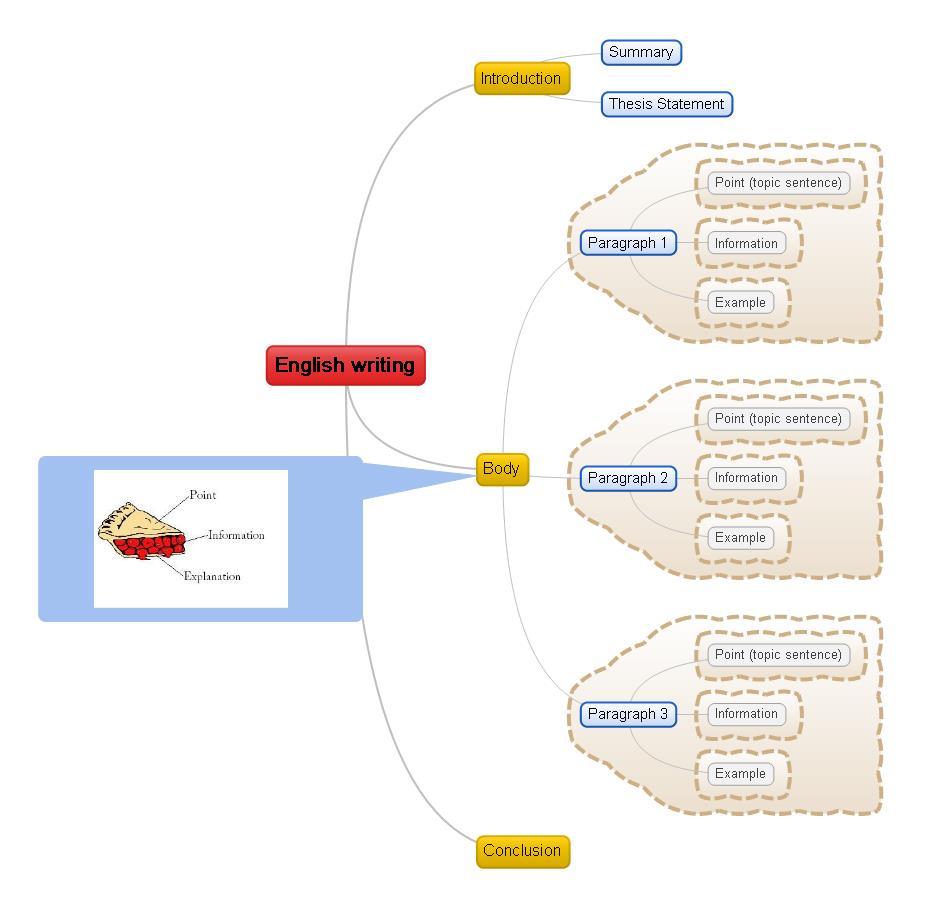
A mind map is a diagram that grows and elaborates around a central word, phrase or concept. Starting from a central topic, we add subtopics or subcategories to branch out the map; at the same time grow the ideas.

Mind map visually organizes your thoughts on the same surface. It’s like visualizing the thoughts in your brain that people can easily see and understand with one glance and be on the same page with you.

When the concept of mind mapping marries technology, voila! Here comes MindMaple! MindMaple, a mind mapping software works as a tool to optimize skill of mind mapping with technology. Teaching and learning then become more creative and interactive.


3.  Please describe three innovative uses of MindMaple in elearning for K-12, college, and professional development

in e-learning for K-12

•    Optimized the integration of left and right brain.
Our left brain majorly is in charge of tasks that are more analytic and logical; while our right brain processes most of the non-verbal tasks that require more creativity and imagination. Mind mapping is a useful technique integrating the functions of both left and right brain in the thinking process; while MindMaple, optimizes such skill with technology. It allows you to think logically; while at the same time retains or even boosts your creativity.

•    Stimulated curiosity and encouraged children to think outside of the box:
The motivation of learning starts from curiosity. Teaching and learning with mind mapping software is interactive which helps children to increase the brain activity and to remain curious.

•    Increased interest of learning for students with learning disability:
MindMaple allows teachers to add images, video clip, or to color code the map. This makes teaching lectures more interactive and can help students with attention deficit hyperactivity disorder (ADHD). Color coding and the nature of mind map that communicate with less word but more visual material can lower the learning barrier for students who have Dyslexia problem.


elearning for college
•    Making presentation more convincing: Either the lectures in class or student performing presentations for their projects, MindMaple visualize communication, which not only make the presentation more interactive, but also more convincing.

•    Planning and scheduling with MindMaple to enhance task management: Schools and teachers can use MindMaple to design the teaching plan, syllabus or school event planning. Task manager function in MindMaple also allows students or teachers to set up deadlines, to keep tracking task progress, or to distribute the resource and budget for better task management. 


•    Organizing ideas and thoughts: Mind mapping software enables students and teachers to think outside of the box; while keeping all ideas visually organized.  MindMaple can be an incredible asset in regards to learning and teaching in a creative, more efficient way. Teachers can use MindMaple for brainstorming sessions. Students can use it for notes taking and studying.


 elearning for professional development
•    When it comes to project management, MindMaple is extremely helpful organizing ideas and tasks with the functions of scheduling and task progress tracking. Project managers and event planners use MindMaple to plan and keep track of multiple projects with deadline.

•    Visual design related professions will find MindMaple helpful in the brainstorm stage. You plant the ideas, let MindMaple help it grow!

•    Journalists can not only use MindMaple to brainstorm and generate articles, but also to plan and schedule the editorial calendar of publication.

4.  What are some of the features that make MindMaple effective in the elearning space? 
•    Real-time collaborative function enables users to work on the same mind map at the same time. It helps the teamwork aspect of learning.

•    Task manager: including human resource allocation, task progress monitoring  and deadline scheduling.

•    Usability: MindMaple simplifies but amplify the whole mind mapping concept with the ease of usability. Our user friendly interface lower the barrier to access the idea of mind mapping. For example, with touch screen interface, users can easily create a mind map on their iPad by simply tapping a topic and draw out from existing topic; just like drawing a map with your hand!

5.  How might MindMaple be used for writing courses (essays, plus creative writing)? -- I'm thinking specifically of the invention stage.
Mind mapping is a skill that grows and elaborates from one central idea or statement. This technique can seamlessly integrate with the process of writing. The central concept will be the topic or the thesis statement of an article. The next subtopic of the central topic stands for points that support the thesis statement. 


6.  Can you recommend three books?

•    The Defining Decade: Why Your Twenties Matter--And How to Make the Most of Them Now
•    Creating Magic: Enhance Your Life With Creativity
•    Mindset: The New Psychology of Success


Thanks for the interview! MindMaple strives to contribute in education by introducing this helpful mind mapping software. If there is any further questions, or if anyone would like to know more about MindMaple, feel free to reach out to me at Yvonne@mindmaple.com. Any suggestion on how we can help more in teaching and learning is appreciate as well!

Friday, August 02, 2013

Portfolios in Training and Development E-Learning


Portfolios can be extremely effective in training and professional development, and are quite easy to implement in asynchronous e-learning, especially when access is limited, and it’s necessary to show the progress of one’s learning or skill-building over time.  Learning management systems such as the open-source Moodle can accommodate both asynchronous and synchronous (“live”) learning and are ideal for both individual and collaborative portfolios.

Portfolios can be used to show individual progress, which can be very motivating because it utilizes cognitive scaffolding and employs a building block approach.

Individual portfolios can also demonstrate how an individual achieves learning objectives, and helps target where performance is optimal, and where it can be improved.
            Process-focus
            Iterative
            Incremental changes / modifications
            Reflective knowledge
            Adaptive
            Evolutionary
            Critical thinking skills

Collaborative portfolios are very effective for the following:
            Sharing ideas
            Knowledge transfer
            Skill building
            Team-building
            Critical thinking skills
            SWOT analyses
            Strategic planning

Simple Solution
In the simplest form, an organization can put together a link to a Sharepoint or Document Exchange portal where individuals can log in and share their files with each other, and then comment.  A simple solution would also be to incorporate Google Drive, and to use Google Docs for portfolios.

LMS Solutions
It’s very easy to utilize elements with typical learning management systems.

Moodle
Moodle offers a wide array of modules and, as it is open source, it offers a number of advantages with respect to adding modules and features. There are a number of low-cost hosting solutions.

Portfolio module. For example, Moodle 2.5  accommodates portfolios in a number of ways. Once the site administrator has enabled portfolios, the user can export a cluster of files into a portfolio that automatically saves into a file archive or Google Docs / GoogleDrive.

Workshop Module. Or, alternatively, you can use the Workshop module to develop spaces where a wide variety of files and activities can be housed and shared.
Forum Module. Another approach could be to use a Forum module to create a discussion board, and allow learners to post their activities that they will then pull together into a portfolio. In a final “display”, the learner can post the documents that constitute the portfolio.

Certificate Module. A nice feature of Moodle is that you can also use the Certificate module to generate a certificate once the portfolio has been completed, and the requirements for successful completion have been satisfied.

For more directions, ideas, check out Moodle for Training and Professional Development just released by Packt Publishing.  

Blackboard
Blackboard offers a number of ways to develop and display portfolios.

Discussion.  The first, and perhaps most inclusive and encouraging of group interaction is the Discussion Board. Keep in mind that Discussion Boards can be open to the entire class, or can consist of subsets and groups within the course.

Collaboration. In addition to having the public display and interaction via the Discussion Board, it’s also possible to set up small collaboration groups using the Collaboration tool.

Journal. In addition, for individual portfolios, the Journals tool can be employed, and a student can create a set of journals. While most people associate Blackboard with higher education elearning, Blackboard has prepackaged solutions for small to medium businesses (under 200 users) and associations. In fact, Blackboard’s ProSites “lite” LMS could be ideal for small-scale use of portfolios for specific association programs.

Desire2Learn (D2L)
Desire2Learn (D2L) has similar capabilities, but one may have to be a bit more creative. For example, it does not have a Portfolio tool, as does Moodle.

Dropbox
However, it’s possible to create a Dropbox that acts as a repository for the different drafts. Because many files can be uploaded to the same Dropbox, it’s easy to manage. The Dropbox can then be associated with Grades (the gradebook).  Rubrics can be associated with Grades, which makes it simple to evaluate different aspects of the portfolio.

Rubrics
In D2L, Rubrics have both Properties and Levels and Criteria. (I’m capitalizing these items because they are categories of tools found in D2L and are accessed through the tab marked “Edit Course.” Of course, Discussions (the discussion board) allows display and peer review of items in the portfolio.  It is easy to set up Groups and Sections for collaborative activities.

*** Free eBooks from E-Learning Queen **


Writing for Human Relations (flowcharts, examples, activities)


Monday, July 15, 2013

MOOCs for Creative Writing: Interview with Lynn Levin

MOOCs for creative writing require innovative instructional strategies, and textbooks that combine prompts, examples, and flowcharts. Certain presses (such as Texture Press) are making innovative textbooks available, in both as a free e-book (Writing for Human Relations), and at low-cost printed format (Poems for the Writing: Prompts for Poets). Welcome to an interview with Lynn Levin, Drexel University, and co-author with Valerie Fox, with Poems for the Writing. 

  
1. What is your name and your relationship to writing and writing instruction?

My name is Lynn Levin, and I teach a variety of English classes at Drexel University and creative writing at the University of Pennsylvania. I am principally a poet and have published four collections of poems, most recently Miss Plastique (Ragged Sky Press, 2013), and a craft-of-poetry textbook, Poems for the Writing: Prompts for Poets, with co-author Valerie Fox (Texture Press, 2013). My previous poetry collections are Fair Creatures of an Hour (Loonfeather Press, 2009), Imaginarium (Loonfeather Press, 2005), and A Few Questions about Paradise (Loonfeather Press, 2000). My poems have appeared in Boulevard, Ploughshares, The Hopkins Review, and other journals. I also write creative nonfiction, fiction, and I am a literary translator of poetry (mostly from Spanish, sometimes from French).

2.  How do you view the process of writing?

I view the process of writing as a series of promising starts which often turn out to be false starts, which are hopefully followed by restarts, some of which gain purchase on the page and eventually lead to a finished poem, essay, or story. When I have a work in progress, I feel most alive...even with all those starts, false starts, and restarts.

3. What are some of the approaches that you have found yield interesting writing?

More than anything, reading the work of others leads to better writing and better thinking. I also believe in capturing random observations and turns of phrase that fly into my mind when I least expect them. Many of those airy notions may trigger poems and stories. It is also true that a majority of these ideas do not retain the charm I first saw in them, but some do blossom. I also stand guilty of failing to revisit many of my numerous jottings.

In another way, I find poetry prompts to be immensely helpful. They nudge me out of my usual ways of building poems. The prompts in Poems for the Writing do that for me, and, I hope, for other poets, too. They help me experiment with new ways of organizing, rearranging, or shopping for thoughts.

4. What do you consider to be “interesting” or “effective” in writing—and why does it matter?

I value the idea of making the familiar seem strange. It goes along with conveying a sense of wonder or marvel at the world. When it comes to making a literary work effective and interesting, I think of strangeness and wonder. But there’s also the human or moral level. A writer has to show compassion to his or her characters. Strangeness isn’t everything.

I have also become more aware of the importance of the beginning of the poem or the first sentences of a prose piece. The beginning establishes a voice that propels the rest of the work.

5. When, how, and why is creative self-expression important in today’s social media world, where almost all voices are likely to be drowned out or simply be a part of the general tsunami of texts, images, and voices?


That’s a great question. It does seem harder and harder for an individual artist of any genre to stand out in the welter.

Creative self-expression is thriving. Now that so many people are blogging, that is, publishing their own journals of opinion, there’s more to read than ever. It’s overwhelming. Twitter, Facebook, and all those other social media sites that I haven’t discovered are part of the same phenomenon. It’s like there are six billion media channels out there. Everyone’s crying, “Read me!” Yes, certainly voices will be drowned out. On the other hand, so many people are writing thoughtful, insightful, and witty pieces. I would never want anyone to quit writing just because of the huge wave of other voices. But then, whom should one read?

This brings up the phenomenon of narrow-casting or friend-casting (as opposed to broadcasting). I hear that audiences are becoming more and more compartmentalized. For example, a lot of people get their news from their Facebook and Twitter feeds, but not from general-interest news sources. That’s worrisome to me on one hand because it decreases one’s exposure to diverse points of view. On another hand, this gives independent opinion writers an appreciative and attentive audience of like-minded readers.

I think this proliferation of voices makes the role of the editor and publisher more important than ever. Someone has to be the arbiter of literary quality.
Someone has to do the hard and heartbreaking work of picking and choosing which voices to promote.

Then there are the loneliness and celebrity factors. People are lonely and they crave attention. Social media serves those needs brilliantly. Hence more voices calling out.

I don’t know how well these ruminations of mine answered your question, but you bring up one of the key issues of our time.

6.  Please describe the book that you wrote with Valerie Fox.

Poems for the Writing: Prompts for Poets (Texture Press, 2013) is a craft-of-writing textbook that presents fourteen classroom- and workshop-tested writing prompts for both beginning and experienced poets. The prompts range from simple concepts, such as the cameo cinquain and the rules poem, to more elaborate intertextual  prompts, such as the fake translation and bibliomancy. The book is very friendly and easy to use, and it is aimed at students (both high school and college), working poets, and teachers of creative writing. The first part of the book comprises the prompts and the second part of the book presents sample poems generated by the prompts. Those sample poems are written by college creative writing students and established poets alike. The incredible selection of sample poems not only proves that the prompts are effective, it shows how widely the prompts can be interpreted.

7.  What is your next step?

Right now, I am writing some short stories and new poems. And I am working my way through a stack of books and magazines I’ve promised myself I’d read. I am determined to read through my numerous notebooks of airy jottings. Maybe I’ll glean some phrases worth making into poems.

Thank you!

Sunday, June 23, 2013

Data Mining: What You Might Not Know

The ultimate goal of data mining is not the acquisition of data, but the exploration and analysis  of massive amounts of data resulting in patterns, rules, and relationships. One of the key outcomes is the identification of reliable and meaningful patterns.

Meaningful patterns can do the following:

* Model typical behaviors
* Identify atypical behaviors
* Express possible cause and effect relationships
* Explain past behaviors
* Describe current conditions
* Develop a predictive model for the future

While developing patterns in data drawn from different types of data can show meaningful  relationships, time-series data mining can be used to postulate

* causality
* life-cycle behaviors
* impacts of proximal or distal relationships
* cluster formation and disaggregation

Characteristics of Data Mining Data

The data may represent changes of behavior and activities over time, or, alternatively, it could  represent the relationship of different types of data which have been collected at one point in  time.

* Same type of data, collected at different points in time
* Different types of data, collected at the same point in time
* Data streams, which involve ordered sequences of items that arrive over time

* offline: regular chunked arrivals
* online: continuous flow

Planning the Data Mining Process

The development of data mining can follow a fairly clear process:

1.  Determine the problem and definition
2.  Determine the characteristics of the data
3.  Develop a plan for data mining
4.  Review of similar data mining projects and algorithms
5.  Become familiar with data, data issues, potentially meaningful data subsets
6.  Data preparation and conditioning
7.  Model and algorithm development
8.  Evaluation of model / comparison with other models
9.  Implementation, which involves generating reports, or continuing to develop ongoing activities


Data Mining: Key Tasks

Key tasks in data mining include the following:

* Identification
* Eliminate unnecessary or distracting frequent item sets
* Definition and differentiation
* Optimize storage and recovery of streams
* Classification
* Cluster recognition
* Segmentation
* Discovery of motifs (sub-sequences)
* Detection of similar clusters or sets
* Detection of outliers and anomalies
* Create predictive models

Data mining that involves continuous streams of data presents unique challenges because of the  nature of the data and types of patterns that are meaningful, given the array of patterns that are  possible to develop. It is also challenging to integrate incoming data with existing databases in  order to qualitatively evaluate patterns in a timely way. It is also challenging to avoid the  "concept drifting" problem, which means that the usefulness and validity of the results will  degrade over time.

In general,

* Sensors and surveillance: networks, physical locations, manufacturing, transportation
* Performance monitoring: manufacturing, networks, controls
* Transaction / activity monitoring: retail, web performance, manufacturing

Algorithms

A literature review of algorithms suggests that data mining for data streams is generally  performed using three different major classifications of algorithms, and that they do not yield  the same results, which could be quite significant, depending on the application.

Landmark Window Based Data Mining

What is measured is the difference between a specific time-stamp (the landmark) and the present.

Pros: Complete comparision with an a priori property
Cons: The order in which information is considered and placed into sets can lead to errors

Damped Window

This approach privileges new data over old or historical data, which means that the older data drops out of  consideration for developing sets

Pros: Efficient use of resources, eliminates old and obsolete information
Cons: Large errors may be made because the information being eliminated may be important for the  rule to be effective

Sliding Window

Sliding favors new data (as in the Damped Window approaches), but does not completely eliminate  old data. Instead, it incorporates summarized versions of old data and data relations.

Pros:  Can incorporate past data and do so relatively quickly
Cons:  The assumptions made to create summaries of old data sets can be flawed

General Observations and Conclusions

At this point in time, the ability to collect data continues to expand and sometimes dramatically,  thanks to technological advances in both hardware and software. However, a review of the processes  and the literature make it clear that the algorithms use to process and make meaning of the data  batchs and streams differ widely. Consequently, the results and conclusions that are created using  data mining techniques (both collecting and in analyzing), can be highly variable. Thus, decisions  made through data mining need to be made carefully, and more than one analytical technique and set  of algorithms should be used.


References

Esling, P., & Agon, C. (2012). Time-Series Data Mining. ACM Computing Surveys, 45(1), 12:1-12:34.

Mala, A. A., & Dhanaseelan, F. (2011). Data Stream Mining Algorithms: A Review of Issues and  Existing Approaches. International Journal On Computer Science & Engineering, 3(7), 2726-2732.

Ramageri, B. M., & Desai, B. L. (2013). Role of data mining in retail sector. International  Journal On Computer Science & Engineering, 5(1), 47-50.


Wednesday, June 19, 2013

Interview with Matt Loper, Moonlyt.com: Innovators in E-Learning Series

One might argue that it's not necessary to have a special platform for online tutoring -- after all, free platforms such as Skype and Facetime are very effective. Further, opensource web conferencing such as Big Blue Button have many of the features (whiteboard, tools, etc.), of an Adobe Connect or Omnovia. However, when it comes to locating vetted tutors and subject matter experts, it's another matter. Moonlyt.com has launched a new platform to integrate the different elements: video chat, scheduling, tutor profile, etc.

Welcome to an interview with Matt Loper, co-founder and CEO of Moonlyt.com.

1.  What is your name and your relation to elearning?
My name is Matt Loper and I am the Co-Founder and CEO of Moonlyt.com.

2.  What do you think are some of the issues that currently concern elearning program developers?
There are a lot of great companies and nonprofit organizations out there trying to completely change the paradigm of traditional education.  Change is definitely necessary as the American educational system is extremely inefficient and expensive.  However, with so much established behavior and infrastructure, there is quite a bit of inertia to completely overhauling the entire system.  Moonlyt seeks to supplement the established system so that students can get the help they need at affordable prices.  Private tutoring is a huge market (some studies show 1 in 4 American high school students have a private tutor) but it is also completely fragmented to local markets.  Moonlyt is a global platform that allows tutors to eliminate geographical constraints by teaching over video chat.  We strive to add accountability to tutoring by allowing students to comparison shop tutors based on user reviews and prices.

Moonlyt.com Home Page


3.  What is Moonlyt and how does it work?
Moonlyt is a social learning and online tutoring platform that allows highly qualified individuals to make money teaching online.  We also allow students and parents to find the very best tutor at the very best prices based on past user reviews.  On Moonlyt, tutors set their own prices and schedules and perform all lessons on our video chat platform.

Teachers / Tutors


4. Please provide two or three examples of how Moonlyt has been used (please share jpeg screen shots as well).
Moonlyt just launched a few months ago but already features a diverse set of tutors including guitar, SAT preparation, mathematics, sciences, foreign languages, cooking lessons, and career advice.  I have personally done several sessions giving career advice to college students looking to get into the financial field or entrepreneurship.

Moonlyt.com session


5. Describe plans for future developments in Moonlyt .
We are working hard to further enhance the interaction between tutors and their students.  We think that the Moonlyt platform allows for online tutoring sessions to be as effective as in-person tutoring.  Our goal is to create tools and analytics that allow Moonlyt tutors to be far more effective than in-person tutors.

6.  What is your philosophy of education in a multi-platform BYOD world?
Technology in the classroom has the ability to greatly enhance students' experience and access to information while allowing teachers to leverage their time and scale their audience.  However, we must remember that technology is a supplement to great teachers, not a substitute.  We will always need great teachers to inspire and motivate students.

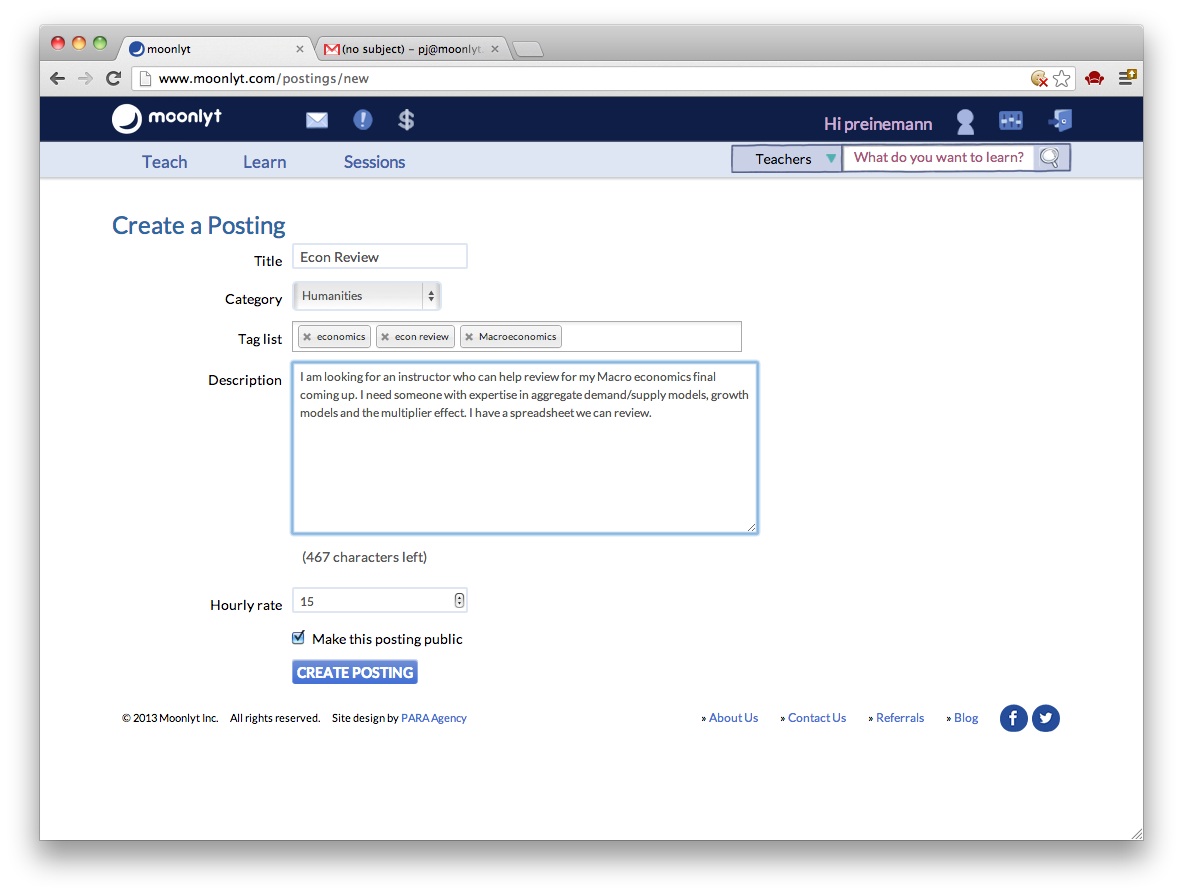
Creating a Posting


7.  What are two or three books that you'd recommend (do not have to be on elearning ;) )
Thinking Fast, Thinking Slow by Daniel Kahneman - This book gave me a deeper understanding of how we think and interact with each other
The Four Hour Chef by Tim Ferris - A book about the most efficient way to learn any new skill disguised as a cooking book.

******
Texture Press: Free E-Books
(full text available free online)

Writing for Human Relations
E-Learner Survival Guide
E-Learning Success: From Courses to Careers
The Glass Book 


Thursday, May 30, 2013

Competency-Based Education: Partnerships Are a Must


Many colleges and universities are moving toward competency-based education, and developing opportunities for students to earn credit based on demonstrated mastery of skills and knowledge areas. This moves far beyond the "credit by exam" model and even portfolio evaluation, to a deeper level of skills and broader subject matter areas. 

Dr. Robert Mendenhall, President of Western Governor's University, describes competency-based education in an article that explains the reasons for its emergence and popularity: What Is Competency-Based Education? (http://www.huffingtonpost.com/dr-robert-mendenhall/competency-based-learning-_b_1855374.html)

Capella, the College for America, and other universities are embarking on competency-based education. Other colleges, such as Excelsior College, have had credit-by-exam programs since the 1970s, and are expanding them. Whatever the form, new approaches are being developed and implemented

In theory, competency-based education could not be more practical. It tests an individual’s ability to apply knowledge, and can assess skill levels. Above all, it’s flexible, affordable, and does not require four or five years of slow-paced education. Further, competency-based education focuses on content that may lie outside a traditional degree program, but which is very useful in the workplace and/or for new technologies.

However, when it comes to highly technical careers that are in high demand, colleges and universities may find themselves unable to develop high-quality courses in a timely manner if they try to build them from the ground up.

To be cost-effective, timely, accurate, and relevant, the following strategies can be developed for competency-based education for high-demand technical education:

--- Up-to-date texts, which may consist of articles, manuals, reports, and software packages

--- Subject matter experts who review the content and assessment strategies

--- Instructors who are experts in the field to review materials, provide assessment services

--- An assessment strategy that privileges projects and synthesis / application of knowledge and skills

--- Partnering with professional associations or societies to take advantage of high-quality articles, peer-reviewed materials, recognized subject matter experts, professional certification.  For example, the demand for geoscientists and engineers is in no way met by traditional geology and engineering programs. The knowledge that is desired by industry is specific and can be provided by associations such as SEG, SPE, and AAPG.

--- Assessment should be coupled with reliable, relevant, and timely internships (which can be virtual) which include tasks that relate to the skills and competencies required by industry, and which are assessed in the program.

Colleges and universities can forge productive partnerships to assure that any competency-based offerings developed are legitimate, high-quality, and can forge relationships with potential employers. The most effective route involves partnering with professional associations that have a solid membership base of knowledgeable experts, and a wide array of corporations and other institutions that can provide graduates with experience and jobs. 

Ideally, the professional associations and societies that colleges and universities partner with are global, to assure the greatest number of opportunities for students, and the widest breadth of knowledge and perspectives. 

At the Great Wall of China, April 2013, after a conference on pre-Ordovician petroleum systems organized by AAPG, with sponsorship by PetroChina and other companies. 

Blog Archive