Showing posts with label AI. Show all posts

Sunday, February 01, 2026

Let's Try Something Different! Mind-Mapping Using Images, Not Words

Let's focus on the invention process—that crucial early stage where you generate and explore ideas. I’ve found that while traditional mind maps often rely on simple word associations, they can be much more powerful when we tie them to our lived experiences and mental images. By visualizing specific moments instead of just jotting down abstract terms, you create more resonance for both yourself and your readers. 

Here is a video: https://youtu.be/UsS-Scys0TU 


Try mind-mapping using images and imagistic descriptions of experiences rather than word associations. 

Key Learning Points

Move Beyond Words: I encourage you not to just list categories like "Success." Instead, try to visualize a specific image or memory you associate with that word. 

Harness Lived Experience: Please use your actual experiences to build your evidence. This makes your writing authentic and helps your narrative "flow." 

Create Emotional Resonance: When you write from a place of sensory detail and personal truth, you'll find it connects more deeply with your audience. 

Categorize and Connect: I like to use mind mapping to help see relationships between different ideas, then drill down into the actual experiences within those categories. 

Reflection Questions

When you think of a broad topic for your paper, what is the very first mental image—not just a word—that comes to mind?

How does describing a lived experience from your own life change how you provide evidence compared to using a general fact?

If you feel "stuck," how might my method of mapping with images help you find a new direction?


Friday, August 08, 2025

Does Trupeer Live Up to the Hype? Rapidly Converting a Basic Video into Polished Product with Guides, AI Voice, and Avatars

Please join me as I try out Trupeer in real time, using a video I just made (which you can check out here) on leveraging situated learning for writing courses. I had a lot of fun generating a script for my 2-minute video, then adding effects, substituting my voice for an AI voice, adding background music, and then, translating everything to Spanish and then Russian!

Trupeer, a start-up, just successfully attracted $3million in seed funding, so I expect that there will be additional features in the future. 

I am demonstrating the different voices and avatar selections. 

The only drawback is that I was using ScreenPal to create the video, and it did not pick up the voice generated by the video.  That was probably a settings issue. I would try again, but then you would not get a chance to see me actually try out TruPeer for the first time in real-time to get a sense of the ease of use and the overall UX. 

This is a follow-up to my first "discovery" video (https://youtu.be/2n8rwbOG9qY) where I tried out TruPeer (https://www.trupeer.ai/) for the first time and found the experience to be extremely intuitive, engaging, and something that sparks creativity and self-confidence. 

For this video, I went back to the 2-minute video I uploaded to show the results of trying out the AI voice-over, transcripts, AI avatar, and translation, along with other features.  You'll see how easily I was able to produce a professional end-result.  

This is my "live" first plunge into the program; unfortunately, I did not record the voices - check out the video I made after this one for a demonstration of the voices. 

I was a bit disappointed by the selection of voices and avatars, and was surprised that the avatars did not sync along with the voice. 

I was very impressed with the transcript and the ease of use.  I played around with my original video, filmed in English, then translated the transcript to Spanish and Russian. The transcript and AI voice were both in the target language. It was fun, and a great way to practice your languages! 

Let me know your thoughts.  What's the best application for TruPeer?


Friday, November 19, 2021

Interview with Edward Cavazos, LingoLet -- Technology Innovations in E-Learning Series

Artificial intelligence is transforming many aspects of elearning as edge computing, cloud access, and speed dramatically improve. Welcome to an interview with Edward Cavazos, LingoLet, and learn how real-time translation and remote simultaneous interpretation are expanding capabilities in elearning and training. 

What is your name and your background? 

Edward Cavazos, VP Sales Operations

32 years within the language industry, focused on technology delivery platforms for communication in spoken language, Sign Language, content creation, multilingual staffing, supporting e-learning companies with translations, interpreters, translators, instructors, monitors, and facilitators.

Edward Cavazos

What is your history with artificial intelligence?

It is only over the last 5 years AI has evolved to be called intelligence and today seen as Artificial Intelligence. The Ai has evolved from speech to text, text to speech, AI transcription of documents, AI of audio files, AI interpreter a two-way communication of one spoken language to another transcribed or spoken. AI is used today in events where attendees in a language or multiple languages can access their language video channel and see the spoken word texted in their language.

What is your experience with elearning platforms? 

Our involvement is to partner and engage with elearning companies who have platform where we provide the necessary language resources and capabilities needed for the project.

How is AI used in e-learning now?  what are the advantages?

AI is not for all projects, but where the training may be general and where the communication is at 93% as acceptable then it can be of value to the client and to those embracing AI to deliver the information in language. 

The advantage is cost savings and the turnaround time of having what is needed in place when there is a short window to complete the project, or where no interpreter(s) are available to support the project.

What do you think will happen in the short and medium-term in e-learning, especially as it relates to AI?

Here is what my crystal ball states. Embrace it, learn what exist, and see how it can be part of the solution for your client and potential clients. Enterprise organization want to work with companies who lead with technology and support with human components as needed. Business is changing and those in the elearning or any business working with organizations needs to educate themselves on AI technology as a solution.

What is Lingolet? 

We are a technology software company focused in the language industry supporting companies needing technology to deliver, communicate, and to access language communication for their markets, clients, customers. Where technology is the vehicle that drives the services needed to meet client’s communication needs in language.

How does LingoLet work, and how does it relate to elearning? 

Lingolet developed the AI features not to replace linguists, interpreters, translators, they will ALWAYS be needed. Lingolet made a decision to lead the way by giving companies options of using and integrating AI technology as part of their immediate communication needs, to become  more efficient and responsive, streamlining process, versus waiting for a human(s) to facilitate the communication to move things forward

How does this relate to elearning? 

In the traditional way, we still provide the human resources needed to support the project, provide the translation of content, provide linguist via the web or in person. 

In the Artificial Intelligence way, I’m not sure if elearning companies are ready to embrace and present this as part of the capabilities?  Let’s give the audience and opportunity to speak to this question.

Please recommend a book or two. 

Blue Ocean Strategy by W. Chan Kim – Renee Mauborgne

You, Inc. by Burke Hedges “Discover the CEO within you.

Please visit the E-Learn Chat interview with Ed Cavazos here: 

https://youtu.be/3jYLVqXlKB4


Monday, March 11, 2019

What to Do when the Robot Comes for Your Job

It's not a matter of "if" but "when."  An excellent article published in Mother Jones breaks it down and provides a timeline of the kinds of jobs that will be replaced between now and 2040.  The article examples many of the arguments that have been used to make the predictions less apocalyptic.

Mother Jones breaks them all down. It's apocalyptic, indeed, but at least with warning, you can develop a plan.

Link to podcast: https://screencast-o-matic.com/watch/cqeebb0qM1 (Links to an external site.)Links to an external site.


Drum, K., and; D, A. D. (2017). You Will Lose Your Job to a RobotMother Jones42(6), 38–69  Purpose of the article:  To address the questions about when and how AI-powered machines replace jobs, and to point out that the owners of the AI-powered machines and the businesses are the ones who will benefit most.
  Useful findings:  Machines powered by artificial intelligence will become better than humans in many different tasks. The article provides a useful timeline.
  Applicability of the article:
*Routine physical tasks will be the first to be replaced, which includes packing boxes, driving trucks, etc.
*Routine cognitive tasks will be next to be replaced (teller, phone sales)
*Non-routine cognitive will be the last to be  replaced. 
 Here is a chart with a timeline showing the robot take-over.  It's not "if" but "when."


-->

Sunday, March 03, 2019

Entrepreneurial Passion: Taking It to the Next Level

I found a very interesting article that explains how and why people with hobbies who are entrepreneurial will take their passion to the next level and turn it into an actual job. They take the passion, transform it into entrepreneurial intent, and then they start making concrete steps to achieve their dreams. 

But.. watch out for the robots! The second part of the video discusses another article that explains how not to lose your marketing job to a robot.

 Link to a presentation / podcast:
 https://screencast-o-matic.com/watch/cqeeDC0q7f


Biraglia, A., and; Kadile, V. (2017). The Role of Entrepreneurial Passion and Creativity in Developing Entrepreneurial Intentions: Insights from American Homebrewers. Journal of Small Business Management55(1), 170–188. 
  Purpose of the article:  How can we use creativity and entrepreneurship to adjust ourselves in difficult times?
  Useful findings:  We can apply Bandura’s Social Cognitive Theory (SCT) to understanding how and why people are entrepreneurs, and how and when they succeed.
  Learning, Motivational and Behavioral processes are the result of reciprocal and bidirectional interactions
  Environmental Inputs
  Personal Factors
  Behavioral Outcomes

Applicability of the article
Entrepreneurial passion is often a characteristic of people who are able to turn hobbies into businesses, and they relate to a thorough knowledge of the topic and also skills and practice.
Creativity helps a person solve problems, and thus build a sense of self-efficacy and confidence.
Entrepreneurial self-efficacy and entrepreneurial intentions are very much influenced by feedback from the environment (awards, collaborations, and presumably financial rewards).
To assure success in an entrepreneurial endeavor, it is important to build reinforcing feedback loops that strengthen cognitive, behavioral, and environmental factors. 

*************************

Cramer, T. (2017). How Not to Lose Your Marketing Job to a Machine. EContent40(5), 4–8.

  Purpose of the article:  To discuss how artificial intelligence is replacing some jobs in marketing, but creating others.

  Useful findings:  Machine learning and artificial intelligence are highly effective at conducting market research and selling, but for each task for AI, there is a need to manage it.
  Applicability of the article:
-Each AI function also needs a person who can design and manage it.
-With the proliferation of websites, it is often necessary to have a human who determines if a site is fraudulent.
-Creativity is still uniquely human. To develop strategies to grow markets, and also to tell stories still requires human beings.
 

Wednesday, October 10, 2018

Energy Industry 4.0: Extreme Transformation Opens Extreme Opportunities

Industry 4.0 has arrived in the energy industry. Just how does the extreme digitalization, monitoring, and assessment of seemingly everything  affect the people who now tend to all aspects of the business?  What will project managers, financial professionals, data scientists, geologists, engineers, geophysicists, and other energy professionals do? What are some of the knowledge bases they will need? What are the skill sets, and where should they gain experience? 

The energy industry will strategically update content and objectives to reflect current business practices, environments, tools, and needs. It will need to conduct continuous needs assessments for Energy Industry 4.0.


Part of this group of skills will involve re-envisioning everything, which requires having the courage to do so.  We need to look at the evolution of incumbent products, as well as the emerging “upstart” disrupters.  It is important to re-envision the macro view as well as the micro views.

Make the invisible visible: reveal the underlying reality:  One of the key benefits of artificial intelligence and machine learning is pattern recognition, which is not a static thing, but constantly evolving and “learning” as more information is added.

It is important to keep in mind that in addition to technological advances, there will be displacements and unintended consequences. Part of the challenge involves social responsibility in order to consider how human capital should be developed to retrain people whose professions become disrupted. Social responsibility also takes into consideration the natural environment, habitats, and lowering the negative impact of human activity.

Managing the Digital Economy:  How is managing the digital economy different than an organization where everyone is onsite? The workforce is distributed, now more than ever, and learning how to use productivity tools in a collaborative environment. Keeping the projects on task are more critical than ever.
  •     Large, decentralized organizations
  •     Collaboration and independent work in the Gig economy
  •     Project Management strategies and platforms
  •     Looking at all applications in “off-label” ways

Artificial Intelligence / Machine Learning: AI and ML apply to all phases of the industry, and the challenge is not “if” or “when” but how much is relevant, and how do we clean up data without introducing our own biases? In addition, privacy and cybersecurity issues must be kept in mind.     
  • Strategic Planning
  • Risk Mitigation / Risk Seeking
  •     Predictive analytics
  •     Deep Neural Networks / Pattern recognition
Big Data Archiving and Continuous Data Gathering: The ability to store and retrieve staggering amounts of data creates opportunities that were simply not possible before. As unstructured data such as old scans of reports is converted into easily analyzable structured data, even more opportunities emerge. It is now possible, for example, to do a deep dive into old well logs, well reports, and more and look for overlooked zones or under-produced ones.
  •     Internet of Things, Industrial Internet of Things
  •     Cloud Computing
Virtual Supply Chains in Energy: Logistics have become very important in times of multiple long laterals in large  shale plays. The same can be said for the coordination required in offshore exploration and production operations. Challenges include security, being able to transfer money efficiently, and
  • Block Chain technologies for supply chain
  • Special challenges with different types of energy (oil and gas, wind, solar, geothermal)
FinTech:  Finance technologies are just emerging, and they will dramatically change how organizations can manage cash, obtain capital, and distribute information. Although cryptocurrencies and digital currencies may be looked upon as a bit unsavory, banks are already utilizing the technology to make their record-keeping more secure, and to facilitate transfers, especially across borders.
  • Digital Currency
  • RoboAdvisors
  • New sources of capital, investment
  • Start-ups and commercialization
Digital Ecosystems: You may be familiar with the way that Craigslist has essentially fragmented and instead of being a “one-stop shopping” platform for advertising, the different topics and products have evolved into their own niche applications. One good example is AirBnB – now, the products are arranged by category (rentals) rather than being geographically grouped (as in the case of Craigslist). The evolutionary cycles are accelerating, and now one has to look at platforms as apps with a clearly finite life cycles, unless they metamorphose into something else.
  •     Platform Life Cycles
  •     Crowd Sourcing / Social networks
Digital Infrastructure: Each quantum leap of bandwidth and computational ability is accompanied by a quantum leap in the capabilities of the applications and the devices themselves. How does one take advantage of the power? And, how does one anticipate changes?
  •     Current state and how to optimize networks
  •     WiFi and G5: What does it mean? What are the hidden costs?
  •     Future directions, and where we are going.
Social Enterprise
    Innovative new technologies that have as a goal to measurably improve the physical environment as well as the social structure, with more opportunities for voices to be heard, and to strive toward the goal of eliminating social and economic inequality, and truly giving everyone a chance to have a productive, meaningful life with a strong social support system.

Saturday, September 15, 2018

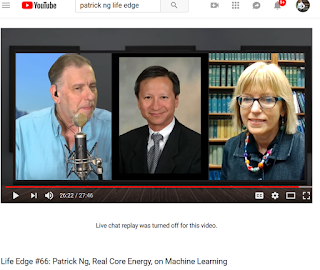
Machine Learning and Python: Interview with Patrick Ng

The United States is now the world's largest producer of oil and gas, and machine learning played a large role in the transformation, which has occurred because of new techniques and technologies.

Welcome to an interview with Patrick Ng, geoscientist and pioneer of innovative ways to use analytics and specifically machine learning, to find new oil and gas reserves and to produce them more efficiently and sustainably.

https://youtu.be/6uQR8PO3l3A

https://youtu.be/6uQR8PO3l3A


LIFE EDGE with Patrick Ng Chat 2018 Q&A Notes

Background - I am a geophysicist by training, and experienced A to Z in  geosciences. 1) As - AVO amplitude versus offset to reduce risk, azimuthal features to map natural fractures, 2) transform seismic to rock properties, and 3) prestack depth imaging / model building to map subsalt reservoirs leading to 3 giant discoveries total over 2.5 billion boe in the Gulf of Mexico, and 4) the Z is drilling wells and learning from the drill bit all the way to total depth (Z).

And I learn through the drill bit that we drill anything but an average well, or rather a range of IP initial productions. The risk lies in the spread, and I make it a business managing risk at Real Core Energy.

Q1: how about examples of using Python in industry?

The hackathon focus was production forecast of a well. Given the flow rate data (courtesy of Halliburton, sponsor) and Python Notebook as template, and bootcamp to bring everyone up to speed. The exercise is to try use geoscience in machine learning, and play with the number of layers and neurons in neural network, and improve the forecast accuracy.

Q2: why Python?

Python is like the foundation, that my teenage daughter uses for make up. Depending on the event, she will put on other colors and things (not sure what to call those… so I won’t).  And the real power of Python comes from a set of libraries. For example:

1) Numpy, numeric Python for vectorized numerical computation
2) Pandas for handling lots of columns and rows
3) SK learn for machine learning algorithms, ready plug-n-play.

Think of.Python example, say write a few lines of codes, in a loop do something to each element in an array one at a time.

Numpy can collapse that into a single line, operates on an entire time series as a vector all at one go.

Often we may have a thousand wells, each with its production profiles. Think of wells as columns across the top with number of barrels per day, week or month hanging down. Pandas can operate on the entire collection of series of data all at once, like getting the mean, median, statistics with one line on an entire group of data. We also get the top 25%, next 50% and bottom 25% percentiles. Quickly we get a feel for how well the producing assets perform.

Q3: why is Python so popular with  machine learning?

It has to do with the availability of powerful libraries like Keras and Tensorflow well suited for neural network and deep learning. While SK Learn has been around for some time, Tensorflow was released by Google to open source consortium in November 2017.

Lets take deep learning as example. Microsoft had success using 158 layers in a deep neural network. Using keras, we specify one layer at a time, and we’d have 158 lines of codes.

But with Tensorflow, we can do that in one line albeit a long line, by listing the number of neurons in all 158 layers all at once. Again fewer lines of codes. But if we want to customize, and tune each layer, then we can do so with Python in a more granular way.

So we go from Python (the foundation), to Numpy, Pandas, Keras and Tensorflow, each provides the tools to do more, faster with fewer line of codes. In a nutshell, Python opens up a whole new way for geoscientists to explore data, do rapid experiments and gain new insights.

Q4: can machine learning make the industry more safe and clean?

Here are two examples. First predictive maintenance, we can better anticipate and schedule downtime for routine maintenance and repairs of equipments. Just as we do annual check up for our AC in Houston and keep them running top shape. That will prevent potential leaks and minimize surprises, so keep us safe.

On cleaner environment, one possibility is that we drill fewer wells and produce the same volume, if we can better predict the outcome with machine learning. Doing so, we reduce the footprint and impact on the environment.

(One more thought came after the Chat, is refracking. If we can use machine learning to better identify refracking candidate wells, we shall improve recovery factor and may also drill fewer new wells. Again reduce footprint and lessen impact on the environment.)

Q5: is there benefit of reprocessing data and machine learning together?

Yes. It has been standard business practice that every few years, with improved algorithm, we reprocess data, get higher resolution and a more detailed look. Like going from 4K to 8K HDTV, instead of 80 to 100 feet resolution in seismic, we may get that down to 40 ft. With higher resolution data, we’d retrain machine learning and get better results. Both go hand in hand.

That brings up a good point. In the world of geoscience, if we change the model, we also get different resulting imaged data. Unlike typical data used to feed machine learning algorithm, say what I bought from Amazon or movies streamed from Netflix, what I read and watched became record. That won’t change. But when imaging seismic, the model and resulting data are tightly coupled. Change one, we change the other.

So learning with machine beats machine learning alone.

Before 1995, the thinking in Gulf of Mexico was that salt bodies would become detached because of buoyancy (density of salt is lighter than that of surrounding rocks). So over time in geologic scale (millions of years, not weeks), salt moved up from great depth and ended up what looks like cup cakes (picture inside the lava lamp). But with the Crazy Horse (now called Thunder Horse) discovery, we learn there is salt mountain that goes forty five thousand feet deep below the seafloor. No cup cakes.

Python is a tool that can geoscientists explore and test their ideas with data. Better understanding of the geology and producing more. Last but not lease, is that Python while really powerful for numerically intense applications, it can go all the way to voice. Using Python-Flask libraries, I put together numerically rigorous app and deliver via Alexa.  That I see can draw more highschool students interested in geoscience.

Closing

As a closing thought, remember the old saying “The journey of a thousand miles begins with one step.” I see learning python is the first step. Just do it!

 Thank you, Patrick! 


Tuesday, April 11, 2017

Big Data and Deep Learning: Industry Downturn Means Uptick in New Analytics

From the Midland Register Times / April 2...
 Permian Basin operators are drilling deep and long — laterals — in order to recover more of the region’s crude and natural gas.

They’re also going deep — as in deep learning — as part of those efforts.

High-tech advances such as big data, deep learning and artificial intelligence are increasingly finding their ways into upstream exploration and production operations. For example, Exxon Mobil Corp. recently set a record for high performance computing for reservoir simulation.

Big data
Technological advances have created a wide spectrum of data for operators that goes far beyond well logs, seismic surveys and pressure readings.

“(It’s) massive amounts of data generated by different methods,” said Susan Nash, director of education and professional development with the American Association of Petroleum Geologists.
 “It’s so massive it’s contained in the cloud and other ways of organizing the data.”

That data can come in structured form, as in databases, or in unstructured forms, as in emails or PDFs, anything that can be digitized, she said.

To continue, click the link: http://www.mrt.com/business/oil/article/Industry-drills-deep-to-improve-production-11039830.php

Tuesday, July 19, 2016

How the Mind Makes Sense of Patterns

LifeEdge 043 focuses on how the mind makes sense of patterns. In this chat, Rick and Susan carry on with an interesting talk about patterns and how the mind makes sense of things. What really is reality? How are patterns present in your life? Can you change yourself by recognizing your habitual patterns? Tell us your thoughts!

Life Edge 043: How the mind makes sense of patterns from RELATECASTS on Vimeo.

Here are additional thoughts about making meaning from patterns.

Visual perception is a process, and there are three sequential stages:

Stage 1:  pass the features from our field of vision from the neurons in our eyes to the primary visual cortex in the brain. This is the pre-attentive stage.

Stage 2:  the brain divides the visual field and creates groupings based on their proximity

Stage 3:  the brain tries to make sense of the patterns and does so by moving between working memory and the image, in a process that involves querying

In machine-based pattern recognition, there are five main approaches (Jain and Duin, 2004):

1.  Template matching
2.  Geometrical classification
3.  Statistical classification
4.  Structural matching
5.  Artificial neural networks

The brain's pattern recognizing processes can bring a number of possible interpretations. When the affective parts of the brain are involved in the process (or the limbic), the result is a deeply impactful experience. Meaning / cognition are linked with emotion, and the result is often what is considered a religious experience. (McNamara, etal, 20016).
Hyperconnectivity between the limbic and temporal lobes, and investigators have found such connections in individuals who have described intense mystical experiences.

Con artists are effective because they understand how to trigger the meaning-making processes of individuals and guide them along a path to a certain interpretation. They do it by skillfully replicating enough of a pattern that the victim leaps to certain conclusions, and then, especially if it is connected with an emotional trigger, will go to great lengths to defend it (even when it is clearly not correct) (Konnikova, 2016).


Resources:

Few, Stephen (2006) Visual Pattern Recognition. Cognos Innovation Center White Paper. https://www.perceptualedge.com/articles/Whitepapers/Visual_Pattern_Rec.pdf

Jain, Anil K., and Robert P. W. Duin. (2004). Introduction to Pattern Recognition. in The Oxford Companion to the Mind, second Ediction. Oxford UP: 698-703.

Konnikova, Maria. (2016) The Confidence Game: Why We Fall For It ... Every Time. New York: Viking, 2016.

Paloutzian, Raymond F., Swenson, Erica L., and Patrick McNamara (2006) Religious conversion, spiritual transformation, and the neurocognition of meaning making. Where God and Science Meet: How Brain and Evolutionary Studies alter Our Understanding of Religion. Vol 2: The Neurology of Religious Experience. ed. by Patrick McNamara. pp 151-170.


How the Mind Makes Sense of Patterns https://lnkd.in/eK5czEa LifeEdge 043 #artificalIntelligence #neurocognition #patterns #neuralnetworks

Blog Archive