Showing posts with label STEM. Show all posts

Wednesday, June 27, 2018

Mom, I Built a Robot Dinosaur! Interview with Bin Feng, Microduino STEM Learning Systems

Look, Mom – I’ve built a robot dinosaur that roars! Young learners benefit from hands-on experiences, especially those which encourage experimentation. Bin Feng at Microduino has been at the forefront of a wide array of hands-on robotics, manipulatable, and modifiable, which engage young students and encourage them to study science, technology, engineering, and math. Welcome to an interview with Bin Feng, co-founder and CEO of Microduino.

Q:  What is your name and your background?
A:  My name is Bin Feng, and I’m the co-founder and CEO of Microduino, Inc., an award-winning global designer, developer, manufacturer and seller of stackable electronic building blocks, related accessories and peripherals, and in-class science, technology, engineer, and mathematics (STEM) learning systems which encourage and enhance inventors’ creativity, imagination, and ingenuity through project-based learning.

As one of Microduino’s principal product architects, I’ve helped guide Microduino from a fledgling start-up founded in 2012 to a rapidly-growing global brand with an expanding STEM/STEAM education product portfolio and a diverse roster of education market customers and international distributors and value-added resellers (VARs). Since the company’s founding, my partners and I have built Microduino’s following of students, teachers, inventors, and electronics enthusiasts into an engaged community of over 1,000,000 members; and developed a comprehensive STEM/STEAM product line and education platform for use in schools around the world.

As CEO, I oversee the strategic development and implementation of Microduino’s business strategies, plans, and supporting programs, and I ensure their alignment with the company’s mission, values, and short- and long-term objectives. On a day-today basis, I direct the company’s operations, product design, business development, sales, marketing, and financial management activities.

Prior to starting Microduino, I was the general sales manager of Leadgo American, the U.S. subsidiary I established for the highly-regarded manufacturer of advanced composite materials used in the aerospace, marine, and wind-power industries. Previously, I held sales and product management roles at Parker Hannifin, the Fortune 250 developer of motion and control technologies for the industrial and aerospace markets. I began my career as an applications sales engineer at General Photonics, a designer and builder of innovative optical instruments and modules to fuel the growth of optical networks, sensor systems, and biomedical diagnosis systems. While there, I managed a multimillion-dollar book of business which included important business relationships with such well-known government agencies and corporations as NASA, Northrop Grumman, Boeing, NEC, and Kodak.

I have a B.S. degree in materials science from Fudan University in Shanghai, China, and a master’s degree in electrical engineering and applied physics from the University of California San Diego (UCSD).

Q:  What is your company?
A:  Founded in 2012, and based in Westlake Village, Calif., Microduino is an award-winning global designer, developer, manufacturer and seller of stackable, LEGO®-compatible electronic building blocks, related accessories and peripherals, and in-class STEM learning systems.

With tailored offerings for individual consumers and academic institutions, Microduino offers a broad range of modules, sensors, and project kits which improve critical thinking and problem-solving abilities, and enable creators to bring their inspirational and pioneering concepts to life. Because of their ease of use, unique patented hardware design, and nearly unlimited applications and configurations, Microduino products have spawned a passionate and highly-innovative worldwide community of students, faculty members, makers, hobbyists, engineers, and electronics enthusiasts of all ages, backgrounds, and skill sets.


Microduino targets, and sells its STEM educational toys and learning systems to, two core markets:
- Consumers:  Individual consumers, including children and their parents, interested in educational toys such as building blocks and interesting do-it-yourself (DIY) kits, projects and applications.
- Education Domain:  Elementary, middle, and high schools, as well as colleges and universities.

Q:  What is your philosophy of learning?
A:  At Microduino, we’re all about fun, enjoyable hands-on STEM learning that encourages children to understand and explore the intersecting worlds of electronics, product design, and hardware coding — and sets the stage for higher education in STEM-focused disciplines and eventual careers in STEM-related fields, such as engineering, software development, and scientific research.

With products that are aligned with the latest Next Generation of Science Standards (NGSS), International Society for Technology in Education (ISTE), and Common Core guidelines for STEM instruction, our comprehensive line of products and learning systems act as a STEM/STEAM education continuum in which children can learn basic product design and coding skills right from the very beginning and at an early age, and then progress through the entire platform by learning more advanced skills and techniques along the way.


From our perspective, it’s not enough, particularly in the STEM education realm, to build a robot, car, drone or some other project. While those activities are certainly fun and educational, to a certain extent, we believe the how, why, and control behind the design are even more important, especially in enabling children to understand the logic, sequential nature, and programmable aspects of a product’s design and operation. How and why does this project work the way that it does? Can it be programmed to operate in a different manner? If so, what new code must I write to instruct the vehicle to behave differently? Can I combine these sensors and modules to create something entirely different?

Moreover, we intentionally developed Microduino products to provide children with endless design and configuration possibilities. As a result, they’re able to leverage their newly-acquired knowledge of electronics and coding to create a whole new array of projects and applications. With Microduino, an individual’s creativity is limited only by his imagination!

Simply stated, with Microduino, a child’s creativity is limited only by his or her imagination! Our motto:  If you can think it, you can create it!

Q:  What are your products, and how do they tie to your philosophy of learning?

A:  Microduino has four main product lines:

- mPuzzle:   Designed for children ages 5 and up, mPuzzle is a collection of easy-to-use, snap-together magnetic components that teach basic electronic circuitry concepts.
~ With mPuzzle, children come to understand how things work by seeing cause-and-effect relationships and outcomes.
~ mPuzzle offers everything kids need to construct common objects found in our everyday world, such as a street lamp that illuminates at dusk, or a TV remote control with a red LED light that shines when it’s turned on.
~ mPuzzle’s use of ordinary objects gives children instant familiarity with their forms and functions, while challenging them to learn how they actually work by building them from the ground up.

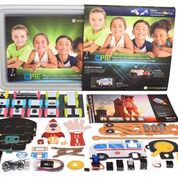
- mPie:  Designed for children ages 7 and up, mPie builds upon mPuzzle’s foundational circuitry lessons and hardware components to teach kids introductory hardware coding and more advanced electronic and product design concepts.
~ With mPie, kids discover the world of hardware coding, which helps them visualize the logical and sequential order of things in a physical and engaging way.
~ mPie’s intermediate lessons enable children to link concepts between the physical and virtual worlds by constructing everyday items, such as a rocket, ambulance, and fly swatter, with which they are already familiar.
~ mPie projects increase in complexity so children learn the importance of sequential design and fabrication, and how to identify and resolve problems when those sequences are not followed.

- Itty Bitty City (IBC):  Created for hobbyists, makers, inventors, and tinkerers, Itty Bitty City is a fun-filled collection of Microduino mCookie modules, sensors and accessories which creators use to build eight exciting projects, including a windmill, lighthouse, night light, piggy bank, and music box. Because of its fun and unique applications, Itty Bitty City is also widely used by students and teachers within schools’ STEM/STEAM programs.

- Microduino Mix Kits:  Targeted at students ages nine and up, Microduino Mix Kits come in four levels, Mix 1-4, with each kit including 12 projects pre-coded in Scratch 3.0, electronic components, and complementary lesson plans. A cornerstone of the product’s STEM value is its focus on coding, and teaching students how to program various projects and their respective components. A code is the written sequence of commands created in specialized coding editors, such as Scratch, that tell individual electronic components how to behave.


In support of its learning philosophy, these Microduino products are fun, enjoyable, educational and hands-on, and inspire and encourage children to further explore the intersecting worlds of electronics, product design, and hardware coding. More importantly, we’ve intentionally designed these kits in such a way so that children can master all the concepts taught by one product; move on to the next series, which teaches more advanced coding and electronics principles; and so forth until they develop a comprehensive understanding which they can use to design more imaginative creations. In other words, these are progressive learning products, and as such, they serve as the perfect STEM/STEAM learning tools for all classrooms, and fit seamlessly into today’s cutting-edge, industry-standardized STEM/STEAM curricula and lesson plans.

Q:  Please provide 3 or 4 examples of successful implementation.
A:  As we’ve said before, a child’s creativity is limited only by his or her imagination! Microduino fans can find all kinds of cool projects to pursue in the company’s IdeaLab at https://idealab.microduinoinc.com. Here are several examples of successful Microduino implementations:

- Smithsonian Magazine:  Scientists Are Using Electronic Eggs to Study Vultures | http://www.smithsonianmag.com/innovation/scientists-are-using-electronic-eggs-study-vultures-180958619 |

IEEE Spectrum:  http://spectrum.ieee.org/geek-life/hands-on/build-an-electronic-vulture-egg |

IdeaLab:  http://idealab.microduinoinc.com/2017/08/case-study-saving-the-vultures-through-technology-and-innovation
- Nescafe Alarm Cap Using Microduino:  http://www.youtube.com/watch?v=hF0GJhcuFQw
- Microduino Music Box:  http://idealab.microduinoinc.com/2017/08/music-box
- Micrduino Hexapod Robot | mPie:  http://www.youtube.com/watch?v=qgNP1NWqD9A

#   #   #

Tuesday, March 13, 2018

Aerial Robotics Beyond Drones: Interview with Bob Dahlstrom, Innovators Series

We tend to think of drones as the only kinds of aerial robots, but Apellix has developed an aerial robot that can be used to deliver products instead of simply sensing or collecting images. Welcome to an interview with Bob Dahlstrom, CEO and founder of Apellix, a dynamic, new aerial robotics company.

1.  What is your name and your relation to innovation and robotics? 
Bob Dahlstrom – Growing up working at my parents’ hardware store from age 12 to my early 20’s provided me hands-on experience with the practical needs of people to fix, repair, or replace a wide variety of items – often with innovative mechanical solutions. Later, in the mid-80s while working in a “clean room” at an integrated circuit manufacturer and writing software code for the first time, I made the connection that the world was destined to have software interact with and instruct hardware, as we moved from physical and electrical mechanical systems to software-controlled systems.

Founding a software company in the 1990s that was finally, 13 years later, an “overnight success” provided me more exposure to software and is where I became unequivocally adamant that software was “eating the world”. Apellix is my first robotics company. To me, robots are software. Looking at things through a software lens, I believe aerial robotics (drones) are just flying computers and with the right sensors and data - and most importantly, software - they can be made to do most anything.


2.  What is Apellix?  How did you get started with it, and what is its mission? 
Apellix is a technology company focused on creating systems to keep workers safe. We are passionate about designing and creating software-controlled robotic systems that keep people out of harm’s way and save lives.

We live in a time when the fantastic has become ordinary. No longer do we have to imagine mythical machines and buildings out of science fiction movies. Our telephones are pocket computers now. Why are people still hanging from skyscrapers cleaning windows, or working from scaffolding cleaning and coating structures, when we have robotic systems that can do the work safer and most likely more effective and efficiently.


3.  How do aerial robots work and how are they different from drones?
This is a FANTASTIC question –An Aerial Robot includes a “robotic arm” and an “end effector”. A “robotic arm” is a type of mechanical arm, usually programmable, with similar functions to a human arm. Robotic arms may include a manipulator and may be connected by joints allowing either rotational motion (such as in an articulated robot) or translational (linear) displacement or can be a lance or probe. The terminus or end of the arm is called the “end effector” or probe tip. End effectors are the device at the end of a robotic arm, designed to interact with the environment. The exact nature of this device depends on the application of the robot.

An Aerial Robotics system includes a robotic arm with an end effector AND the ability to fly close to, touch, or modify a structure or surface. Just the fact of having an arm with an applicator / end effector on it requires flights wherein the lift platform (the drone) must fly with precision close to structures. Drones, and all aircraft in general, are designed to fly away from potential obstacles, not close to them.


4.  What are the main applications of the Apellix robots?
Apellix is an early-stage company and the leader in aerial robotics. It is the only company with proven capability to measure the thickness of steel on a 300’ flare stack or clean and paint a wind turbine 260’ off the ground. With proprietary circuitry, software, and power management systems, our Apellix-designed drones serve as industrial tools capable of all-day continuous work.

Our initial product, currently available for pre-orders, is in the field of contact-based Nondestructive Testing (NDT) for evaluating the properties of materials in industrial and infrastructure assets such as bridges, ships, oil & gas refineries, and more. For example, we test the thickness of steel or the protective coating of a bridge to ensure it is structurally sound.

The Apellix SmartBee™ platform provides the capability for multiple types of Nondestructive Testing. One example, designed for a ship manufacturer, conducts dry-film thickness (i.e. paint thickness) testing pursuant to SSPC-PA2 standards on vertical ferrous surfaces at height. The aircraft is piloted manually to the initial test location where the computer operator (pilot) engages the software using our PC / tablet-based user interface, and a pre-programmed sampling process begins. All actual testing is conducted under 100% computer control. During the sampling process, test results are provided in real-time to the operator on the base station (computer laptop or tablet), displaying the actual paint thickness measurement and whether the surface is compliant. Once the sampling is complete, the aircraft returns to a safe position and awaits pilot commands to direct it to the next location. For each measurement, environmental data, GPS positioning, project data, photo confirmation, and related aircraft data are stored for one-step download to an Excel spreadsheet (csv). Aircraft performance and use data are also tracked via Internet of Things (IoT) for predictive maintenance and development purposes.


5.  Why did you choose the robots to be aerial rather than placing them on scaffolding or some other fixed structure where they could move back and forth, but not have to be airborne? 
By freeing robots from the ground and allowing them to operate in 3-dimensional space, we have created a set of affordances not available to ground-based or place-bound robotics. One example of this would be painting a large cargo or cruise ship. Currently, to paint the side of a ship, it takes a crew of 30 workers 4 to 5 days to set up the scaffolding, paint, and remove the scaffolding. The paint is applied is 6 to 8’ sections (the length of a painter’s reach without moving to a new section of scaffolding) and “feathered” to ensure proper coverage at the edges of where a person can reach. This results in a large number of areas where the paint is overlapped. A tethered aerial robotic system, with paint and power on the ground, would allow painting to start in the far-left corner of the ship’s hull, move horizontally to the far-right corner, and turn off the paint. It would then move down to allow a 12” overlap, turn on the paint and proceed horizontally to the left. This efficiency enables a much better paint job with fewer potential failure points.

Apellix has conducted proof-of-concept testing in which our aerial robots successfully delivered water-based coatings using 3300psi industrial airless pump systems on vertical surfaces. We have tested at flow rates up to 1.6 gallons per minute. Apellix is currently conducting proof of concept testing where our aerial robots provide no-touch cleaning using non-combustible cleaning solutions and pressurized water rinsing. We expect to expand testing to include limited blasting as well. Apellix is currently seeking industry partners to support this additional testing and development.


6.  How do you compensate for wind and humidity when you are working on large ships, equipment, bridges, etc?
Apellix aerial robotic systems use large, computer-controlled, heavy-lift multi-rotor drones outfitted with various sensors and functions to allow precisely controlled flight close to structures. Manual control of such systems is unable to accomplish the precise flying and maneuvers required, thus software-controlled flight is crucial. While drones often operate in 15-knot winds, their operations are confined to keeping a tight camera focus on the target, so wind moving the drone a foot or two in any direction is not critical. In an aerial robotic system, such as those used by Apellix, flying inches from a structure a sudden gust of wind can be catastrophic.

The amount of time it takes to see something and move your finger is approximately two-tenths of a second. In that amount of time, a computer with a standard Intel Core i7 or similar processor can make 63 million calculations (~315,000 millions of instructions per second – MIPS), thus computer control can allow an amazing degree of control and stability, even in high winds.

As I like to say, aerial robots (and drones) are flying computers and, with the right sensors, they are data gathering machines. Each Apellix aerial robot has a full onboard computer with an Intel x86 processor, a full server-based operating system, and a custom-built Apellix sensor board, giving it the ability to collect a lot of real-time data, including environmental variables such as ambient air temperature, barometric pressure, relative humidity, atmospheric levels of oxygen and gases and more.

The Apellix WorkerBee™ is under development to enable aerial applications for cleaning and for spraying paint. Part of the efficiency of painting is what’s called the transfer efficiency ratio (Transfer Efficiency (TE)  = Weight of Material on the Target (WT) / Weight of Material Sprayed (WS) x 100%). For example, the average material loss is 30%, but moving the spray nozzle 7” from the optimal distance changes material loss to 50% or more. By knowing the humidity, temperature, recommended application rules, and more, we can calculate the optimal distance for the spray nozzle from the structure being coated, thus minimizing over-spray and under-spray.


7.  How do you overcome the limitations of a) battery life; and b) weight of the cargo.  Paint is heavy... 
Paint is heavy, and so are batteries. Our solution, in addition to the software-controlled aerial lift platform (the drone,) is to keep them on the ground and utilize an umbilical cord to send power and material up to the aerial systems. This allows for theoretical all-day operations, something needed in an industrial aerial robotics system. Of course, depending on the use case and customers’ requirements, we can also offer a non-tethered system for small touch-up or repairs.

8.  What have your experiences been thus far? 
The interaction of people and robots is complex and growing more sophisticated all the time. Apellix painting platforms are run by operators on the ground. They work at heights, without putting the operator in danger, and allow the work to be performed to greater precision via software control than a human can do. It replaces hours of work by humans. But it doesn’t take human control out of the loop.

It does change lives. Robotics are reducing occupational hazards. They’re saving our tax dollars for the corrosion prevention of public assets, such as highway bridges and battleships. They’re saving private dollars on protection of buildings, ships, above-ground storage tanks, and oil rigs.

Executives from around the world are flying into Jacksonville, Florida to speak with us about our innovations, we’re winning local, state, national, and international startup and robotic competitions, and industry awards such as a 2017 Innovation of the Year from the National Association of Corrosion Engineers (NACE).


It’s amazing working with magical flying machines every day. The technical work we do at Apellix today is possible due to the great work and science of those that have come before us. But more importantly, to me personally, the most memorable experience can be summed up from a recent conversation I had with the CEO of a company in the oil & gas space who said; “Bob, I’ve had to tell 5 mothers their sons are never coming home again”. If we can engineer out the risks of falls, injuries, and deaths from the job site and prevent these types of conversations from happening, that is a win for everybody.

Perhaps most satisfying to the A Team (Team Apellix) is that we’re adding to the greater body of knowledge, specifically data on the maintenance of expensive assets. We’re helping to save lives. And we’re at very least winning battles in the never-ending war on corrosion.

9.  What is the future for Apellix? 
Apellix will continue to work on and refine its SmartBee™ and its WorkerBee™ platforms and add additional features and functions. For example, now that we control, with great precision, the flight of an aerial robotic system in close proximities of structures and even touch structures we can add most any type of end effector or tip to the robotic arm. Thus, devices that are currently handheld and touched to the concrete on a bridge to measure corrosion of the rebar embedded into the structure can be placed on the Apellix aerial robotic system. This eliminates the need to rappel down a structure or utilize cranes or scaffolding to climb up to areas of the structure to take the readings.
As the advantages of the Apellix aerial robotic platform become more widely known and understood we fully expect to learn of a multitude of items of different types that can create value when carried or added to the platform.

The future is bright, keep your eye on Apellix.

Visit the Apellix YouTube Channel or follow them on Twitter

Friday, May 16, 2014

Interview with Don Sevcik, MathCelebrity - Innovators in E-Learning Series

One of the biggest challenges in online math education is being able to show the students how to go through the process of working problems and equations. One solution has been developed by an automated math tutoring website, MathCelebrity. Welcome to an interview with Don Sevcik, president of MathCelebrity.


1.  What is your name and your relationship to elearning? 
My name is Don Sevcik and I am President of MathCelebrity.

2.   What is MathCelebrity?  How does it work?
MathCelebrity is a free automated online math tutoring website.  You enter a math problem or search term, press the button, and every single line of work appears in less than one second which shows you how to solve the problem.

Click image to enlarge.

3.  Who is the site targeted for? Age groups? Types of math?
We cover Kindergarten through College.  We have 27 subjects and over 430 calculators.  We have been around for 7 years so the website has a vast array of curriculum coverage.  We build more features each week.

Click image to enlarge. 


4.  What do you think is the best way to teach applied math that asks people to solve real-life problems?
I'm big on empirical evidence and heuristics.  Real life math problems need real life explanations as well as problems that have been solved in the past which utilize a similar solution.

Click image to enlarge. 


5.  How do you help people get over a fear of math? 
I try to lay out a detailed, easy to follow, step by step solution on the website.  With personal tutoring, I try to leverage real world examples that make sense.

Click image to enlarge. 


6.  What are your plans for the future?  How would you best take math games / tutoring into the "wild"? 
My future plans are to continue build more lessons, as well as expanding on science.  We also have a programming blog.  Many of our fans have expressed interest in programming, and I think STEM fields are a great thing to learn early.  That is what our fans respond to, so that is what I will continue to offer.

Click image to enlarge. 

Friday, October 05, 2012

Interview with Paige Johnson, Intel: Innovators in Education Series

Educational transformation requires a significant investment, and not just from a single source. The most effective educational growth often occurs when companies, communities, educators, and committed volunteers join forces and determine the best and most strategic way to invest. With that in mind, Intel Corporation has initiated a new program, Intel Teach, which awards Intel Schools of Distinction

Welcome to an interview with Paige Johnson, education strategist for Intel Corporation. In this interview, she  describes how Intel, the Intel Foundation, and Intel employees have donated resources and time to help underserved communities have access to technology and know-how in order to achieve true transformation of their educational programs and goals.

 Paige Johnson, Education Strategist


1.       What is your name and your relation to innovative learning?
My name is Paige Johnson and I am the education strategist for Intel Corporation. Intel gets directly involved in education programs, political advocacy and technology access efforts that enable today’s youth to develop the skills they need to be the innovators of tomorrow. Over the past decade alone, Intel and the Intel Foundation have invested more than $1 billion and Intel employees have donated close to 3 million volunteer hours toward improving education in more than 60 countries.

Intel has invested millions of dollars in education transformation efforts through our Intel Teach program, which offers professional development to over 10 million teachers around the world, to Intel’s support of the K-12 Blueprint, which helps with technology planning and deployment in schools.

2.       What does it mean to be an Intel school of distinction?
The Intel Schools of Distinction Awards program honors schools that have 21st century learning environments and offer innovative programs that inspire students to excel in math and science. To be considered an Intel School of Distinction, a school must develop curricula that meet or exceed benchmarks -- including national mathematics and science content standards -- and an environment that fosters excellence and excitement in these critical subject areas.

3.       What are some of the projects and what is the goal?
Intel Schools of Distinction integrate a wide variety and science and math programs into their curricula. Here are some examples of projects from two of this year’s winners:
·         The Sadie Tanner Mossell School in Philadelphia, PA utilizes a unique partnership with the University of Pennsylvania and extended teacher hours to propel its student body to success.
·         The TAF Academy in Kent, WA integrated math into all of its subjects and created an additional period in the day for struggling students to receive extra help.

The primary goal of the Intel Schools of Distinction Awards is to identify, recognize and help replicate the successful teaching methods of the nation’s top performers in science and math education. By promoting these innovative institutions and bolstering their efforts through grants and sponsor awards, we aim to extend the reach of their impact to other schools, who often seek out the advice of institutions who earn the coveted title of Intel School of Distinction.

4.       Please describe three schools that have been considered for awards and what makes them impressive.
Elementary Math winner: At George Hall Elementary School in Mobile, Ala., instruction is differentiated to meet the varied learning styles and levels of understanding of students, 99 percent of whom are minorities and 90 percent of whom come from financially disadvantaged families. Instructors engage students in hands-on activities where they are given the opportunity to work with manipulatives and see concrete examples before thinking about abstract meanings. Lessons are designed to help students make real-world connections and engage in authentic problem solving. The results of George Hall’s transformation are staggering: Whereas only 30 percent of students reached proficiency in math eight years ago, 96 percent of fourth graders achieved proficiency in 2011.

Star Innovator/High School Science winner: A philosophy of inclusion guides STEM instruction at Ossining High School in Ossining, N.Y., where all students – regardless of test scores or grades – are encouraged to enroll in the school’s scientific research course, gain hands-on experience in STEM projects, and consider the possibility of a career in science. Through project-based instruction, students act as scientists, working both individually and collaboratively, and reaching out to experts in their field to further learning. All students are encouraged to present their work in an annual symposium.


Ossining, New York, High School

Elementary Science winner: At Legacy Elementary in Madison, Ala., students don’t acquire science knowledge by reading about it; instead, they experience it firsthand in the school’s outdoor learning laboratory. Instruction is inquiry based, student centered, and technology infused. Students plant vegetable gardens, create and study habitats for wildlife, examine microscopic organisms, and apply math strategies as they learn about land and water ecosystems. Students manage the high-tech weather station and produce educational videos with teachers acting as guides on the side. More than 90 percent of fifth graders achieved proficiency on state tests in 2009, 2010, and 2011.

Tuesday, November 16, 2010

Interview with James Caras, Sapling Learning: E-Learning Innovators Series

Science education online is often a hit or miss affair, and it is difficult to develop an instructional strategy that both engages the learner and incorporates effective assessments at higher levels of difficulty. Welcome to an interview with Dr. James Caras, Sapling Learning, who focuses on science education.

1. What is your name and connection to elearning?
Dr. James Caras. I am the Founder and President of Sapling Learning. I have been developing online instructional technologies and media for higher education science for over 17 years--ever since the NCSA Mosaic Web browser first became available.

2. What is Sapling Learning? What is the content? How does it work? Where can people access it?
Sapling Learning is a leading provider of engaging and interactive online homework and assessment software. The learning software can be accessed anytime through a Web browser, and delivers question-based assignments to students, providing them with real-time tutoring when they need help in the form of hints, feedback specific to misconceptions a student has, and detailed solutions. Sapling is focused on higher education science, technology, engineering, and math (STEM), but also will roll out solutions for other problem-solving disciplines such as economics. For instructors, our software provides automatic grading and detailed performance statistics, saving them time and increasing the transparency by which they can gauge their students' progress and ability.


3. Who are you trying to reach and what are your goals?
Sapling's goal is to increase the quality of STEM education through adoption of our software by higher education faculty. Besides the quality of our content and software, we are accomplishing this because we help drive down the cost of educational materials to students, and promote student engagement through rich interactivity and immediate instruction when students struggle. If this country is going to be successful and competitive in the 21st century, we need bright people to have access to tools that remove barriers to understanding STEM concepts and promote their interest in science and engineering.


4. What is your elearning philosophy?
You can't fill a closed mind. Students are open and receptive to instruction if they are engaged with a problem and therefore open to receive information on how to solve it.


5. How do you see the future of m-learning evolving? What's the next breakthrough?
Sapling Learning has spent a lot of time thinking about this. Mobile learning is actually very different than learning at a computer, if you include phones, iPods, and other single-hand-held devices as the hardware for delivery of eLearning software. I don't include the iPad in this category. Students will not do scientifically rigorous homework on a cell phone. These devices are much better suited to other forms of learning that are more "quick-click" oriented. Memorization exercises like flashcards are perfect for the phone, as are drag-and-drop diagram labeling. Multiple choice quizzing as well. Video delivery for instruction is a good use of mobile devices. But as far as working through the equations and calculations of a multi-step physics problem, tutoring a student through each of those steps, or asking a student to perform a virtual experiment, you need a much larger screen.


Breakthroughs are not the most pressing need for the evolution of m-learning--the current bottleneck is standardization. Online learning delivered through any device needs to be relevant to the discipline being studied. For STEM e-learning, there is a need for rich interactions such as drawing molecules or graphs, or performing virtual experiments. Rich interactions such as this benefit tremendously from Flash and Java, yet these are not fully supported on all mobile devices.


HTML5 is no answer because it is far from a standard, lacks easy-to-use and robust development environments, and has tremendous compatibility issues. All of these significantly drive up the costs of development and support, as well as degrade the user experience. Since student grades depend on Sapling's software being bullet-proof and widely compatible, we take these considerations very seriously.


6. Please recommend 2 books (can be fiction / non-fiction / technical)
I recently read two books that I enjoyed a great deal. For fiction, Red Mars by Kim Stanley Robinson. For non-fiction, The Tipping Point by Malcolm Gladwell.


Blog Archive