Showing posts with label off-off-broadway. Show all posts

Sunday, April 21, 2024

A 2024 Video Performance of Chucky’s Hunch by Rochelle Owens

May The Future be alive
Like apple seeds with the promise 
         Of The forbidden Fruit 
That Eve Mother of All Living ate--
        Thus, the world gained
 Knowledge and Frightful Liberty!

                           ---Rochelle Owens

In Your skull reigns anarchy... 
                           ---Rochelle Owens

When Rochelle Owens’s play, Chucky’s Hunch, was first performed Off-Broadway in 1981, critics lauded what they expressed as a tour-de-force performance by the actor playing Chucky, and they took the plot at face value.  The play, which is a long dramatic monologue by an aging man triggered by the news that the second of his three ex-wives has won the lottery, takes the audience into a fascinating psychological odyssey.  On the face of it, the play is simply about the embittered rantings of a failed Abstract Expressionist artist whose grandiose plans took him nowhere except into penury and bad health, as he lives with his 85-year-old mother somewhere in upstate New York.  He reads his letters to Elly, his ex-wife, to the audience, and in doing so, expresses a range of thoughts and feelings, ranging from rageful recriminations to sentimental recounting of the times that he and Elly spent together, and his observations of her behavior. The narrative is a straightforward epistolary one, punctuated by a framed tale (The Snake and the Porcupine).  

Chucky's Hunch is featured in this anthology.

However, when looking more closely at the structure of the play, and then relating it to her other works, particularly her long poems, it becomes clear that the structure is one of repetition and interweaving, just as she has done in her brilliant “Black Chalk,” “Patterns of Animus” and “The Aardvark Venus.”  As in those poems and others, there is an apocalyptic intensity that envelopes the reader with a sense of creeping horror at observing the protagonist’s existential nihilism that insists on destructive behavior and an ineluctable journey toward self-erasure. It is good to note that one can read the play for free via the Internet Archive (https://archive.org/details/wordplays200perf/mode/2up) although it is necessary to create an account and borrow it online.


The release of a video version in 2024, with Charles Berliner as Chucky, music by Marcia Kravis, video editing by Ellen Reynolds, and produced by Rochelle Owens, enables the audience to see a darker and more intimate version (https://youtu.be/OZdRLyXTNbI?si=F5wzMoBLzhhjwnYu).  As a narrator, Chucky could not possibly be more unreliable.  He flings words like the Abstract Expressionist flings paint, and it is necessary for the reader to find the patterns that make the deeper meaning, which is not really about Elly and her perceived slights to Chucky, but more about fatal “dances” (like the fabled Tarantella) of those who fall in love with each other, and in their dance of love, they toy with the parallels between love and death. Eros is held up as a life force in popular culture, but for Owens, Eros gives way to Thanatos, and the death-drive animates the various love dances / erotic tarantellas that weave in and out of the play. 


Love-Death Dance 1:  Chucky and Elly.  Chucky reminisces about his time with Elly and the items of clothing he purchased for her. Their life together was something he now views with a combination of sweetness and bitterness, a relatable pain for anyone reflecting on failed relationships of the past.  Images of a bright-white smile framed by carmine-red lipsticked lips further eroticize the narrative. 


Love-Death Dance 2:  Characterized as an impecunious and unmotivated bum, Chucky mooches off his 85-year-old mother, who horrifies him with the relations she has with Chester, her 82-year-old boyfriend.  Depicted in graphic terms, the discordant notion of a couple approaching death carrying on as though they were teenagers is deeply unsettling to Chucky. 


Love-Death Dance 3:  Mother and son have a close relationship, one fraught with contradictions. Chucky describes how he chews his mother’s food for her as an Eskimo mother would chew food for her baby, which may seem potentially kind-hearted except that she lost her teeth because he hit her. 


Love-Death Dance 4:  Chucky’s only friend is his dog.  The dog was killed, however, because it came between the amorous and deadly contortions of a porcupine and a snake.  Their passion killed not only Chucky’s only living friend, but also each other.  As a female voice narrates the frame-tale, images of a snake about to strike and a young porcupine fill the screen. 


Love-Death Dance 5:  Chucky’s tarantella with his own mind starts at the beginning of the play, and it weaves in and out of a kaleidoscope of emotions.  They take him around in colorful, expressive effusions of emotion and reminiscences, but ultimately, the audience sees him as on a path to madness.  When he disappears without a trace, the tarantella takes its final frenzied spin.  The impressions are emphasized by the juxtaposition of images of seagulls feeding on trash piles. 


Chucky complains that Elly never answers his letters, and he resents the fact that she is not only surviving, but is prospering, thanks to winning the lottery. She has gone on to live and thrive in the modern, changing world.  Chucky’s world is one that resonates with medieval times – with echoes of the earthiness of Chaucer’s Canterbury Tales and the resignation of Boethius in The Consolation of Philosophy, and the aleatory movements of the Wheel of Fortune. The still photos and collages in the film form a backdrop behind the performer, and they resonate with the words, not so much depictions but visual metaphors. The soundtrack, featuring sombre music, seagull cries, and more. 


In the end, Chucky psychologically juxtaposes himself in a final dance with the memory of the successful Elly, and in that final dance, he generates more self-destructive energy and pathos, leaving the audience staring into the “filthy maw” of an oblivion of one’s own devising, forged from the dances of “love-death” which left him with little more than shame and regret about his life. And thus Chucky hits home.  Chucky is Everyman. 


---Susan Smith Nash, Ph.D. 


Wednesday, September 20, 2023

"Oklahoma Too" - A Rare Video Gem by Rochelle Owens: Humor, Disruptions of Language, and a Question of What Is Real

May The Future be alive
Like apple seeds with the promise 
         Of The forbidden Fruit 
That Eve Mother of All Living ate--
        Thus, the world gained
 Knowledge and Frightful Liberty!

                           ---Rochelle Owens

In Your skull reigns anarchy... 

                           ---Rochelle Owens

The short film, Oklahoma Too, written and directed by Rochelle Owens in 1987, is filled with wry humor and social commentary. In addition, it is an exploration of the capacity of language to classify, represent truth, human desire and behavior, and ultimately to contain the seeds of its own disruption of meaning(s). 


In the gift store, Voila, in Oklahoma Too

Video: https://youtu.be/1wVC8Oh6SPU?si=RXgZPNMcR6OyCEEH  

How Much Paint Does the Painting Need  https://rochelleowens.net/poetrybooks.php?book=how_much_paint 

BACKGROUND AND CONTEXTS

Filmed in Norman, Oklahoma, in 1987 during the depths of the oil bust, Oklahoma Too takes place in a gift store across the street from Norman Public Library on Gray St. and also in the nicely appointed living room in a private home. 

(Personal note: There was a used bookstore in the same shopping center. I used to ride my bicycle to it after visiting the library in the mid 1970s, when the library was very new. I think it is possible that the used bookstore is still there. I used to buy and sell Regency romances as well as Jane Austen novels. The first Jane Austen novel I read or attempted to read was Sense and Sensibility, purchased in paperback form in Vermont).

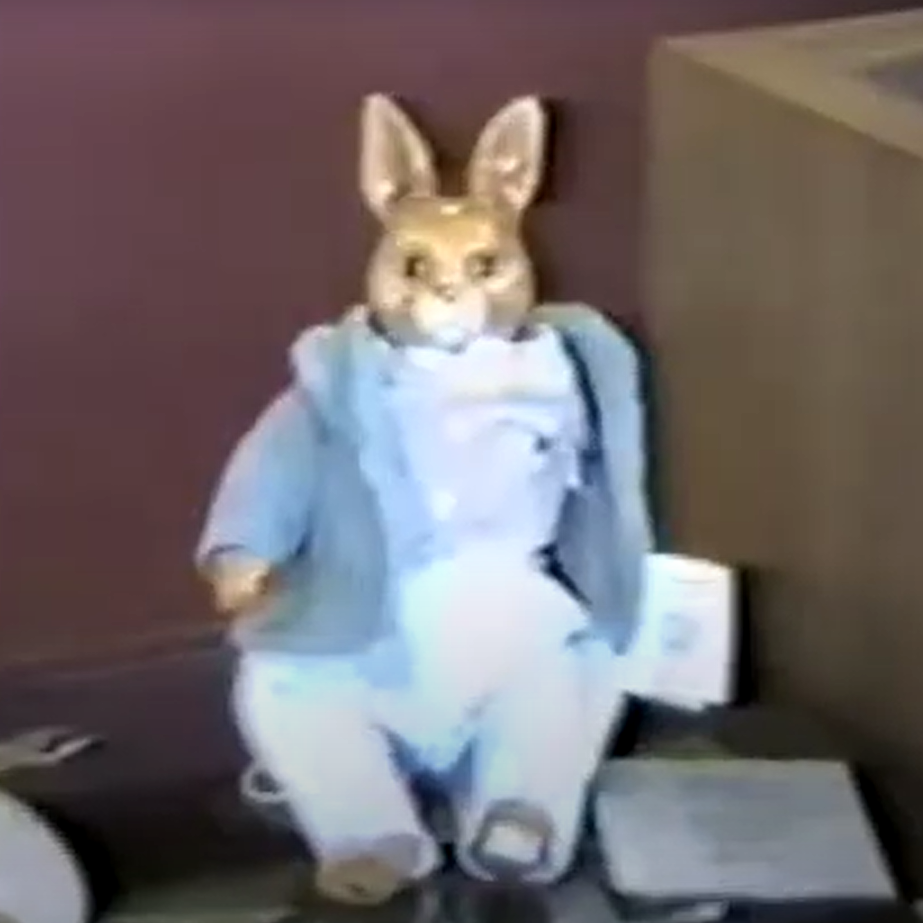
The name of the store is Voila and it features jewelry in locked glass cases, plus gifts and lovely collectible decorative pieces for the home including cloisonné and China figurines such as a whimsical ornamental rabbit dressed in a jacket, reminiscent of the rabbit in Alice In Wonderland.

Gold nugget jewelry, fashionable in the 1980s, plays a prominent role in the film. Contrary to what one might think, based on the appearance of the nuggets, they were not mined by bearded prospectors panning for gold in streams in Nevada or California.  Instead, the chunks of gold were 14 karat confections fashioned to look like nuggets and worked into pendants, rings, and earrings, and often considered investment pieces. Such an investment was a good one in the 1980s when gold and silver skyrocketed in price. In the video, the inauthenticity of the “gold nuggets” introduces a tension between appearance and reality, and the way that language convinces one of “the real.”

DRAMATIS PERSONAE

The video has several key characters. They include three upper middle class professional women eager to purchase something novel to reinforce their social status. Next is Mr. Markup, the owner of a line of nugget jewelry. He recruits a graduate student from Greece to sell the nugget jewelry to pay tuition. Finally, there is a local man who sits behind a jewelry case and reads excerpts from a poem by Owens, “Anthropologist at a Dinner Party” that later appeared in the collection, How Much Paint Does the Painting Need. 


LITERARY FOUNDATION

The poem, “Anthropologists at a Dinner Party” was inspired by an actual dinner party with professors from the University of Oklahoma which included George Economou, chair of the English department, and professors from the anthropology department. 


Although one of the anthropology professors ostensibly specializes in Native American culture, he brings the history of the peoples of northern Europe to the conversation. Despite his specialty, he himself is of European origin, and not Native American. He talks about Picts in Northern Europe and then mentions Aryans and intermarriage. The professor’s narrative is subverted by subtexts of eugenics, a theme that underscores a later work by Owens, “Black Chalk.” The history of Oklahoma informs Oklahoma Too, which includes the removal of Native Americans, the Trail of Tears, and a history of cultural destruction and the many attempts to subjugate, exploit, and potentially eradicate Native American peoples.

PLOT SUMMARY

The film commences as three women dressed as the elite of a small college town appear in the opening scene. The cast of men consists of the entrepreneur and an impecunious graduate student along with a diffident potential customer of gold nuggets or other trinkets. 

Owens has said that she typecasts to facilitate and energize improvisation.  In Oklahoma Too improvisations occur in the jewelry store and then later in the scene when the graduate student is attempting to sell the gold nugget jewelry. He's in the living room of a home of one of two women and the more insistent he becomes the more they resist. They even counter his sales pitch with one of their own: Why not contribute funds to save the Arctic seals being clubbed to death by hunters? There is an element of the absurd in not only the lively and humorous dialogue, but also in the exaggerated Western wear that the foreign student from Greece wears. He is a Greek cowboy wholeheartedly embracing the accoutrements of local culture, and thus potentially equipping himself to be more convincing in the heart of Oklahoma. 


Whether the Greek graduate student’s pitch succeeds, or if the women succeed in convincing him to donate to their cause, is part of the negotiation of text and textual space that marks Oklahoma Too. In fact, one could consider the improvisations as ultimate language play.  One can further suggest the dialogue, with its many levels of ambiguity, and the three voices speaking over each other, are, by their very indeterminacy, a part of the world of art.  Reality is a series of complex negotiations. Signification is just one of those negotiations. Another language negotiation is the right to deconstruct, which embodies the right to collapse and implode language itself the ultimate liberation from oneself and impositions of identity and thus fate.

THEMES

“Foreign” vs. “Local:” The film toys with the notion of “foreign,” and suggests that all are constructed identities. In fact, when the “foreigner” (the Greek graduate student) dons the apparel of the Western cowboy, he reinforces the notion that appearances always deceive. 

“Faux” vs. “Authentic” nature:  The “gold nuggets” are shaped to look like they came straight from a prospector’s gold-panning operations, with his donkey observing from the edge of the stream. In reality, they are simply lumps of 14K gold (or even just coated with a veneer of gold to be “gold filled”). At any rate, gold is melted and fashioned into a shape that mimics authentic nuggets. 

Con the Con: Mr. Markup is telling the graduate student that he can sell nuggets and earn enough for tuition. In a flash, the Greek graduate student becomes an accomplished sales rep, with a stunning repertoire of sales pitches.  The bourgeois women are likewise cons – except what they “sell” is participation in a high-status philanthropical “cause.” They try to convince the graduate student to contribute to their fund to “save the seals.”

CONCLUSION

The poem by Owens satirizes university faculty and the conversations they have at dinner parties, which are almost always remembered in retrospect as a platform for one or two dominating, bloviating know-it-alls, who, despite their seeming commitment to liberal perspectives (human rights, civil rights, etc.), reveal their internalization and unconscious espousal of normative forces.  In this case, there is a subtext of eugenics. 

Owens’s vision and direction create an energetic scene In the living room as all three actors speak over each other, creating “noise” rather than clear dialogue. Their attempts to con the others into giving money to their own cause or self-interest explore the way that the audience tries to make sense – which voice dominates? Which one can you follow? The fact that all three voices are of equal valence is critical:  at the end of the day, cacophony prevails. Art is what happens when clarity comes from the cacophony. The artist provides the clarity.

It is also worth noting that the Voila gift store was a charming oasis. The University was likewise an intellectual and spiritual oasis, which fostered creativity and self-expression during the mid to late 1980s, when Oklahoma suffered through the devastating “Oil Bust” and farm crisis. 

---Susan Smith Nash, Ph.D.


Blog Archive