Showing posts with label innovative poetry. Show all posts

Tuesday, January 11, 2022

The Enduring Value of Linguistic Play: Thomas Fink and Maya Mason's Collaboration: A Pageant for Every Addiction

 It’s a remarkably cold and windy New Year’s Day, and I can’t think of anything I’d rather do than to sit with a small stack of Thomas Fink and Maya Mason’s playful and intelligent poems and let them take my mind wherever it wants to go.

I love the way their poems are an invitation to a dance: they spur a conversation with the future, the past, and the present.  I enjoy seeing how the anxieties of antecedents play out: one visual allusion leads to another, one set of topics and tropes leads to thinking of other authors, and so on. 

Sometimes this approach leads to specious connections and I wonder which corners of my mind produced them, which is something akin to finding YouTube has created “My Mix” that contains principally opera from Henry Purcell and Mexican rancheras performed by mariachi bands from the 1950s.  

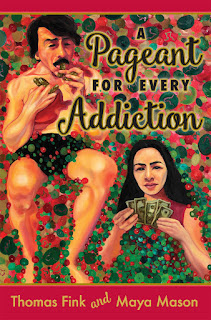
Thomas Fink and Maya Mason. A Pageant for Every Addiction. East Rockaway, NY: Marsh Hawk Press. 2020. 77 pages.  ISBN: 978-0996991209

The cover art is what captivates first: It’s compelling, especially on a cold New Year’s Day when one is obliged to trot out one’s New Year’s Resolutions, even if they constitute little more than cleaning out a closet and ordering vegan protein supplements and Vitamin D on Amazon and “Favoriting” a morale-boosting podcast on YouTube. A man holds elongate objects in his hands (lumpy anise treats?) and a woman holds what appear to be $100 bills between her hands.  Multi-colored dots give the painting an effervescent, playful feel.

The first poem made me smile. “First Date Questions” – I could not even imagine anyone asking me such questions, but if some did, I would immediately pay attention. The questions move from the concrete to ones that are clearly playing with cultural assumptions, asking you to look at things in new ways:

… Don’t

you just hate when you reach the zoo,


and the zebras have been sent

out for cleaning?


I love the whimsy and way they ask one to consider the basis for our underlying mindsets:

I hate to think of

worms eating my

dog’s eyes; is that love?


The questions are a perfect form for a collaboration, and an ideal way to start a collection since they embody a kind of conversation.

Addictions are judgments. They are condemnations of sorts, and impugn the character of the addict, even if the addiction is to something as innocuous as hoarding blank journals. So, it is only fitting to see a poem entitled “You’re Morally Inferior If” and to see that each 4-line stanza contains at least one criterion upon which to judge and condemn a person.  They also made me smile.  Here are a few:


               you keep

               your fingernails long –

               rendering hands useless


or


               …. you


               buy two of the same

               necklace, you’re too

               sentimental to kill

               mere mouse.


As a geologist with a soft spot for paleontology, I was drawn to “Substitute Fossil,” wondering first, how fossils relate to addictions although I can easily envision a Fossil Pageant in the A Pageant for Every Addiction.

Fossils are fairly meaningless unless they are classified; fossils are not only remnants of the past, they are used to time-stamp a layer of the earth (formation), since many fossilized organisms lived in very defined spans of time.  Fossils then, invoke classification systems, and as such, naming and identity.

If you substitute fossils, it’s possible to completely subvert the entire classification system, and suddenly the system will have no connection to a stable time frame, orientation, or even meaning.

That’s exactly what is going on in “Substitute Fossil,” and it’s up to the reader to create a new set of relationships of time, meaning, connection.  If fossils are indicators, they can be both the alphabet and the syntax of meaning. If we substitute, we have the arbitrariness of classification laid bare:

… convict

our glad workhorses into gold


deficits – to

a new alphabet for potpourri to assum

maneaters of grammar castrate

the chairmen of prattle …


The final minimalist long poem, “A Few Promises” makes the reader smile with whimsy, sometimes schadenfreude:

“A staircase for

every stiletto”

“A straightjacket

for

every extrovert”


The verses incorporate professions, physical phenomena, and life forms. They also relate back to the realities of uncertainty, unpredictability, and gambling, including market plunges. They are not only promises to fulfill dreams, but also to solve problems (or even create them – “a shark for every bathtub”). 

In the end, the collection touches the experiences of readers and triggers one’s own “conversation” in a Bakhtinian, carnivalesque manner, while showing ways to restructure assumptions and gently subvert generic expectations.


Wednesday, September 16, 2020

Indeterminacy, Freedom, and Female Authorship in Emily Dickinson’s “All overgrown by cunning moss"

 It is illuminating to assess the impact of one writer’s imagination on that of another, who may be working in isolation, even in another continent. For Emily Dickinson, the work of Charlotte Bronte, publishing under the pseudonym, Currer Bell, was of particular interest, perhaps because of Charlotte’s desire to disguise the fact she was a female, and also that the use of a pseudonym emboldened her to write about transgressive topics, and essentially liberate herself from society’s numerous and sundry cages for women, especially at the time that Dickinson lived, in the middle of the nineteenth century. 

“All overgrown by cunning moss,” is a poem written by Emily Dickinson around the year 1859. It is one of the earlier poems and does not reflect the impact of the Civil War.  The manuscript is in the Houghton Library, and a facsimile can be accessed online.

The poem is quite brief. It consists of three stanzas of four lines each. The rhyme scheme is ABCD and the lines have no consistent metric feet, except to say that they alternate between relatively longer and shorter lines. 


Emily Dickinson wrote and bundled her poems in fascicles. The manuscripts are now in the Houghton Library, Harvard University. 

Emily Dickinson’s poem often deal with death, graves, and mortality, and this poem is no different. The “little cage” of “Currer Bell” is the grave, “all overgrown by cunning moss.” It lies in Haworth, which is the last town that Currer Bell, the pseudonym for Charlotte Bronte, lived. The repetitions of certain words give rise to certain meanings. First, there is “This Bird” (stanza 2), which is capitalized, as is the “Nightingale.”  The grave is overgrown with weeds; it’s the resting place (the final cage) of the name of the nom-de-plume, “Currer Bell.” However, the actual author referred to as the Nightingale, or, Charlotte Bronte, has long escaped, and is in neither nest nor cage. In the poem, Charlotte Bronte is in the eternal green of the Yorkshire hills, and in “other latitudes” which could signify the world of the intellect. Among Romantic poets such as Wordsworth and Coleridge, the “Nightingale,” refers to the creative spirit, and a voice of nature. 

What Emily Dickinson probably did not know was that Haworth was not a charming, verdant town or village when the Brontes lived there.  Instead, it was a grimy mill town with polluted air and water, due to the toxins produced by the textile industry, which had transitioned from a cottage industry (everyone had a loom in their front room), to own of dirty, crowded factories and no sewer systems. The life expectancy was just 25 years of age when the Brontes lived at Haworth (Cahill, 2018). 

Nevertheless, death permeates the poem, and the statement that “the Yorkshire hills are green – “ (Dickinson, 1999) juxtaposes the green of life with final “cage” that keeps “Currer Bell.” It's a deceptively simple poem, and the term “cunning moss” is probably key to it all. The “cunning moss” – the intelligent growing plant life that sprouts up to cover and disguise, is keeping her secret safe, while “cage” (the grave) which is “interspersed with weed” contrasts with the “other latitudes” and the Yorkshire hills.  

Like so many of Dickinson’s poems, “All overgrown by cunning moss” becomes a fascinating exploration of indeterminacy. The grave and what it has inside it are ultimately impossible to capture, define, or identify. The name of the person is only the pseudonym, and the captor, “This Bird” have long gone, not found in any nest, or in any state of being, for that matter. The “frosts too sharp” precipitated translocation; the sense that a bird (entity) willed itself to “other latitudes” which seem safer, albeit impermanent.  

In this poem, indeterminacy is a kind of freedom, even as it means erasure and the impossibility of recognition in the mortal coil wherein the pseudonym existed, at least in sufficient capacity to escape and to thus defy a socially constructed form of being.  


REFERENCES

Cahill, J. (Aug 11, 2018). “The ultimate guide to Bronte country: Haworth, Yorkshire.” Beyond the Lamp Post. 11 Aug 2018. https://www.beyondthelamppost.com/bronte-country-haworth-yorkshire/  Accessed Sept 16, 2020.


Dickinson, E. (n.d.) “All overgrown by cunning moss, J148, Fr146.” Emily Dickinson Archive. Houghton Library, Harvard University. https://www.edickinson.org/editions/2/image_sets/74779. Accessed 11 August 2020.


Dickinson, E. (1999). “All overgrown by cunning moss, (146).” Poetry Foundation. https://www.poetryfoundation.org/poems/52200/all-overgrown-by-cunning-moss-146 Accessed 16 Sept 2020.


Monday, February 12, 2018

Rochelle Owens: Fragmentations and Unifications of Vision


Rochelle Owens has made a name for herself for her avant-garde plays and her poetry which take the reader into uncomfortable territory of taboo, flesh, violation, body fluids, and life.  The graphic nature of her imagery has been the “shiny object” that generally captures the critic’s attention, and unfortunately the sometimes shocking nature sometimes blinds them to the work’s philosophical complexity and her subtle commentary on how we see reality, beingness, and becoming in a world that contains intersections of imaging technology and the body / person herself.


Hermaphropoetics: Drifting Geometries is a collection of poems describing a series of stills in videos depicting the same object (a person).  To summarize, Hermaphropoetics is about the fragmentation of unity and/or the deconstruction or deliberate disassembling of unity.

The various poems illustrate how there are many ways to see the same thing. Owens takes a series of still photos that comprise a video and describes them individually. However she does not say where exactly they fit within that series of images. Observing one still after the other creates a historical continuum from the first videographers, the Lumiere Brothers, to today’s high-tech videographers. Rochelle’s emphasis on the fragmentation of video and the dissolution of a recorded event also brings to mind today’s more or less omnipresence video making abilities in the form of smart phones.  We are reminded that the technology has made us tend to forget that video still is a series of single frame images.

The parallel with language is clear. Language creates a reality and the words (parole) are the individual stills. Take them out of sequence and the reality they create is mediated – always – by the reader / audience.  On a cellular level we like to think that the raw images create reality.

Rochelle Owens shows us that once you stop the flow  - image after image after image, you suddenly find yourself unable to actually connect with the reality until you place it within a narrative which by definition includes language. That language does not necessarily have to be verbal but there is a language nonetheless.

So Owens considers video stills. We can say that they must exist in a certain order to gel into meaning(s). The stills constitute the words and the parole of the grammar of visual discourse.

The sequence of video stills demonstrates that all meaning is in essence a construct that is constantly being deconstructed and reconstructed.

The repetitions of images are like incantations. They rip open and expose the heart and a sense of life. When Rochelle discusses exposed flesh she’s also talking about the private laid bare in the raw, painful moments where one is subjected to the indignity of the gaze.

The camera is invasive. It creates in the subject a profound level of humiliation that has to do with one’s autonomy. The individual in fact is a being, and that beingness is suddenly stripped away and placed in the hands of the individual who has the capability of ordering the series for sequences of images and also to create a narrative that describes what is happening.

In addition to creating sequences, Rochelle Owens creates fragments and in doing so reveals how it is possible to cast the meaning-making process into indeterminacy.

In doing so, she seizes upon the nature of what it is to create art. There is the artifice of becoming and the frames seem to be becoming something, but the frames can never become anything without the reader’s externally imposed narrative.

We crave explanations and we want a sense of the whole but the parts do not and cannot add up because the video stills that come together to make a narrative are inadequate to keep the mind of the post-postmodern reader in a single track.

The objectification of that frozen moment of death, nakedness, vulnerability and exposure is what Rochelle Owens has created.  Owens's avant-garde plays and poetry have always had a way of making reader feel vulnerable and awkward. On one level, that emotional response is in part about the process of coming to grips with indeterminacy.

The camera is in essence the technology of object-making. The accompanying consumption occurs by creating the tools by which the reader enters and then slowly moves into a state of self-fragmentation. Self-fragmentation is painful at first, but after 10, 20, 30, 40, and 50 repetitions profound desensitization occurs and one enters into almost an almost trance-like state.

Each camera technique offers its own slow trajectory. Life’s puzzle pieces are meaningless when scattered out of order. Repetition, despite J Hillis Miller and his notion that there is no meaning without repetition, does not necessarily hold water. Simple repetition does not make meaning. Patterns are patterns.

The assignation of value that is to assign value to the pattern -  whether denotative or aesthetic - is arbitrary. Nevertheless, there can be a sense of urgency if the pattern has some kind of consequence in the phenomenal world, such as being run over by a car or the likelihood of certain aggressive behaviors of dangerous people.

Rochelle Owens shows the absolute arbitrariness of life force elements that we generally consigned to the sacred.


Reference


Owens, Rochelle. Hermaphropoetics: Drifting Geometries. San Diego: Singing Horse Press, 2017. 173 pages. ISBN: 978-0-9356-58-5

Blog Archive