Showing posts with label poetry. Show all posts

Saturday, August 19, 2023

O Jaw Bone: The Experience of the Two Choctaw Removals in Poetry and Biography

In the winter of 1831, the Choctaw Indians were forced out at gunpoint to walk barefoot and in thin clothing from their homelands, 11 million acres in what is now Louisiana, Alabama, Mississippi, and Arkansas, to the Indian Territory in what is now southeast Oklahoma.  There are historical accounts of the privation, suffering, and extreme cruelty, but I did not realize that anyone who made the terrible journey had written a song or a poem.  


The Gilcrease Museum (located in Tulsa, Oklahoma), actually has a document written by an unnamed author about the removal. It appears on the Choctaw Nation website: https://www.choctawnation.com/biskinik/a-trail-of-tears-song-the-new-jaw-bone/ 


Poem

1. Jackson send the Secretary War
To the Indians of the law
Walk o jaw bone walk I say
Walk o jaw bone walk away.

2. Eaton tells us go away
Here no longer you can stay
Walk o jaw bone walk I say
Walk o jaw bone walk away

3. On my way to the Arkansas
G_d d__n the white man’s laws
O come and go along with me


The manuscript of the poem by an unnamed Choctaw author


 The website contains the poem along with a guide to understanding the people mentioned in the poem.  Reading the poem and imagining the cruelty of the suffering, especially to the elderly and the young, gives me chills. 


Until today, I did not realize that there was a second Choctaw Removal.  It took place in 1903, and coincided with the dissolution of the Choctaw Nation. In it, Choctaws were sent by train to Ardmore, Oklahoma, which was in the Choctaw Nation.  The way they were transported was brutal – they were loaded like cattle onto box cars, and when they arrived in Ardmore, they were imprisoned in a warehouse, where there was no ventilation, sanitation, heat, or adequate food (https://choctawnationculture.com/media/40683/2017.12_the_last_choctaw_removal_-_ardmore.pdf).  Some were then shipped out to different farms and locations where they had to work for a place to sleep. Others were given allotments of land that had no water or arable land. Some stayed in Ardmore, living in abject destitution. 


My mother was born in Ardmore in 1932.  My grandmother had lived in that town, staring in the late 1920s, and I remember her telling me that the way the Choctaw Indians had to live was worse than criminal. In addition to a lack of food and water, the Mississippi Choctaws suffered from outbreaks of disease. Despite the desperate poverty, the Choctaws pulled together the best they could and preserved their dress, songs, beliefs and culture. Here is a link to Choctaw tribal members wearing traditional outfits: https://www.choctawnation.com/about/culture/traditions/dress/ 


Lesa Phillips Roberts (1889 – 1994) was a very Choctaw girl who survived the Second Removal from Mississippi to Oklahoma. She ended up in Atoka, Oklahoma, where life was very precarious. The Mississippi Choctaws were given allotments of land, but they were often in undesirable areas, and the Choctaws already in Oklahoma were often placed in conflict with them.  Her life story was captured by her son, Charles Roberts, near the end of her life. It was published in The American Indian Quarterly in 1990 in an article entitled “A Choctaw Odyssey, The Life of Lesa Phillip Roberts.” 


The Choctaw Nation Cultural Center is located in Calera, Oklahoma, near the town of Durant.  Durant is a regional center with a four-year university (Southeast Oklahoma State University), Choctaw business enterprises (casino, food products), and the Choctaw Nation Tribal Complex.    


Tuesday, March 14, 2023

Interview with Thomas Fink: Poet, Essayist, Literary Critic, and Abstract Painter

Welcome to an interview with Thomas Fink, whose latest collection of poetry, Zeugma, a fascinating title for a rhetorical term that refers to a single word that links disparate ideas ("she broke his glass sculpture and his heart").  It is a great pleasure to have the chance to learn more about his background and some of the ideas that inform his poetics, criticism, and art.  In addition to his artistic and scholarly work, Fink has supported publishers and writing programs such as the Marsh Hawk Press

What is your name and background?

I’m Thomas Fink, a professor of English at City University of New York’s LaGuardia Community College for the past 41 years. I’ve published twelve books of poetry and two books of criticism about contemporary poetry, as well as a recent book on teaching college students to interpret poetry. I “moonlight” as an abstract painter.

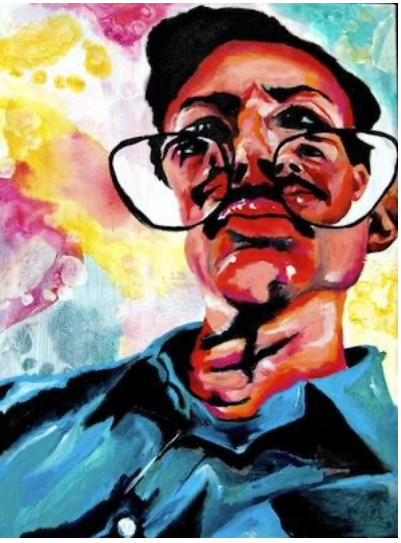
Portrait of Thomas Fink by Maya D. Mason

When did you become interested in experimental or avant-garde poetry?

When I graduated from Princeton University in 1976 and was just about to enter the MA and PhD program at Columbia University, a high school friend gave me John Ashbery’s Self-Portrait in a Convex Mirror as a present. At first, I found the book infuriating, but eventually, it opened me up to a wide range of avant-garde poetry, and I wrote the third doctoral dissertation (after David Shapiro and Donald Revell) on Ashbery’s work. 

What makes a poem experimental or avant-garde... especially in 2023? 

I’ve given up trying to answer that question! For one thing, if I were to try to apply it to my own poetry-writing process, writer’s block would set in and persist indefinitely. The innovative practices and procedures that have been around since World War II or even before are still viable but can hardly be called avant-garde any longer. Some proponents of what is labeled Conceptual poetry perceive their poetics as a replacement for those earlier practices, which they consider exhausted and not worth “repeating.” I don’t agree. Others believe that particular kinds of politicizing of poetry, whether tied to formal choices or not, are the most authentic, useful avant-garde gestures. Sometimes I find that this approach produces poetry that is both intellectually and aesthetically compelling.   

Please tell us a bit about your collection, Zeugma.  What is the main focus?

I didn’t set out to have a single focus in Zeugma. But in her Foreword, Patricia Carlin finds that the title, which implies the yoking together of disparate things, is enacted in the book itself and hence serves as a focus to represent “the fragmented, unstable, and confusing contemporary scene” (9). It would be hard not to view “Bewilderness,” the opening poem, as a reflection on the pandemic, and individual poems surely have references, sometimes oblique and sometimes not, to extremism in the Republican Party. 

Zeugma

I think everyone will recognize the allusion in the title of “November 7, 2020.” A bunch of poems are written in a hybrid form that I came up with called “Sonnina”; it’s a cross between a sonnet and a sestina. Also, there are continuations of long-running series: “Yinglish Strophes,” which uses an approximation (and often an exaggeration) of Yiddish-inflected English syntax to air topics such as intergenerational differences/connections in a family and perspectives forged by immigration, “Goad,” which actually reflects the theme implied in its title, and “Dusk Bowl Intimacies,” which registers both displacements and quests for individual security. The verse-play, “Who My People Are,” may also reflect some concerns of the three series I’ve mentioned. 


Tuesday, December 27, 2022

A Conversation with Rochelle Owens about Patterns of Animus (2022)

 Audio Recording of interview with Rochelle Owens over Patterns of Animus: http://www.zenzebra.net/audio/rochelle-2022-12-07.mp3 

Rochelle Owens Patterns of Animus
Rochelle Owens:  Patterns of Animus

Speaking to Rochelle Owens is always a pleasure because she sheds insight on her work and philosophical underpinnings. She also explores the ideas that inform her poetry as well as her plays.

Welcome to an interview with Owens, where she reads from her new long poem, “Patterns of Animus,” and chats with Susan Nash about her work and interests now and in the past. “Patterns of Animus” appears in her collection of the same name, which also contains a series of essays written about her earlier work. To purchase Patterns of Animus or to read free on Kindle, click here.


Post settings Labels podcast,rochelle owens,poetry, No matching suggestions Published on 12/22/22 1:08 PM Links Location Options Post: EditChanges saved

A Conversation with Rochelle Owens on The Aardvark Venus (2020)

 Audio Recording:  http://www.zenzebra.net/audio/rochelle-2022-12-08.mp3

Rochelle Owens has been writing and publishing poetry since the early 1960s, and now her early work is available together with recent work (from 2020) in a single volume, The Aardvark Venus: Selected Poems 1961 - 2020. 

Welcome to an interview with Rochelle Owens, who chats with Susan Nash about her work, the philosophical ideas that have influenced her. 


To purchase a perfect-bound paper copy, or to read it on Kindle, please click here


The Aardvark Venus, by Rochelle Owens


Monday, April 11, 2022

A Visual Poetics Coup de Dés of Meaning: Thomas Fink's Selected Poems

 Thomas Fink.  Selected Poems and Poetic Series. East Rockaway, NY: Marsh Hawk Press. 2016. 244 pages. ISBN: 978-0-9964275-0-0


This stunning collection includes examples from some of Thomas Fink’s most innovative and subversive work.  His work subverts the subversive, thinking specifically of all the concrete poetics that followed Malarmé’s Un coup de dés jamais n’abolira le hazard (1897) that has been used as the foundation for so many visual poets, including John Cage, John M. Bennett, Jesse Glass, Dick Higgins, F. A. Nettlebeck, Rochelle Owens, and Armand Schwermer, just to mention a few.  The visual poets subvert reading and meaning-making practices by add the aleatory, while Fink systematizes the strategies for generating meaning from a visual poem, particularly in his series that use the same form. 


For example, subversion of the subversive occurs in “Jigsaw Hubbub” where a Figure 8 / vertical Infinity sign is used several poems. The reader automatically resystematizes his / her method of approaching the poems, and looks for similarities and differences.  The same can be said for the “Goad” series where the upside down Greek letter Omega suggests the end of meaning (a common conceit in the twentieth century), but the fact that the shape is the same for each of the “Goad” poems instantly imposes at least two types of strategic meaning-making processes: first, comparing the shape of the upside-down Omega in each for raw semiotic meaning, and second, in the words themselves and the meanings forged by reading from right to left, descending from line to line. 


The collection of work is particularly fascinating because it is arranged chronologically and we can see a timeline of textural and thematic innovation. The collection begins with 1993’s Surprise Visit. The poems serve as an antidote to the then-ubiquitous L=A=N=G=U=A=G=E poetry, and are intertextual in the sense that they evoke and import an entire body of exogenous work. Perhaps the most delightful example is “Louise Bourgeois” which one cannot read without thinking of her big daddy longlegs spider sculptures, her bold prolificity, and the workshop where basically everything was cubed, drilled, formed into serviceable art (which is to say that it beckons itself to be in the service of EveryPerson).


Excerpts from Gossip (2001) reflect the giddy sense of having dodged apocalypse, until, of course, apocalypse showed itself to be a narrative characterized by its innate multiplicity.  Such inescapability from deterministic narratives is reflected even as natural phenomena are considered to be random, are likewise subjugated to narrative, as in “Reprise”


like a refugee

and every time you kiss me it’s like 


another little piece of my

lightning striking again … (p. 13)


After Taxes (2004) incorporates poetics of unparalleled sweetness, with a palpable desire for meaningful connections that flow through dreams, memories, and the actual experience, past or anticipated. “In Memoriam” is either a letter from a grandfather to a grandchild, or from a grandchild to a grandfather, or simply from / to childhood to later life, a homage to the ability of language and letters to forge enduring bonds and to affirm life. 


Dusk Bowl Intimacies stretch from 2011 to 2015. Each has more or less the same formal structure: A block prose poem followed by a minimalist verse, three to eight lines in length. The voice is the persona of an older woman, possibly a grandmother. She is an inquisitive spirit who investigates the underlying assumptions in the ways that language embodies everyday life, and then closes with lines that assert a personal commitment or an exhortation. 


“Home Cooked Diamond” and “Jigsaw Hubbub” are visual poems. As mentioned earlier, “Jigsaw Hubbub” toys with infinity, and subverts the popular notion widely espoused in the twentieth century that a visual poetics liberated language, thus unleashing an infinite number of potential meanings, and thus finding a way to define infinity.  “Jigsaw Hubbub” puts a playful stop to that, while “Home Cooked Diamond” has enough variation in the shape and textual arrangement on the page to look like shadows from a tree as the day progresses, looking “slant” and also into a mirror. 


“Home Cooked Diamond” has the feel of a memoir and an awkward road trip with  parents whose flaws are all too obvious to the children, which makes the telling all the more uncomfortable. The struggle one has to read parallels the emotional struggle in the author’s voice. It’s strangely emotionally compelling. 


--- Susan Smith Nash, Ph.D. 


susan smith nash, ph.d.

Thursday, March 31, 2022

The Irreducible Uncertainty of Poetics in Hedge Fund Certainty: Thomas Fink

Thomas Fink. Hedge Fund Certainty. Meritage Press and I.E. Press. 2019.  ISBN: 978-1-934299-14-2


The beauty of poetics is its irreducible uncertainty.  The meanings are unmoored, allowing the reader to do what she / he would like. They can attempt to lash meanings to a limited number of options which may prove satisfying for some (especially those who consider the interpretive enterprise as a kind of exegesis). 


However, the real joy of discovery engaging in a sense of play.  The process involves observing the words, the structure, the syntax, and arrangement on the page and then embracing all the possibilities as they come to mind. 


A hedge fund is probably as far from certainty as one could imagine, so Fink’s play on the idea of certainty gives rise to ideas of gaming the system to have a positive outcome. The collection begins with “Yinglish Strophes.” All are in English, but with Yiddish syntax and arrangement, line breaks, and subjects that create an intense sense of place and of character. The words trigger a deep sense of nostalgia and loss: .. “Never later / was I back Russia the same once” (Yinglish Strophes 25). 


It is delightful to see the long poem, “Subprime Mortgage Bargain Lot” series. The title alone is amusing, because most readers will see that this has everything to do with rolling the dice and losing, seeing something you thought you possessed, whether it be the meaning of numbers on a page, or your ability to agree on a value with other readers. 


Hedge Fund Certainty evokes Stéphane Mallarmé’s Un coup de dés Jamais n’abolira le hasard (1897). Translated to “A throw of the dice will never abolish hazards (or risk)” Mallarmé created a concrete / visual poetry notable for the aleatory aspects of the word choice, and the open arrangement on the page. 


Likewise “Subprime Mortgage Bargain Lot” is seemingly aleatory, and it gives you the choice to read the words in clusters or straight across the page.  Further, the words break in unusual places and words interject themselves.  The result is a vertiginous race to the bottom of each page. It is a thoroughgoing condemnation of greed and the brutalization of humanity as wholesale wealth redistribution occurs: “Out with / your ragid / daydreaming / that costs / & costs / the hard / working” (from “Subprime Mortgage Bargain Lot 16). 


The collection ends with “Prohibitionism,” which proclaims a message of hope: a telethon for poetry, that would suggestion unity, but the arrangement on the page denotes separation into opposing clusters of words (or camps), although the last line suggests a coming together: “walls / curve  toward  one  another.”  


-- Susan Smith Nash, Ph.D.

susan smith nash, ph.d.


Wednesday, February 02, 2022

Preserving Alternative Epistemologies through Preservation of Indigenous Languages

 Irma Pineda. In the Belly of the Night and Other Poems: En el vientre de la noche y otros poemas. Ndaani’Gueela’ne xhupa diidxaguie’ English translation: Wendy Call. Illustrations: Natalia Gurovich. Mexico City: Pluralia Ediciones e Impresiones. 2021. 9780607-7655-xx-x

To publish poetry written in endangered indigenous languages not only preserves the language, but also a way of knowing, which is often an alternative epistemology. 

The work of poet Irma Pineda is no exception. She writes in Isthmus Zapotec, from her rural small town in Oaxaca, Mexico, where the number of speakers is dwindling rapidly. She also writes in Spanish in what she considers to be “mirror poems” rather than denotative translations of each other. 


In order to accommodate both versions in a single English version, translator Wendy Call sat with the author, Pineda, who explained just how each poem is shaped, and the kinds of word play that each has, and why. In investigating the differences, core ideas about the world and systems of knowledge came to light. For example, in Spanish, “En el vientre” means “in the belly.”  However, “Gueela” does not mean belly or intestines at all, but umbilical cord. Further, the umbilical cord is inextricably linked to the house where one was born, because, after birth, the umbilical cord is placed in a small pot, which is then buried under the house. 

The earth and the body have a unique connection that does not occur with the Spanish colonial impositional culture. The fact that the translator spent time to learn about the embedded beliefs and traditions, and to incorporate them into her English translation, and to explain the process in the preface, is a great contribution to the understanding of the Isthmus Zapotec culture and poetic output. The themes in the clusters of poems include the concept of the “guenda,” which is simultaneously spirit and animal. 

In “Sun,” reflects an animistic view of the world, where objects in the natural world can take on human traits, and then shape-shift back. Similarly, the crocodile’s eggs swim just as the observer’s mind opens to the fecundity of all things, and unbreakable (albeit not always visible) connections. 

An animist perception of the world is also apparent in a poem from the first cluster of poems, “Red Belt,” where the red ribbon wrapped around the narrator’s pregnant belly both adorns and protects.  The final cluster of poems, “From the Cord House to the Nine Handspans” incorporate the Isthmus Zapotec traditions while reflecting on the deep love the narrator has for Sebastian, in his journey through life, from the “[umbilical] cord house” where he was born, to the “nine handspans” (the grave, nine handspans below the surface of the earth). 

Knowing that Pineda is writing from her home in Mexico City, and lives in a kind of self-imposed exile from the cluster of Isthmus Zapotec speakers she grew up with, adds another level of loss and nostalgia. 


Wednesday, September 16, 2020

Indeterminacy, Freedom, and Female Authorship in Emily Dickinson’s “All overgrown by cunning moss"

 It is illuminating to assess the impact of one writer’s imagination on that of another, who may be working in isolation, even in another continent. For Emily Dickinson, the work of Charlotte Bronte, publishing under the pseudonym, Currer Bell, was of particular interest, perhaps because of Charlotte’s desire to disguise the fact she was a female, and also that the use of a pseudonym emboldened her to write about transgressive topics, and essentially liberate herself from society’s numerous and sundry cages for women, especially at the time that Dickinson lived, in the middle of the nineteenth century. 

“All overgrown by cunning moss,” is a poem written by Emily Dickinson around the year 1859. It is one of the earlier poems and does not reflect the impact of the Civil War.  The manuscript is in the Houghton Library, and a facsimile can be accessed online.

The poem is quite brief. It consists of three stanzas of four lines each. The rhyme scheme is ABCD and the lines have no consistent metric feet, except to say that they alternate between relatively longer and shorter lines. 


Emily Dickinson wrote and bundled her poems in fascicles. The manuscripts are now in the Houghton Library, Harvard University. 

Emily Dickinson’s poem often deal with death, graves, and mortality, and this poem is no different. The “little cage” of “Currer Bell” is the grave, “all overgrown by cunning moss.” It lies in Haworth, which is the last town that Currer Bell, the pseudonym for Charlotte Bronte, lived. The repetitions of certain words give rise to certain meanings. First, there is “This Bird” (stanza 2), which is capitalized, as is the “Nightingale.”  The grave is overgrown with weeds; it’s the resting place (the final cage) of the name of the nom-de-plume, “Currer Bell.” However, the actual author referred to as the Nightingale, or, Charlotte Bronte, has long escaped, and is in neither nest nor cage. In the poem, Charlotte Bronte is in the eternal green of the Yorkshire hills, and in “other latitudes” which could signify the world of the intellect. Among Romantic poets such as Wordsworth and Coleridge, the “Nightingale,” refers to the creative spirit, and a voice of nature. 

What Emily Dickinson probably did not know was that Haworth was not a charming, verdant town or village when the Brontes lived there.  Instead, it was a grimy mill town with polluted air and water, due to the toxins produced by the textile industry, which had transitioned from a cottage industry (everyone had a loom in their front room), to own of dirty, crowded factories and no sewer systems. The life expectancy was just 25 years of age when the Brontes lived at Haworth (Cahill, 2018). 

Nevertheless, death permeates the poem, and the statement that “the Yorkshire hills are green – “ (Dickinson, 1999) juxtaposes the green of life with final “cage” that keeps “Currer Bell.” It's a deceptively simple poem, and the term “cunning moss” is probably key to it all. The “cunning moss” – the intelligent growing plant life that sprouts up to cover and disguise, is keeping her secret safe, while “cage” (the grave) which is “interspersed with weed” contrasts with the “other latitudes” and the Yorkshire hills.  

Like so many of Dickinson’s poems, “All overgrown by cunning moss” becomes a fascinating exploration of indeterminacy. The grave and what it has inside it are ultimately impossible to capture, define, or identify. The name of the person is only the pseudonym, and the captor, “This Bird” have long gone, not found in any nest, or in any state of being, for that matter. The “frosts too sharp” precipitated translocation; the sense that a bird (entity) willed itself to “other latitudes” which seem safer, albeit impermanent.  

In this poem, indeterminacy is a kind of freedom, even as it means erasure and the impossibility of recognition in the mortal coil wherein the pseudonym existed, at least in sufficient capacity to escape and to thus defy a socially constructed form of being.  


REFERENCES

Cahill, J. (Aug 11, 2018). “The ultimate guide to Bronte country: Haworth, Yorkshire.” Beyond the Lamp Post. 11 Aug 2018. https://www.beyondthelamppost.com/bronte-country-haworth-yorkshire/  Accessed Sept 16, 2020.


Dickinson, E. (n.d.) “All overgrown by cunning moss, J148, Fr146.” Emily Dickinson Archive. Houghton Library, Harvard University. https://www.edickinson.org/editions/2/image_sets/74779. Accessed 11 August 2020.


Dickinson, E. (1999). “All overgrown by cunning moss, (146).” Poetry Foundation. https://www.poetryfoundation.org/poems/52200/all-overgrown-by-cunning-moss-146 Accessed 16 Sept 2020.


Sunday, April 26, 2020

Interview with Lynn Levin: Poet, Writer, Translator, Professor

Lynn Levin is well known for inspiring creativity in students and writers at all levels. Together with Valerie Fox, she has edited the widely adopted Poems for the Writing: Prompts for Poets.  In addition, she is known for her quirky, engaging writing that encourages new ways of perceiving and thinking.  Now Lynn has a new collection of poems, The Minor Virtues (2020), published by Ragged Sky Press.

Welcome to an informal chat with Lynn.

1. What is your name and your background?
My name is Lynn Levin, and I am a poet, writer, translator, and an adjunct associate professor of English at Drexel University. I teach composition, creative writing, and literature classes. Before I started teaching, I had a career in advertising.

Lynn Levin

2. How would you describe your writing practice?
I love to describe things in my poems. I think that refreshes and enhances life. I write to think through experience and capture quirky insights, many of them comic. I want to surprise and entertain my readers and myself. My view of the world is like a picture hung on a wall, then set awry by the settling of the house or a mild earthquake. I guess that’s the quirky part. And I want to be understood. Too much obscurity masks feeling and makes the reader’s job a chore.

3. Please share the name of your latest publication.
I am fortunate to have two recent publications. I just published my fifth poetry collection, The Minor Virtues (Ragged Sky Press, 2020), and I recently published, with my co-author Valerie Fox, Poems for the Writing: Prompts for Poets, Second Edition (Texture Press, 2019).

4. What is The Minor Virtues about? What are some of the main focal points?
The title section of poems, The Minor Virtues section, begins with celebrations of small everyday practices—among them, fixing broken things and buying produce from the marked-down cart—which, when fancifully contemplated, branch into deeper appreciations of life. The other poems in the book look at life from both serious and comic angles. I include a range of poems in both free and formal verse. Thematically, I like to say that my writing is dark with a funny edge or funny with a dark edge.

5. What inspired you to write The Minor Virtues
I wanted to aim for happier and calmer poems, poems that conveyed a love of life even as some of the poems speak of missteps or losses. Overall, I set out with good cheer in mind.

6. Any closing thoughts?
While it is vital that writers speak out against injustice and wrongdoing, I made the conscious decision in this book to tread lightly around those topics and to focus on appreciations, affection, nostalgia, bemusement, and other milder sensibilities


Thursday, July 11, 2019

Creative Writing Workshop #1: Seeing Things in a New Way

Once you've seen a tornado, you never look at a severe storm alert in the same way. Alerts are no longer abstractions - they have the roaring wind, blinding rain, and golf ball-size hail as their concrete objective correlatives.

It's refreshing to be able to see things in a new way, and many times, creative writing strategies can help you alter your perspective.

In a recent workshop that took place at the Coffee House on Cherry Street, a diverse group came together with the goal of building creativity and seeing how we could apply them in every day life. Organized under the auspices of Tulsa Geological Society, AAPG, and Humanities Institute, the workshop emphasized using examples from literature, especially literature that explores the sciences and psychology, to help teach oneself to re-perceive the world around us. 


Changing places:
Think about reversing activities or changing places.  You may wake up one day and find that your self and consciousness are now inhabiting the body of the white German Shepherd you teased as you walked the fenced yard it protected.

Examples: 
Heart of a Dog, by Mikhail Bulgakov
A Connecticut Yankee in King Arthur’s Court, by Mark Twain

Write from the perspective of a different person:
Consider yourself to be another person and write as though you were that person. It can be in any form; a dramatic monologue, or simply thoughts.

Examples:
The Book of Disquiet, by Fernando Pessoa
“Cuchulain’s Fight with the Sea” by William Butler Yeats

Disjunctive modifiers:
Vivid descriptions by creating modifiers that clash and do not seem to go together, but they make you see things in a new way.

Examples:
A Route of Evanescence” by Emily Dickinson
Abstentions” by John Ashbery

Mangled Quotes

Find quotes from a person that is more or less famous, and first, respond to it (as though the quote were an introduction) and then modify it for your personal entertainment.

Examples:
Blow, blow, thou winter wind,
   Thou art not so unkind
      As man’s ingratitude;
        William Shakespeare

“Happiness is not an ideal of reason but of imagination” – Immanuel Kant
“No man's knowledge here can go beyond his experience” – John Locke
“He who thinks great thoughts, often makes great errors” – Martin Heidegger

Recommended Books: 
Levin, Lynn, and Valerie Fox (2019) Poems for the Writing: Prompts for Poets, Vol. 2. Texture Press.

Nash, Susan Smith. (2013) Writing for Human Relations. Texture Press.  (free Kindle version)

 Recommended Energy Leadership MBA (100% online, low tuition options) AACSB Accredited. Information page. Texas A&M University Texarkana.


Sunday, May 12, 2019

Remembering George Economou (1934-2019): The Magic in the Gaps between the Words and Worlds

Today, we take a moment to remember George Economou, poet, literary scholar, and translator, who passed away in early May at the age of 84.  George, who was quite unusual in his broad range of scholarly endeavors (poetry, translation, medieval literature, modernism, and classical Greek), produced a fascinating work, Ananios of Kleitor, which we contemplate here, along with his life.

George Economou
A conversation about Sappho
I’ll never forget a conversation I had with George Economou one evening when I was visiting his wife,  Rochelle Owens, and him in Philadelphia.  I had taken the train that winds its way down the Hudson River from Albany, New York, where I was living and working at Excelsior College. I had just completed a study of Classical Greek and Latin literature and had been immersing myself in Sappho.  It always surprised me that the classicists could fawn over Sappho when all that remained of her manuscripts were very small fragments and scraps.

“How can anyone possible assess the merit of the poetry of disconnected scraps, fragments, partial phrases and words?  And, how do you know which goes with which?  Do any of them actually go together?  Are they from separate pieces of parchment or papyrus?”
George went into a long discussion of how it was possible assess the poetic merit of a work even if all you had were disconnected, disjointed bits of distressed papyrus.

Scraps of papyrus and a rediscovered minor Greek poet
This conversation took place a few years before Ananios of Kleitor was published. He was, I believe, working on it… Ananios of Kleitor was (in theory) an extremely scholarly investigation of long-lost papyri, found by German investigators working in Egypt in the 1930s. The fragments were assembled on the page of the book to represent how the scholar had pieced them back together. In doing so, Economou discusses the life, times, contexts, and accomplishments of an ancient Greek poet, Ananios of Kleitor, with bawdy details as well as technical preoccupations. The poem fragments, when rendered as a full poem, turn out in some cases to be erotic (even pornographic), you would never guess it by looking at the minimalist layout of seemingly random words and letters.  The overall impression reminded on of the early 20th century DaDa and concrete poetry. 

But, back to the question, which George had clearly been considering in-depth for some time: “How do you know what goes in the gaps?  And, how do you know if it’s any good?”

The introduction to Ananios of Kleitor explains just how the gaps (and even intellectual lacunae) are filled; he describes the way that people attach well-known narratives or quotes from anecdotes in the cultural consciousness to a quote. The extreme exigesis reminds one of Borges and Nabokov.

Supposedly, the provenance of the papyri was a German library’s special collection, and one immediately thought of the Vermeers and other classics collected by the Nazis (along with a number of brazen forgeries). The layer upon layer of ontological uncertainty is intriguing for many reasons. I was reminded of the prolific schizophrenic forger of renowned artists’ minor works, and when finally exposed (he made the mistake of forging the same work five or six times, and then gifting them to different museums, not thinking about how they might issue press releases that would make some recognize they had the same gift), he had duped more than 40 museums in the United States. 

George did not go as far as to fabricate papyri or have extensive photographic plates in his book (or on the publisher’s website), but I suppose he could have done so.

Classical Greek, Medieval, and Modernist / Postmodernist mergings
In doing so, Economou gives a living example of the rhizome-type quality of texts (those which appear in on the page and those which remain in what Derrida might call the “trace” of signification).  But, instead of being incredibly obscure, Economou made the abstract deconstructivist notion a living, organic example.

The rhizome has interconnected roots beneath the surface, just as the fragmentary piece of a well-known quote or extract from song, literary work, folklore, or even quotes from drama or film, will trigger what is in the mind(s) of the audience. It is the mechanism behind the dialogical imagination as described by Bakhtin.

And, even as you erase the words between those in a well-known phrase, you leave the “trace” and full erasure is never possible.

Economou, who loved the intertextualities between periods of literature (even when the relationships were antagonistic or appropriative), was extremely rigorous in pointing out all the references and inter-textualities in Dante and Piers Plowman, not just to other works of literature or antecedents, but also to religious and philosophical belief systems. The tension between appropriation and appreciation were always a matter of the political realities of the day. Dante, Boethius, and Rabelais were just a few of those who spent some uncomfortable moments in prison for the various ways they subverted authority. It was interesting to see in Dante, in particularly, how the blend of Greek and Christian personae led to layer after layer of interpretative possibilities (and their subversions and reversals).

Lifework: Translating Piers Plowman
In addition to working with medieval and 20th century texts (which often resituated themselves in the medieval), George was a prolific translator.  In one course I took from him, we examined theories of translation and took “translation” to anything that is transported from one side to another. In doing so, we looked at Lawrence Venuti’s ideas about translation, which could be considered “interpretation” and thus a work of art as viable as the original.  Such was obviously the case in many of the translations of Dante.

Now we live in a world of Google Translate, and I believe there is a privileging of the literal, rather than the artistic or interpretive version. Economou, who was a friend of Louis Zukofsky, pointed to Zukofsky’s homophonic translations of Catullus, which focused only on the sound of the words, and rejected altogether any sense of denotative meaning.

In doing so, Zukofsky forced a return to the actual sound of poetry; the meanings we spontaneously weave from the sounds when they hit our verdant minds.

And, in the gaps in the texts from Ananios of Kleitor, we have a chance to return to what our own minds contribute to the meaning-making process. Those gaps are filled in with projections from our own mental libraries and emotional repositories.

What is fascinating about Ananios of Kleitor is that we see the process of gap-filling, as Economou creates ruptures in the text itself, opens up gaps, lets the reader mull the gaps, filling in from his or her own repositories. Then, the reader is able to see the filling-in process of the author himself, in his notes, findings, inter-textual discoveries, and scholarly detective work. All is a construction, and the suggestion is that both construction and the disruption of meaning are intentional – until they’re not.

I’m very sad that Dr. George Economou passed away. He touched my life in many ways, first as a refugee from the earth sciences who for some odd reason wanted to follow my Bachelor of Science degree with a Master of Arts in English.  Dr. Economou was the chair of my thesis committee, and then when I followed with my Ph.D., he was the chair of my dissertation committee.  More than that, he and Rochelle were deep friends, guides, and inspirations. Dr. Economou placed in my hand the keys to a locked door that, once unlocked, changed my life with an infinitude of tools and texts.

And, deep abiding admiration and friendship. 

Susan Smith Nash
Tulsa, Oklahoma


Thursday, November 22, 2018

Alexander Pushkin’s home in St. Petersburg, Russia.

The famous poet of heroism lived in a house that was actually a palace. Of the Russian aristocracy, Pushkin was also descended from an African King, General Abraham Petrovitch Gannibal, of a tribal kingdom near present-day Cameroun. Pushkin was proud of his heritage, and often refered to himself as "afrikanitz" (African).

The day I visited "Pushkin House," was in late June, still in the season of "White Nights" where the sun touches the horizon, just to eerily glow light again on the other horizon. It rained almost every day, and in the photograph on the walkway to the house, I am carrying a borrowed umbrella. It was before 9-11, the ruble had just crashed, and you could see signs of economic suffering everywhere.  Elderly people on pensions were reduced to begging, retired professors were selling their books for cash, and there was talk of violence and the Russian mafia. In fact, I saw a man groaning under the bridge across the Neva River near my dormitory at the Herzen University, where I was studying for a few weeks.

I was delighted to have the chance to visit Pushkin's house, whose poetry I admired. It was not necessarily easy to visit.  First, I felt a bit uncomfortable because there was a great deal of resentment toward foreigners or outsiders, who were viewed to have contributed to the collapse of the economy. To my surprise, however, I was constantly mistaken for a Russian. I was learning Russian and could understand at times up to 50 or 60 percent of what was being said (but sometimes that dropped to around 10 percent).

We took a car to the palace, paid our fee, and entered. To visit the museum, you had to take off your shoes and put on slippers in order to not destroy the wood floors or the exquisite carpets. Everything was built in the style of Louis XIV through Louis XVI – lots of bright white walls, gilt frames, gold leaf, mythological figures, dolphins, etc. Many paintings in the style of Poussin. 


I could better imagine Pushkin’s values and sense of heroic loss and the desire to write epics and thereby construct history when I saw his house. I could imagine Pushkin drafting “The Bronze Horseman” in his home library, which had so many shelves it resembled the library of a university or monastery. 

The wood parquet floor was roughly the same color as his mahogany escritoire, which had intricately worked bronze pulls and terminations. 


In addition to writing poems, Pushkin also wrote short prose. His short story, "The Shot," also addresses issues of heroism, sacrifice, and firm adherence to a higher sense of duty. In it, the prince Ypsilanti, attempts to institute reforms for the improvement of life for his people.

Pushkin lived the philosophy of political resistance, personal honor, heroism, and valor that he expressed in his poems. He died at age 38 in a duel. 


Saturday, November 17, 2018

Pablo Neruda’s home in Valparaiso, Chile.

I had the opportunity to visit Pablo Neruda's house during a trip to Chile a few years ago on a day trip from Santiago to Vina del Mar and Valparaiso. Valparaiso is an important port city and the site of a number of naval battles. 

Despite its vulnerability to devastating earthquakes, the last in 2010 and a particularly damaging one in 1906, Valparaiso has well-preserved stunning buildings and squares influenced by the German, Austrian, and French architecture. Valparaiso is a UNESCO World Heritage site, which translates into a great deal of local pride and general neatness.

Pablo Neruda's house, "La Sebastiana," is located on a steep road on a hillside. You can see the Pacific Ocean from his rooftop balcony. I could imagine his writing Veinte poemas de amor y una canción desesperada (1924) and Residencia en la tierra (1931) with a fountain pen in his hand, clean, white sheets of paper in his notebook under his arm, and a stiff ocean breeze on his face.

In the summer, I can imagine his using his handkerchief to blot the sticky saltiness of the air on his arms. You feel your quadriceps tremble as you ascend the almost vertical steps, your throat fill with joy.

Pablo Neruda's poem, "A 'La Sebastiana'" lies on a desk, wonderfully inspirational. Here's the first stanza (I took slight liberties with the word choices, and for that, I refer to Lawrence Venuti's ideas about literary translations :)). 

To "La Sebastiana" 

I built the house.

I made it first of air.
Then, I raised a flag into the air
and I left it hanging
from the firmament, from the star, from
the brightness and the darkness.


Here's a LINK to the rest of Neruda's poem.

And, in line with what Neruda envisioned as a perfect house for writing, the house and the neighborhood are cheerful, intimate, but not invasive. I noticed that the colors were bright, and each house seemed to be painted a different bright, cheerful hue. The rooms seemed small, which is not how I would design a house, but perhaps the options are limited when the hillside is so steep.


Valparaiso is still a critical port city. It is proud of its Navy, which undoubtedly was charged with maintaining the waters safe for commerce. If one thinks that this is a trivial duty, all one has to do is to look at Somalia, a failed state, and the fact that its waters are teaming with ersatz, improvised flotillas of pirate bandits who will attack and kidnap absolutely everything and anything.


As I look at the narrow pathways up and down the steep hills, I reflect that Valparaiso was also the epicenter of conflicts as well as earthquakes. Bolivia used to own a part of the coast now claimed by Chile, and Spain fought to keep Chile as a part of its possessions.  Later, with various economic adjustments and political conflicts, Valparaiso found itself in a strategic position. 

After visiting Neruda's house, I went with my small group to the Plaza Sotomayor, where we toured some of the historical buildings and took photos of the stunning sculptures and monuments. It gave me a sense of the context of Neruda's writing, and also of some of the influences on his view of nature, history, and heroism. I view Neruda as a philosophically heroic figure; perhaps not so much for his political stance (ephemeral -- do we even remember what that was?) but for his gift of poetry and the ability to illuminate human spirit.

Looking out across the Pacific Ocean, one feels a sense of vastness and a sense of the infinite -- feelings so well evoked by Neruda's writing. One also feels a renewed sense of stewardship toward nature and harmonious coexistence with the oceans and all forms of life on earth.

Monday, October 15, 2018

Carson McCullers’s Home in Columbus, Georgia

It was early in March and the weather alternated between chilly and wet, and bright green blossoming spring. I walked down the old sidewalks in the neighborhood where Carson McCullers lived, and I could feel a certain vibration – was it the feeling of the underdog?  The town is on a river that had just flooded, and like all towns on rivers, the heart and soul of the flowed in the waters.


Columbus, Georgia and the Chattahoochee River (photo Susan Smith Nash) 
Carson McCullers lived only a few miles from the Chattahoochee River, which involved driving on old brick streets, where lawns are manicured and green, and the shrubs and bushes grow rapidly, to bud out, flower and fade equally rapidly. It feels like a place of genius, and that it certain has been.

Carson McCullers’s home in Columbus, Georgia is now a living museum and a place for researchers working on Carson McCullers to stay in residence. It is connected to the Carson McCullers Center for Writers and Musicians (where Nick Norwood is its director) at Columbus State University. There they can immerse themselves in her life, times, and literary productions while living in a town that was, during Carson’s childhood, highly socially stratified and segregated industrial textile mill town.


Columbus, Georgia - Converted mills.  (photo - susan smith nash) 
Once inside the home, I was struck by the fact that people did not include hallways in the floorplan and they had to walk through the different rooms. That may explain some of the odd floor plans I’ve seen in older homes. Further, they do not have closets. It’s necessary to have armoires or large cedar chests and chests of drawers. So, you walk in and out of each other’s rooms without any sort of separation or buffer.


Carson McCullers's home and now museum in Columbus, Georgia (photo: susan smith nash) 
So, in such a home where there are no halls, you will always be a part of another person's room. As I looked at Carson's books, her work spaces, and her living quarters, I felt the sickness and the exultation. I felt the body desperately ravaged by rheumatic fever, and then by stroke after stroke, but more, I felt the body that felt itself connected to all of society’s harmed, broken, vulnerable, and desperately fragile, all of whom had in common the fact they loved, and they loved deeply, usually unrequited, unknown, or simply the wrong person. She has a special ability to describe the loneliness and isolation of the human condition, and the special human qualities of society’s misfits, outcasts, sick, young, old, and more.


Photo of Carson McCullers in her childhood home in Columbus, Georgia (photo: susan smith nash) 
Love was the condition that pushed the individual directly from room to room, place to place, feeling connections, but perhaps not able to express it, and certainly not able to articulate the pain and anguish when that love was not returned. It was a bright spring day and outside the azaleas were already blooming, the trees oxygenating the air with their showy green foliage. In this close, narrow house, I felt the harsh ironies of love when one does not love oneself. Carson McCullers was small, pixie-cut, brave, but fame was too much for her. She fell in love with a soldier at Fort Benning. They married. They loved each other, competed with each other, and ultimately had to separate. People blame her drinking, but that was probably only a symptom. Carson needed the competition as a conversation to continue to write, to have the courage to write about taboo subjects: The racial issues of the Deep South, the loves of the developmentally delayed, the deaf-mute, the same and “other-sex” confusion, all are painted in through scenes in which people react to each other, sacrifice themselves for each other, and then realize that their sacrifices ultimately meant nothing.


I saw the sofa where she composed many of her works, and I was moved by the fact that she continued to write, even after experiencing severe pain from her condition. Common wisdom holds that Carson McCullers was a desperate alcoholic, but others maintain that it was not really so much alcoholism as heart and vascular issues stemming from rheumatic fever and the series of strokes she suffered. At a certain point the sense of grief in the home was too much for me. I shivered lightly and looked out the front window and contemplated the neatly trimmed yards. The home is on a quiet residential street in a very nice part of town.


The lots are large and there are wide sidewalks where people walk their dogs. It reminded me of Ardmore, Oklahoma, and my grandmother’s house. Where did “The Ballad of the Sad Café” take place?  Near here? Near the river where Coca-Cola was supposedly formulated, and where people either worked as laborers in the textile mills or as gentry who spent time sipping mint juleps and capturing life in dreamy watercolors to hang in galleries with impossibly high ceilings and the musical tones of hushed, low Deep South antebellum accents. 


The Chattahoochee River at Columbus, Georgia (photo by susan smith nash) 
Life Edge: Interview with Nick Norwood, Director of the Carson McCullers Center


Blog Archive