Showing posts with label Patterns of Animus. Show all posts

Sunday, July 13, 2025

Rochelle Owens: Reflections on Body, Mind, and Mystery

Conversation on July 2, 2025 with Susan Smith Nash

Susan Smith Nash: With the advent of COVID and devastating global events, Rochelle Owens produced new poetry with deep philosophical insights that connect with her body of work, and also forges new directions and connections. 

Her books during that time include The Aardvark Venus: New and Selected Poems (1961 – 2020) published in 2020   and Patterns of Animus: Poetry, with Accompanying Essays and Reviews (2022).

I had the opportunity to have a conversation with Rochelle Owens on July 2.  Here is a transcript of her words.  I am deeply grateful – her insights are so illuminating!


Rochelle Owens: I have been aware for several years now that my body is not what it was, that my energy and everything is changing because I'm old. In this period of understanding and acknowledging the transformation of my body, I find myself identifying with certain parts of Simone de Beauvoir's vast literary work in ways I never could before.

Simone remembered that her father told her she had the brain of a man because she was so intelligent and different from other little girls of that period—very curious and scholarly, wanting to know everything, an exceptional child who always knew she wanted to write books. She said something that I find quite pertinent: "When I was a child, when I was an adolescent, books saved me from despair. That convinced me that culture was the highest of values."

I identified with that completely. Books saved me too when I was a child. I walked to the library and read all the time, and it saved me. This corresponds with her father's observation about her having "the brain of a man"—because that is part of the destiny projected onto us women. Men are supposed to invent and create, while women are meant to listen, to be cheerleaders.

Simone also said something that strikes me deeply now: "To lose confidence in one's body is to lose confidence in oneself." When she was getting older, she felt her body changing and admitted she lost confidence. I can identify with that profound connection between physical and spiritual confidence.

This leads me to think about René Descartes, the 17th-century philosopher and forerunner of very modern thinking about the body. He said something very pertinent: "The only thing we have power over in the universe is our own thoughts." Before Descartes, I used to think there was a God, some idea of a personal God, and that made me feel comfortable. But then the state of being an atheist also makes me feel quite comfortable.

I listen to Luc Ferry a lot, in French of course, and I relate to his thinking about this transition. Ferry helps me understand how we can move between these states of belief and disbelief without losing our sense of meaning or comfort. His work on how philosophy can provide consolation even in a secular age resonates with my own journey from theism to atheism.

And then there's Ludwig Wittgenstein, whose influence on modern thought is enormous. He captured something I've reflected in many of my poems: "Not how the world is, but that it is, is the mystery."

Everything that exists in the universe is made up of atoms, and when we leap to quantum mechanics—which in my brash and nonconformist manner I know very little about, yet feel I know enough to enrich my blood cells and brain—we're dealing with these minuscule particles and their bizarre interactions that make up the universe. Science has determined with advanced technology the reality of atoms, which are made up of even smaller particles that our eyes cannot see without instruments.

What fascinates me is this interaction we don't understand, this bizarre phenomenon that simply happens. It's a mystery—the fact that the universe and we exist is a mystery. There's a phenomenon called superposition in quantum mechanics, where particles seem to be not just in one determinate position at one time, but somewhere here and also there simultaneously. This radical view turns many common-sense metaphysical ideas on their head. Imagination does that too.

The brain, like other human organs, has this premise: survive. The body must survive. And yet I'm an old woman now, and I have lost confidence. This connects to whether we police our thoughts, whether physical caution starts applying to our mental and intellectual selves. That could be dangerous.

I remember when I was in Oklahoma with my Georgie, attending a concert by a famous African-American folk singer. Before that concert, the policeman in my mind was inhibiting me—I began to police myself. But after the concert, I got on the speeding roller coaster higher to inventiveness and creativity, thinking of how male philosophers, with their scrotums, have always been given the authority and privilege of wanting to outdo other male geniuses. Male geniuses want to rival each other and win, whereas women are trained differently.

Much of my later poetry is filled with the idea of the mammalian—the body and the organs—because that is everything. Without our brain, our sophisticated human categorizations, we wouldn't have this evolutionary strategy to survive. We developed all these functions anatomically: five fingers on each hand, everything in order.

I think of Ötzi, the Iceman, the oldest mummified human being from 5,000 years ago, found preserved in ice in the Alps between what we now call Italy and Austria. He had a fanny pack, arrows—he'd been walking and was pursued and killed, shot with arrows. His body was preserved by ice and climate, and we can still study him. We are the body—everything. My poems have always been concerned with the body because I am the body.

There are persistent ideas that run through my work like threads: the worm, the rot, the horror of consciousness. But I like to stand firmly on the edge of clarity and horror—the clarity and dispassionate awareness of what might be horrific description. My horrific descriptions are very concrete, but they're not disgusting because of juxtaposition. You'll have the worm or the rot or the skull, but then there's this incantatory repetition—"hot and black and hot my coffee"—that grounds the reader and makes them connect to their own lived experience.

The antidote to this diffuse horror is work. "Work is a binding obligation"—everyone can identify with that line. We all have to work. Whether it's domestic work or warrior work, work is what we're supposed to do. The Comanche women did both: all the domestic work—making teepees, feeding families—and they had powerful spiritual authority too. In Native American culture, women have spiritual authority. They were creators of artwork, beadwork, embroidery, the patterns that were spiritual and prescribed, meant to protect. They used traditional imagery: the four directions, the four winds, animals with their protective qualities.

I'm very glad they didn't practice female genital mutilation like some Egyptian and African tribes, or foot binding like the Chinese. The constant pain of bound feet, women hobbling around because they were crippled—it makes me angry to think about it.

This all comes back to the mystery Wittgenstein spoke of, the strange fact that anything exists at all. The atoms and particles, the consciousness and horror, the body aging and losing confidence, the work that binds us—all of it part of this inexplicable phenomenon of being. Whether we believe in God or consider ourselves atheists, whether we think the words of scripture were written by human beings with their brains or inspired by something beyond—the mystery remains. That it is, not how it is, but that it is at all.


Wednesday, December 15, 2021

Thoughts on Elements in Rochelle Owens’s Poem Series, “Patterns of Animus” Part 4 Carnal / Spiritual

Rochelle Owens is writing a multi-part poem, “Patterns of Animus,” which may, at the end of the day, be long enough for a book.  Owens, who has been a part of the poetry vanguard since the 1950s, is still producing innovative, philosophical, subversive work. 

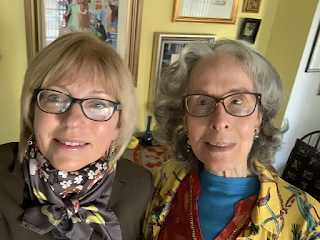
Susan Nash and Rochelle Owens, November 2021

Patterns of Animus Part 4 Carnal / Spiritual takes quotes from Dostoyevsky ("How can you live and have no story to tell?") and the presence of a cosmic-level tapeworm as points of departure; together they posit an alternative mechanism for the functions of the universe. Instead of constantly expanding and growing, Owens introduces the notion of the tapeworm.  It’s interesting to think of the universe dominated by a tapeworm mechanism: parasitically feeding off the energy of its host, and ultimately killing the host (and thus, that part of the cosmos, or perhaps all of it) a postulated end of time, end of the universe. The tapeworm is greedy, eternally hungry, and ultimately grows to enormous size and length in the gut of its host. 

It's not unusual to see an ouroboros in literature, especially Medieval and Renaissance literature, where the snake swallowing its tail causes the snake to metamorphose into another snake with completely different patterns and aspect. The ouroboros had symbolic significance in Ancient Egypt and denoted the transmigration of souls.  For medieval and Renaissance writers who delved into topics of alchemy and mystical practices, the ouroboros represented the transformation of worthless substances into gold. The tapeworm is a kind of anti-ouroboros, capable of sucking in, but instead of entering a sheltering, warm womb, nothing grows, and nothing transforms itself into something else. The tapeworm devours without producing anything except an insatiable hunger. The tapeworm eventually kills the host by completely coopting the digestive system. Anything eaten feeds the tapeworm. Nothing is left over for the pitiful and pitiable host. The image that comes to mind is of a cow in a field, ribs and hipbones protruding, looking like a skeleton draped with hide. The cow is eating grass, chewing, chewing, and chewing, trying to curb her hunger – ultimately a lethal hunger, because the more she eats, the more she feeds the tapeworm. The tapeworm would be a comfortable metaphor for consumer culture, but in Rochelle’s hands, its vaster, horror-inducing, and perfectly sublime (as described by Edmund Burke). 

As an essential cosmological mechanism and unseen presence in the universe, Owens’s construction of the tapeworm opens the mind up to really intriguing (and horrific) ideas and images. First, one might say that the mechanism is appropriate – after all, we have detected the presence of black holes.  What if they are simply mouths of the multiple tapeworms that riddle the universe? They suck up the energy. We have mathematically explained it with models in astrophysics that suggest that stars expand but only to a point, and then they implode. I don’t understand how the extreme gravitational pull is explained by physics. I thought one had to have a tremendous amount of mass in order to have a gravitational pull. Perhaps the mass is there, but is in a long-term process of compression and collapse, and perhaps that is what drags in the nearby “nutrients” (light, moving objects, etc.).  How would that process relate to a tapeworm? A tapeworm has two orifices: the gaping mouth that ushers nutrients into its “filthy maw” (to quote Spenser in The Faerie Queene), and its back orifice, its anus.  Perhaps there are eruptions in the cosmos that correlate to the tapeworm mechanism’s outpourings of waste products. I don’t know. It’s a fascinating, mind-expanding mental exercise to envision it. 

In Owen’s study, next to the computer where she works on her poems, there is a window that provides a view of a corner and a lovely little tree, which Rochelle has observed with concern and outpourings of well wishes for its health.  She also has a Merck’s manual which contains a lengthy entry on tapeworms. 

There is an essential horror in the concept of a massive cosmic tapeworm. It makes the Dune sandworms look like Silly String. Intrusive thought -  Do you remember Silly String?  I don’t know if it is still being manufactured – it was something you would spray from a can, and it would come out as thin strings of plastic.  I’m not sure what the entertainment value really was, but I remember being in a Silly String war. It was fun to spray over plants as a kind of decoration. It was probably toxic and highly flammable.  I am just guessing, though. 

I can imagine Owens’s cosmic tapeworm as a fundamental, thumpingly insistent expression of a rap song, with its dark chord progressions and even darker lyrics. The yawning, filthy mouth, the devourer of its host is actually a pretty good metaphor for the dark songs of classic 1990s group Tool as well. I don’t know what that genre of rock is called, but it definitely fills one with existential gloom, and at times, horror. 


Still Life: Rochelle Owens

A brilliantly clear day in Philadelphia

Susan Smith Nash
Susan Smith Nash, photo by Rochelle Owens


Wednesday, June 16, 2021

Thoughts on Rochelle Owens: Patterns of Animus, Part 3, The Ludwig Skulls

Rochelle Owens's latest work, Part 3: The Ludwig Skulls, is a part of a larger work, Patterns of Animus, which has been published online in Poems and Poetics edited by Jerome Rothenberg, and Jacket. The overall work, Patterns of Animus, can be said to constitute a neural network of patterns related to the creative process, which is also a practice of intentional destruction on signifiers and the meaning-making mechanisms in all their manifestations. In "Part 3, The Ludwig Skulls," the incantation-like repetitions and the horror that the Patterns of Animus images evoke suddenly takes a dark turn into deep sadness, loss, and a sense of shock on contemplating what happens after death. She focuses on the skulls of Ludwig von Beethoven and Ludwig Wittgenstein, pulling them together as revolutionary geniuses, the first whose skull was studied after his death in order to posit a connection between nature (the skull you were born with) and genius.

Male Skull, Male Genius

Owens's primary emphasis is on the deep questioning of society’s tendency to place male genius on a pedestal and then make the criterion of excellence something that only highly charismatic and hyperbolically dramatic males can achieve.

The act of disarticulating a skeleton in order to study the skull is a metonymy for fragmentation. In this case it is a systematic dismantling that gives rise to the existence of multiple meanings, multiple interpretations. The process constitutes a persistent and grotesque “memento mori,” and, like the memento mori of Renaissance art, it serves as a reminder of death that is supposed to make one’s appreciation of life the most keen. Nevertheless, such a memento mori also posits a kind of living horror, a waking nightmare of life in which the haunting presence of death is inescapable and even joy can only be maximized by smashing it together with death.

It’s very much a Renaissance motif, which one sees not only in paintings but also in poetry and drama. “Alas, poor Yorick” is perhaps the most famous reference, when Hamlet gazes onto the skull of the famous actor, Yorick, whose reputation has faded, and all that is left is the skull.   The idea is expressed in the line from “The Ludwig Skulls” --“only death gives life meaning.”

Technologies of Revelation

When a body is dissected, it is taken apart to explore and uncover what lies hidden. In "The Ludwig Skulls," there is more than method used in this process of revealing patterns and other phenomena. Owens explores the technologies of revelation; namely cameras, projection, and light. She repeats the following passage:

      Camera zooming and panning

      projection screen

      solar light slashes (“Patterns of Animus” part 3)

(https://jacket2.org/commentary/rochelle-owens-2)

The juxtapositions of the frantic camera, the fragmentation of language via letters (as Wittgenstein broke apart language to expose the ultimate futility of using it to convey universal meaning), with the routine support work of a lab tech, and the energizing qualities of hot, black coffee, combine to shred and break apart the elitist carapace of knowledge and culture.

The process of disaggregation is more important to the process of revelation than one might think. The disarticulation of a skeleton is clearly a dismantling of the bodies (of authority, of knowledge) of the past. As one contemplates the fragmentations, one might think of Marinetti’s Futurist Manifesto from 1909. However, Marinetti was in large part simply reacting against aristocratic or bourgeois sensibilities. Owens, however, introduces a subversive humor. The memento mori of a Ludwigian skull  a response to the continued lionizing of the “great male skulls” that make it impossible to break free from old paradigms because both the beliefs and the countering subversions are held in the skulls of the Ludwigs, who represent dead, white European males and the mainstream European intellectual tradition.

The central irony that a deaf man can write some of the world’s most stirring music has been a paradox that haunts people who learn the history of Beethoven’s life. They do not realize what an iconoclast he was, and they forget the context of Romanticism and some of its most important terms: the ineffable and the sublime to express almost mystical or transcendental awareness.  He embraced revolution in the sense that it disrupted the order, and in the chaos seethed a cauldron of potential.

Wittgenstein writes about the ultimate impossibility of language to communicate meaning. How different is what Wittgenstein saying about language than what Beethoven did with music?  The musical notes he cannot hear are the words that float around, unmoored from their meanings.

Skulls and Puzzle Bones

Owens suggests that to truly create a work that breaks free from the strictures of dominant culture paradigms, it is necessary to identify the underpinnings (the “skulls”) and to interject light, nature, and natural processes (life as well as rot) and then to reconfigure both language (“cursing / howling / screaming”) and the essential order (the “puzzle bones”), and then to juxtapose decay with the vital fluids of life (spit, blood, gore).

As pointed out before, Wittgenstein stated, among other things, that language has a certain irreducibility, and that it is not capable of expressing the ineffable (“about which we cannot speak we must consign to silence”), or if it is, it is only by creating language that is the equivalent of silence, a kind of white noise of random juxtapositions.

Owens contends that to overcome the embedded patriarchy and hegemonic strictures of language, one must move to the visual (the “camera zooming and panning”) that triggers the parts of the brain that can admit new patterns and are not trapped in the pattern-recognition / meaning construction of language or music built within “old skulls.”

When construction and subversion (or deconstruction) are all constructed of the same materials and when the builders and the subversives are of the same group, there is no subversion at all. All that happens is a transfer of power, and the King accedes to a cousin, the Duke. In the end, the bastions of power are reinforced. The ten percent become the one percent. All they have done is create a smaller, and tighter elite by keeping the masses busy by going to war with themselves.

In the end, it is the essence of the human body itself that offers a pathway to illumination and the production of the kind of art that exposes the mysteries of life itself.

---Susan Smith Nash, Ph.D.

    Norman, Oklahoma


Blog Archive