Showing posts with label experimental poetics. Show all posts

Thursday, March 31, 2022

The Irreducible Uncertainty of Poetics in Hedge Fund Certainty: Thomas Fink

Thomas Fink. Hedge Fund Certainty. Meritage Press and I.E. Press. 2019.  ISBN: 978-1-934299-14-2


The beauty of poetics is its irreducible uncertainty.  The meanings are unmoored, allowing the reader to do what she / he would like. They can attempt to lash meanings to a limited number of options which may prove satisfying for some (especially those who consider the interpretive enterprise as a kind of exegesis). 


However, the real joy of discovery engaging in a sense of play.  The process involves observing the words, the structure, the syntax, and arrangement on the page and then embracing all the possibilities as they come to mind. 


A hedge fund is probably as far from certainty as one could imagine, so Fink’s play on the idea of certainty gives rise to ideas of gaming the system to have a positive outcome. The collection begins with “Yinglish Strophes.” All are in English, but with Yiddish syntax and arrangement, line breaks, and subjects that create an intense sense of place and of character. The words trigger a deep sense of nostalgia and loss: .. “Never later / was I back Russia the same once” (Yinglish Strophes 25). 


It is delightful to see the long poem, “Subprime Mortgage Bargain Lot” series. The title alone is amusing, because most readers will see that this has everything to do with rolling the dice and losing, seeing something you thought you possessed, whether it be the meaning of numbers on a page, or your ability to agree on a value with other readers. 


Hedge Fund Certainty evokes Stéphane Mallarmé’s Un coup de dés Jamais n’abolira le hasard (1897). Translated to “A throw of the dice will never abolish hazards (or risk)” Mallarmé created a concrete / visual poetry notable for the aleatory aspects of the word choice, and the open arrangement on the page. 


Likewise “Subprime Mortgage Bargain Lot” is seemingly aleatory, and it gives you the choice to read the words in clusters or straight across the page.  Further, the words break in unusual places and words interject themselves.  The result is a vertiginous race to the bottom of each page. It is a thoroughgoing condemnation of greed and the brutalization of humanity as wholesale wealth redistribution occurs: “Out with / your ragid / daydreaming / that costs / & costs / the hard / working” (from “Subprime Mortgage Bargain Lot 16). 


The collection ends with “Prohibitionism,” which proclaims a message of hope: a telethon for poetry, that would suggestion unity, but the arrangement on the page denotes separation into opposing clusters of words (or camps), although the last line suggests a coming together: “walls / curve  toward  one  another.”  


-- Susan Smith Nash, Ph.D.

susan smith nash, ph.d.


Tuesday, January 11, 2022

The Enduring Value of Linguistic Play: Thomas Fink and Maya Mason's Collaboration: A Pageant for Every Addiction

 It’s a remarkably cold and windy New Year’s Day, and I can’t think of anything I’d rather do than to sit with a small stack of Thomas Fink and Maya Mason’s playful and intelligent poems and let them take my mind wherever it wants to go.

I love the way their poems are an invitation to a dance: they spur a conversation with the future, the past, and the present.  I enjoy seeing how the anxieties of antecedents play out: one visual allusion leads to another, one set of topics and tropes leads to thinking of other authors, and so on. 

Sometimes this approach leads to specious connections and I wonder which corners of my mind produced them, which is something akin to finding YouTube has created “My Mix” that contains principally opera from Henry Purcell and Mexican rancheras performed by mariachi bands from the 1950s.  

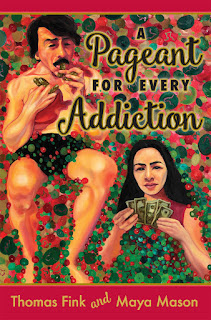
Thomas Fink and Maya Mason. A Pageant for Every Addiction. East Rockaway, NY: Marsh Hawk Press. 2020. 77 pages.  ISBN: 978-0996991209

The cover art is what captivates first: It’s compelling, especially on a cold New Year’s Day when one is obliged to trot out one’s New Year’s Resolutions, even if they constitute little more than cleaning out a closet and ordering vegan protein supplements and Vitamin D on Amazon and “Favoriting” a morale-boosting podcast on YouTube. A man holds elongate objects in his hands (lumpy anise treats?) and a woman holds what appear to be $100 bills between her hands.  Multi-colored dots give the painting an effervescent, playful feel.


The first poem made me smile. “First Date Questions” – I could not even imagine anyone asking me such questions, but if some did, I would immediately pay attention. The questions move from the concrete to ones that are clearly playing with cultural assumptions, asking you to look at things in new ways:

… Don’t

you just hate when you reach the zoo,


and the zebras have been sent

out for cleaning?


I love the whimsy and way they ask one to consider the basis for our underlying mindsets:

I hate to think of

worms eating my

dog’s eyes; is that love?


The questions are a perfect form for a collaboration, and an ideal way to start a collection since they embody a kind of conversation.

Addictions are judgments. They are condemnations of sorts, and impugn the character of the addict, even if the addiction is to something as innocuous as hoarding blank journals. So, it is only fitting to see a poem entitled “You’re Morally Inferior If” and to see that each 4-line stanza contains at least one criterion upon which to judge and condemn a person.  They also made me smile.  Here are a few:


               you keep

               your fingernails long –

               rendering hands useless


or


               …. you


               buy two of the same

               necklace, you’re too

               sentimental to kill

               mere mouse.


As a geologist with a soft spot for paleontology, I was drawn to “Substitute Fossil,” wondering first, how fossils relate to addictions although I can easily envision a Fossil Pageant in the A Pageant for Every Addiction.

Fossils are fairly meaningless unless they are classified; fossils are not only remnants of the past, they are used to time-stamp a layer of the earth (formation), since many fossilized organisms lived in very defined spans of time.  Fossils then, invoke classification systems, and as such, naming and identity.

If you substitute fossils, it’s possible to completely subvert the entire classification system, and suddenly the system will have no connection to a stable time frame, orientation, or even meaning.

That’s exactly what is going on in “Substitute Fossil,” and it’s up to the reader to create a new set of relationships of time, meaning, connection.  If fossils are indicators, they can be both the alphabet and the syntax of meaning. If we substitute, we have the arbitrariness of classification laid bare:

… convict

our glad workhorses into gold


deficits – to

a new alphabet for potpourri to assum

maneaters of grammar castrate

the chairmen of prattle …


The final minimalist long poem, “A Few Promises” makes the reader smile with whimsy, sometimes schadenfreude:

“A staircase for

every stiletto”

“A straightjacket

for

every extrovert”


The verses incorporate professions, physical phenomena, and life forms. They also relate back to the realities of uncertainty, unpredictability, and gambling, including market plunges. They are not only promises to fulfill dreams, but also to solve problems (or even create them – “a shark for every bathtub”). 

In the end, the collection touches the experiences of readers and triggers one’s own “conversation” in a Bakhtinian, carnivalesque manner, while showing ways to restructure assumptions and gently subvert generic expectations.


Blog Archive