Showing posts with label literary criticism. Show all posts

Tuesday, March 14, 2023

Interview with Thomas Fink: Poet, Essayist, Literary Critic, and Abstract Painter

Welcome to an interview with Thomas Fink, whose latest collection of poetry, Zeugma, a fascinating title for a rhetorical term that refers to a single word that links disparate ideas ("she broke his glass sculpture and his heart").  It is a great pleasure to have the chance to learn more about his background and some of the ideas that inform his poetics, criticism, and art.  In addition to his artistic and scholarly work, Fink has supported publishers and writing programs such as the Marsh Hawk Press. 

What is your name and background?

I’m Thomas Fink, a professor of English at City University of New York’s LaGuardia Community College for the past 41 years. I’ve published twelve books of poetry and two books of criticism about contemporary poetry, as well as a recent book on teaching college students to interpret poetry. I “moonlight” as an abstract painter.
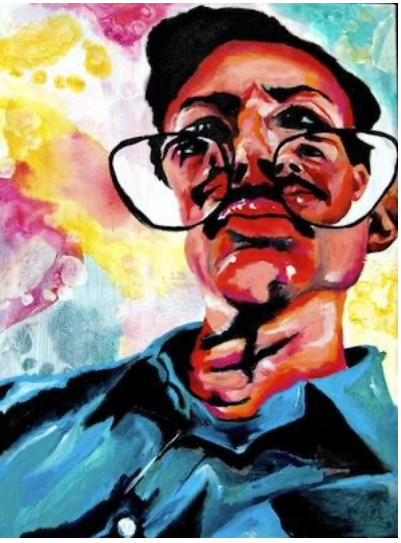
Portrait of Thomas Fink by Maya D. Mason

When did you become interested in experimental or avant-garde poetry?

When I graduated from Princeton University in 1976 and was just about to enter the MA and PhD program at Columbia University, a high school friend gave me John Ashbery’s Self-Portrait in a Convex Mirror as a present. At first, I found the book infuriating, but eventually, it opened me up to a wide range of avant-garde poetry, and I wrote the third doctoral dissertation (after David Shapiro and Donald Revell) on Ashbery’s work. 

What makes a poem experimental or avant-garde... especially in 2023? 

I’ve given up trying to answer that question! For one thing, if I were to try to apply it to my own poetry-writing process, writer’s block would set in and persist indefinitely. The innovative practices and procedures that have been around since World War II or even before are still viable but can hardly be called avant-garde any longer. Some proponents of what is labeled Conceptual poetry perceive their poetics as a replacement for those earlier practices, which they consider exhausted and not worth “repeating.” I don’t agree. Others believe that particular kinds of politicizing of poetry, whether tied to formal choices or not, are the most authentic, useful avant-garde gestures. Sometimes I find that this approach produces poetry that is both intellectually and aesthetically compelling.   

Please tell us a bit about your collection, Zeugma.  What is the main focus?

I didn’t set out to have a single focus in Zeugma. But in her Foreword, Patricia Carlin finds that the title, which implies the yoking together of disparate things, is enacted in the book itself and hence serves as a focus to represent “the fragmented, unstable, and confusing contemporary scene” (9). It would be hard not to view “Bewilderness,” the opening poem, as a reflection on the pandemic, and individual poems surely have references, sometimes oblique and sometimes not, to extremism in the Republican Party. 

Zeugma

I think everyone will recognize the allusion in the title of “November 7, 2020.” A bunch of poems are written in a hybrid form that I came up with called “Sonnina”; it’s a cross between a sonnet and a sestina. Also, there are continuations of long-running series: “Yinglish Strophes,” which uses an approximation (and often an exaggeration) of Yiddish-inflected English syntax to air topics such as intergenerational differences/connections in a family and perspectives forged by immigration, “Goad,” which actually reflects the theme implied in its title, and “Dusk Bowl Intimacies,” which registers both displacements and quests for individual security. The verse-play, “Who My People Are,” may also reflect some concerns of the three series I’ve mentioned. 


Thursday, March 31, 2022

The Irreducible Uncertainty of Poetics in Hedge Fund Certainty: Thomas Fink

Thomas Fink. Hedge Fund Certainty. Meritage Press and I.E. Press. 2019.  ISBN: 978-1-934299-14-2


The beauty of poetics is its irreducible uncertainty.  The meanings are unmoored, allowing the reader to do what she / he would like. They can attempt to lash meanings to a limited number of options which may prove satisfying for some (especially those who consider the interpretive enterprise as a kind of exegesis). 


However, the real joy of discovery engaging in a sense of play.  The process involves observing the words, the structure, the syntax, and arrangement on the page and then embracing all the possibilities as they come to mind. 


A hedge fund is probably as far from certainty as one could imagine, so Fink’s play on the idea of certainty gives rise to ideas of gaming the system to have a positive outcome. The collection begins with “Yinglish Strophes.” All are in English, but with Yiddish syntax and arrangement, line breaks, and subjects that create an intense sense of place and of character. The words trigger a deep sense of nostalgia and loss: .. “Never later / was I back Russia the same once” (Yinglish Strophes 25). 


It is delightful to see the long poem, “Subprime Mortgage Bargain Lot” series. The title alone is amusing, because most readers will see that this has everything to do with rolling the dice and losing, seeing something you thought you possessed, whether it be the meaning of numbers on a page, or your ability to agree on a value with other readers. 


Hedge Fund Certainty evokes Stéphane Mallarmé’s Un coup de dés Jamais n’abolira le hasard (1897). Translated to “A throw of the dice will never abolish hazards (or risk)” Mallarmé created a concrete / visual poetry notable for the aleatory aspects of the word choice, and the open arrangement on the page. 


Likewise “Subprime Mortgage Bargain Lot” is seemingly aleatory, and it gives you the choice to read the words in clusters or straight across the page.  Further, the words break in unusual places and words interject themselves.  The result is a vertiginous race to the bottom of each page. It is a thoroughgoing condemnation of greed and the brutalization of humanity as wholesale wealth redistribution occurs: “Out with / your ragid / daydreaming / that costs / & costs / the hard / working” (from “Subprime Mortgage Bargain Lot 16). 


The collection ends with “Prohibitionism,” which proclaims a message of hope: a telethon for poetry, that would suggestion unity, but the arrangement on the page denotes separation into opposing clusters of words (or camps), although the last line suggests a coming together: “walls / curve  toward  one  another.”  


-- Susan Smith Nash, Ph.D.

susan smith nash, ph.d.


Friday, August 28, 2020

Language and Ironic Imagery in Zora Neale Hurston's "Sweat"

I’ve been re-reading some of the short stories by Zora Neale Hurston. I like “Sweat” – it’s basically a “twist of fate” kind of “poetic justice” story that takes place in the 1920s in a historically all-Black town in Florida, probably modeled after Eatonville, Hurston’s hometown, which was founded by 27 individuals on August 15, 1887 (Florida History Network, n.d.). 

Delia, a hard-working black woman has worn herself out running a laundry business to support her husband, Sykes (who is often called "Syke" in conversation). He, in the meantime, grows increasingly indifferent to her as she has lost her looks due to all her hard work over the years.  He uses her appearance as an excuse to take up with Bertha, a woman who is new to town.  Bertha is heavy, and just what Sykes likes: “Ah sho’ ‘bominates uh skinny ‘oman. Lawdy, you sho’ is got one portly shape on you! You kin git anything you wants,” (Hurston, 2013, https://biblioklept.org/2013/01/21/sweat-zora-neale-hurston/). Unappreciated, and openly humiliated, Delia still tries to make amends with Sykes, but to no avail.  

Hurston was a Columbia University-trained anthropologist, who documented the language, lives, and customs of individuals and communities. She studied the people in the all-Black communities of Florida, interviewed a former slave who was on the last voyage of a slave ship to the U.S., and studied Voodoo (Voudoun) in Haiti.  Consequently, her short stories display a genius for language and characteristic cultural customs.

As for literary devices, in “Sweat,” Hurston creates visual echoes that have the potential to generate a multiplicity of interpretations.  For example, the bullwhip that Syke uses, and which startles Delia has a snake-like appearance.  Later, Sykes encounters a rattlesnake roughly the same size as the bullwhip. He decides to keep it, despite Delia’s pleas to kill it because it is dangerous and it terrifies her.  Sykes even has the temerity to tell her that he  likes the rattlesnake more than he likes her. 


“Naw, now Syke, don’t keep dat thing ‘roun’ heah tuh skeer me tuh death. You knows Ah’m even feared uh earth worms. Thass de biggest snake Ah evah did see. Kill ‘im Syke, please.”

“Doan ast me tuh do nothin’ fuh yuh. Goin’ roun’ trying’ tuh be so damn asterperious. Naw, Ah aint gonna kill it. Ah think uh damn sight mo’ uh him dan you! Dat’s a nice snake an’ anybody doan lak ‘im kin jes’ hit de grit. (Hurston, 2013, https://biblioklept.org/2013/01/21/sweat-zora-neale-hurston/)"


From a Freudian literary critical perspective, Hurston's use of the bullwhip and the snake are fairly obvious symbols of a male phallus and are used to represent male oppression of women. Specifically, they represent Sykes's domination of Delia, and a situation in which Delia willingly subjugates herself, since she will not leave Syke, even when she has to defend herself with a skillet.


In her analysis of "Sweat," literary critic Catherine Carter points out the way that snake is used as a symbol connecting the drama of Delia and Sykes to Biblical narratives, particularly those in the book of Genesis and the Garden of Eden (Carter, 2014).

Shortly after making the statement, the rattlesnake escapes the laundry basket and bites Sykes in the neck, killing him. In the end, the instrument of his own cruelty kills him.  Hurston makes that ironic parallel very clear.

What may not be quite as apparent is the connection that Hurston is making to slavery and the internalization of the relatively recent experiences of slavery and the consequent enslaved mindset.  The bullwhip is an image that evokes the idea of a slave owner’s or an overseer’s bullwhip. The slave owner, who was legally allowed to whip the men and women trapped in slavery, was also legally allowed to consort with any female who caught his fancy, and to openly mock and deprecate other women, including the mother of his children.

It is useful to keep in mind that Delia first mistook the bullwhip for a snake. Later, the rattlesnake, roughly the size of the snake, kills Sykes. However, given the visual analogue, one could also suggest that a poetic justice would also be served if the slave owners and overseers where killed by the instruments of their own torture.

Most writers who analyze "Sweat" focus on gender roles, the oppression of women, and women finally talking back. Those themes are certainly in "Sweat." However, Zora Neale Hurston's "Sweat" is also an anthropological look at echoes of slavery's implements of torture, and the internalization of slavery's various mindsets, which range from submission, sadism, and liberation. 


Works Cited

Carter, Catherine. “The God in the Snake, the Devil in the Phallus: Biblical Revision and Radical Conservatism in Hurston’s ‘Sweat.’” Mississippi Quarterly: The Journal of Southern Cultures, vol. 67, no. 4, 2014, pp. 605–620. EBSCOhost, search.ebscohost.com/login.aspx?direct=true&db=mzh&AN=2017381029&site=ehost-live


Hurston, Zora Neale.  “Sweat” Biblioklept. 2013. https://biblioklept.org/2013/01/21/sweat-zora-neale-hurston/


The Florida History Network. "August 15, 1887: Eatonville, Florida becomes one of the first all-black towns in U.S."  The Florida History Network.  n.d. http://www.floridahistorynetwork.com/aug-15-1887---eatonville-becomes-one-of-first-all-black-towns-in-us.html


Susan Smith Nash, Ph.D.


Tuesday, December 31, 2019

Great Beach and Holiday Reading: Sayaka Murata's Convenience Store Woman Is a Fun Read, with Intriguing Philosophical and Socio-Cultural Elements

Podcast: http://zenzebra.net/podcasts/murata-convenience-store-nash.mp3

Convenience Store Woman (Konbini ningen) by Japanese author Sayaka Murata was originally published in 2016.  It’s the story of a rather shy 18-year-old woman, Keiko Furukura, who lands a job at the newly opening Hiiromachi Station Smile Mart, a convenience store in the heart of the business district of Tokyo.  18 years later, Miss Furukura is still working at the same Smile Mart, to the dismay of her sister, Mami, and other family members. They are mystified why Keiko does not want to advance past a part-time job at a convenience store in order to have a real career. Or, at the very least, they think that Keiko should at least be married and try to have a child. They know, but do not understand why, Keiko has never even been on a date.

The Smile Mart is its own clockwork utopia where the needs of customers are anticipated with the help of the day’s weather forecast, special product promotions, the time of year, and other external factors. Similar to the way in which a traveler in Japan’s airports will be greeted by deep bows by the flight crew precisely at the moment of boarding, the Smile Mart follows a set of instructions and guidelines and requires its employees to complete rigorous training. Such details as the type of smile to hold, and the tone of voice to use to cheerfully shout out greetings and sales promotions are included in the training, as well as the specifications regarding the uniform and way to wear one’s hair. The Smile Mart itself is a constantly revolving kaleidoscope of colors, shapes, smells, sounds, lights, and products, all of which create a full and satisfying world for Keiko, who knows her role and how to contribute to maintaining its mechanical perfection.

Susan Smith Nash reading Sayaka Murata's Convenience Store Woman. Great beach reading -- fun, with intriguing philosophical and socio-cultural elements. 
For the strangely affect-less Keiko, whose essential nature is to not have an essence at all, the Smile Mart provides her substance for the emptiness of her identity, and a series of gestures, inflections, and phrases for her inner silence. Over the years, Keiko has changed; she has metamorphosed, not in conjunction with any sort of inner enlightenment but by means of closely observing and mimicking the clothes, behaviors, words, and expressions of those around her. She skillfully selects and blends words so that they give the appearance of spontaneity and authenticity, but her coworkers are not completely convinced, and in fact, keep a bit of distance from her.  They seem to sense that Keiko is literally a construct of the convenience store; not only does she shape her outward manifestation to blend in and play a useful role, she consumes food and water from the Smile Mart, making her literally a creation of the store. 

The Smile Mart is Pygmalion; Keiko its Galatea in this post-industrial world of constant reification processes, of daily restocking and recreation within the microcosm of the Smile Mart. Because Keiko’s actions are self-directed, however, this automaton has achieved self-awareness. Identity and beingness are self-directed constructs. The constant contact with the ever-changing inventories, light, and dynamics of the Smile Mart constitute the kind of “crossover” (or mixing of genes) that one sees in Japanese mecha (robot) anime.  Keiko seems almost to be a the sentient parallel of a mecha / robot.


While Keiko is completely content in her world, she does not enjoy the constant badgering of Mami, her sister, to conform to the social norms for women. So, when the very odd 40-something deadbeat Shiraha is hired on as a part-time worker, Keiko is primed to be receptive in a way she was not before. At first, she finds Shiraha to be utterly repugnant for his slacker attitude and constant ridiculing of employees for being slaves to the system. Shiraha is ultimately fired because his reason for applying for work at the Smile Mart – to catch a wife – resulted in his stalking and harassing female customers.

And, it is at this point that the book takes a very bizarre turn. Keiko stumbles upon the fact that Shiraha is homeless; hopelessly behind in the rent and unwelcome at his family’s home. Instead of turning away, she invites Shiraha to go home and co-occupy her apartment.  Shiraha rather unkindly comments that he could never be attracted to her, to which Keiko expresses relief.  She considered Shiraha a useful pet; she feeds him, and in turn, he protects her from social criticism.

This made me think of Natsume Soseki’s I Am a Cat (1905), in which the cat speaks in aristocratic tones, making itself superior to humans.  I would be curious to know if Murata uses the same sort of high-register, formal diction for Shiraha.

Murata’s ironies are delightful.  Instead of being concerned for the actual welfare of the individuals, Keiko’s co-workers and family members are delighted that she is, at least, following social norms, even if her husband is a deadbeat and she is forced to work doubly hard to support him. Shiraha cheerfully and openly explains his goal is to be a parasite, and as such, he will do Keiko a favor by causing her to elicit pity and compassion.

Convenience Store Woman becomes at this point a rather powerful commentary on the role of women in society, and the ultimate lack of self-determination. Shiraha begins to guide Keiko in his own self-serving (and societally condoned) direction, grooming her to take a full-time “regular” job so that she can better support him. But, post-industrial society and its perfectly regulated Smile Marts (and other microcosms) are ultimately safer and happier places. When Keiko finds herself in an understaffed Smile Mart, she steps in, in an instant reanimated and energized. Her identity is restored. She is happy.


Some critics have pointed out the rather Gothic elements of Convenience Store Woman. They are there, but it’s definitely not a full-fledged Gothic novel with dark secrets and bizarre spells and/or a cult of personality. In my opinion, the Gothic elements simply have to do with the rather bizarre hold that Shiraha has over Keiko, and his attempts to harness her to go and work to support him.

The richness of the details that author Sayata Murata provides in the convenience store, not only in the arrangement of products and the sales processes, but also in the dynamics between managers and workers, are such a familiar staple of our world that we immediately identify it as the post-industrial community.  In many ways, the Smile Mart and its employees are an extended family, with its members focused on protecting and providing for one’s physical and emotional needs.

On a personal note, I think that Convenience Store Woman should be required reading for all 7-11, OXXO, and QuikTrip employees.  I would love to see the transformation, especially if they follow the protocols and customer care concepts found in Murata's novel :).

--- Susan Smith Nash, Ph.D.


Blog Archive