Showing posts with label visual poetics. Show all posts

Tuesday, March 14, 2023

Interview with Thomas Fink: Poet, Essayist, Literary Critic, and Abstract Painter

Welcome to an interview with Thomas Fink, whose latest collection of poetry, Zeugma, a fascinating title for a rhetorical term that refers to a single word that links disparate ideas ("she broke his glass sculpture and his heart").  It is a great pleasure to have the chance to learn more about his background and some of the ideas that inform his poetics, criticism, and art.  In addition to his artistic and scholarly work, Fink has supported publishers and writing programs such as the Marsh Hawk Press

What is your name and background?

I’m Thomas Fink, a professor of English at City University of New York’s LaGuardia Community College for the past 41 years. I’ve published twelve books of poetry and two books of criticism about contemporary poetry, as well as a recent book on teaching college students to interpret poetry. I “moonlight” as an abstract painter.
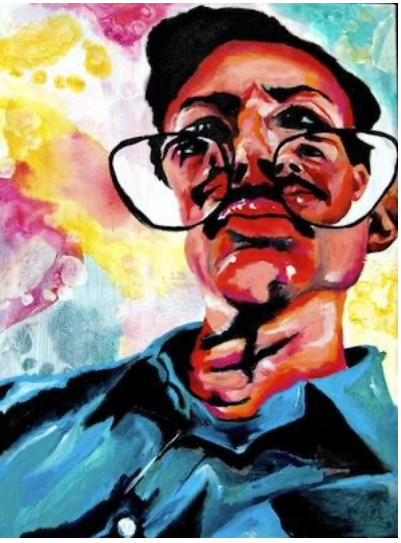
Portrait of Thomas Fink by Maya D. Mason

When did you become interested in experimental or avant-garde poetry?

When I graduated from Princeton University in 1976 and was just about to enter the MA and PhD program at Columbia University, a high school friend gave me John Ashbery’s Self-Portrait in a Convex Mirror as a present. At first, I found the book infuriating, but eventually, it opened me up to a wide range of avant-garde poetry, and I wrote the third doctoral dissertation (after David Shapiro and Donald Revell) on Ashbery’s work. 

What makes a poem experimental or avant-garde... especially in 2023? 

I’ve given up trying to answer that question! For one thing, if I were to try to apply it to my own poetry-writing process, writer’s block would set in and persist indefinitely. The innovative practices and procedures that have been around since World War II or even before are still viable but can hardly be called avant-garde any longer. Some proponents of what is labeled Conceptual poetry perceive their poetics as a replacement for those earlier practices, which they consider exhausted and not worth “repeating.” I don’t agree. Others believe that particular kinds of politicizing of poetry, whether tied to formal choices or not, are the most authentic, useful avant-garde gestures. Sometimes I find that this approach produces poetry that is both intellectually and aesthetically compelling.   

Please tell us a bit about your collection, Zeugma.  What is the main focus?

I didn’t set out to have a single focus in Zeugma. But in her Foreword, Patricia Carlin finds that the title, which implies the yoking together of disparate things, is enacted in the book itself and hence serves as a focus to represent “the fragmented, unstable, and confusing contemporary scene” (9). It would be hard not to view “Bewilderness,” the opening poem, as a reflection on the pandemic, and individual poems surely have references, sometimes oblique and sometimes not, to extremism in the Republican Party. 

Zeugma

I think everyone will recognize the allusion in the title of “November 7, 2020.” A bunch of poems are written in a hybrid form that I came up with called “Sonnina”; it’s a cross between a sonnet and a sestina. Also, there are continuations of long-running series: “Yinglish Strophes,” which uses an approximation (and often an exaggeration) of Yiddish-inflected English syntax to air topics such as intergenerational differences/connections in a family and perspectives forged by immigration, “Goad,” which actually reflects the theme implied in its title, and “Dusk Bowl Intimacies,” which registers both displacements and quests for individual security. The verse-play, “Who My People Are,” may also reflect some concerns of the three series I’ve mentioned. 


Monday, April 11, 2022

A Visual Poetics Coup de Dés of Meaning: Thomas Fink's Selected Poems

 Thomas Fink.  Selected Poems and Poetic Series. East Rockaway, NY: Marsh Hawk Press. 2016. 244 pages. ISBN: 978-0-9964275-0-0


This stunning collection includes examples from some of Thomas Fink’s most innovative and subversive work.  His work subverts the subversive, thinking specifically of all the concrete poetics that followed Malarmé’s Un coup de dés jamais n’abolira le hazard (1897) that has been used as the foundation for so many visual poets, including John Cage, John M. Bennett, Jesse Glass, Dick Higgins, F. A. Nettlebeck, Rochelle Owens, and Armand Schwermer, just to mention a few.  The visual poets subvert reading and meaning-making practices by add the aleatory, while Fink systematizes the strategies for generating meaning from a visual poem, particularly in his series that use the same form. 


For example, subversion of the subversive occurs in “Jigsaw Hubbub” where a Figure 8 / vertical Infinity sign is used several poems. The reader automatically resystematizes his / her method of approaching the poems, and looks for similarities and differences.  The same can be said for the “Goad” series where the upside down Greek letter Omega suggests the end of meaning (a common conceit in the twentieth century), but the fact that the shape is the same for each of the “Goad” poems instantly imposes at least two types of strategic meaning-making processes: first, comparing the shape of the upside-down Omega in each for raw semiotic meaning, and second, in the words themselves and the meanings forged by reading from right to left, descending from line to line. 


The collection of work is particularly fascinating because it is arranged chronologically and we can see a timeline of textural and thematic innovation. The collection begins with 1993’s Surprise Visit. The poems serve as an antidote to the then-ubiquitous L=A=N=G=U=A=G=E poetry, and are intertextual in the sense that they evoke and import an entire body of exogenous work. Perhaps the most delightful example is “Louise Bourgeois” which one cannot read without thinking of her big daddy longlegs spider sculptures, her bold prolificity, and the workshop where basically everything was cubed, drilled, formed into serviceable art (which is to say that it beckons itself to be in the service of EveryPerson).


Excerpts from Gossip (2001) reflect the giddy sense of having dodged apocalypse, until, of course, apocalypse showed itself to be a narrative characterized by its innate multiplicity.  Such inescapability from deterministic narratives is reflected even as natural phenomena are considered to be random, are likewise subjugated to narrative, as in “Reprise”


like a refugee

and every time you kiss me it’s like 


another little piece of my

lightning striking again … (p. 13)


After Taxes (2004) incorporates poetics of unparalleled sweetness, with a palpable desire for meaningful connections that flow through dreams, memories, and the actual experience, past or anticipated. “In Memoriam” is either a letter from a grandfather to a grandchild, or from a grandchild to a grandfather, or simply from / to childhood to later life, a homage to the ability of language and letters to forge enduring bonds and to affirm life. 


Dusk Bowl Intimacies stretch from 2011 to 2015. Each has more or less the same formal structure: A block prose poem followed by a minimalist verse, three to eight lines in length. The voice is the persona of an older woman, possibly a grandmother. She is an inquisitive spirit who investigates the underlying assumptions in the ways that language embodies everyday life, and then closes with lines that assert a personal commitment or an exhortation. 


“Home Cooked Diamond” and “Jigsaw Hubbub” are visual poems. As mentioned earlier, “Jigsaw Hubbub” toys with infinity, and subverts the popular notion widely espoused in the twentieth century that a visual poetics liberated language, thus unleashing an infinite number of potential meanings, and thus finding a way to define infinity.  “Jigsaw Hubbub” puts a playful stop to that, while “Home Cooked Diamond” has enough variation in the shape and textual arrangement on the page to look like shadows from a tree as the day progresses, looking “slant” and also into a mirror. 


“Home Cooked Diamond” has the feel of a memoir and an awkward road trip with  parents whose flaws are all too obvious to the children, which makes the telling all the more uncomfortable. The struggle one has to read parallels the emotional struggle in the author’s voice. It’s strangely emotionally compelling. 


--- Susan Smith Nash, Ph.D. 


susan smith nash, ph.d.

Blog Archive