Showing posts with label concrete poetry. Show all posts

Tuesday, March 14, 2023

Interview with Thomas Fink: Poet, Essayist, Literary Critic, and Abstract Painter

Welcome to an interview with Thomas Fink, whose latest collection of poetry, Zeugma, a fascinating title for a rhetorical term that refers to a single word that links disparate ideas ("she broke his glass sculpture and his heart").  It is a great pleasure to have the chance to learn more about his background and some of the ideas that inform his poetics, criticism, and art.  In addition to his artistic and scholarly work, Fink has supported publishers and writing programs such as the Marsh Hawk Press

What is your name and background?

I’m Thomas Fink, a professor of English at City University of New York’s LaGuardia Community College for the past 41 years. I’ve published twelve books of poetry and two books of criticism about contemporary poetry, as well as a recent book on teaching college students to interpret poetry. I “moonlight” as an abstract painter.
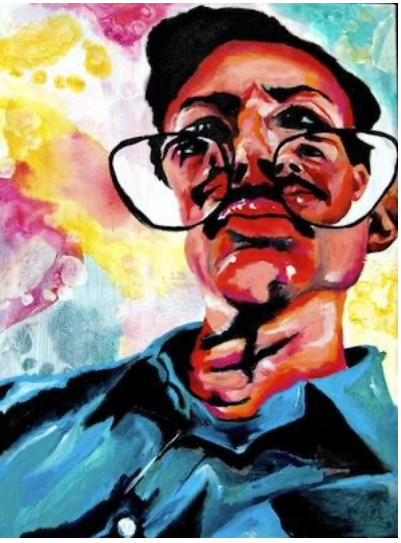
Portrait of Thomas Fink by Maya D. Mason

When did you become interested in experimental or avant-garde poetry?

When I graduated from Princeton University in 1976 and was just about to enter the MA and PhD program at Columbia University, a high school friend gave me John Ashbery’s Self-Portrait in a Convex Mirror as a present. At first, I found the book infuriating, but eventually, it opened me up to a wide range of avant-garde poetry, and I wrote the third doctoral dissertation (after David Shapiro and Donald Revell) on Ashbery’s work. 

What makes a poem experimental or avant-garde... especially in 2023? 

I’ve given up trying to answer that question! For one thing, if I were to try to apply it to my own poetry-writing process, writer’s block would set in and persist indefinitely. The innovative practices and procedures that have been around since World War II or even before are still viable but can hardly be called avant-garde any longer. Some proponents of what is labeled Conceptual poetry perceive their poetics as a replacement for those earlier practices, which they consider exhausted and not worth “repeating.” I don’t agree. Others believe that particular kinds of politicizing of poetry, whether tied to formal choices or not, are the most authentic, useful avant-garde gestures. Sometimes I find that this approach produces poetry that is both intellectually and aesthetically compelling.   

Please tell us a bit about your collection, Zeugma.  What is the main focus?

I didn’t set out to have a single focus in Zeugma. But in her Foreword, Patricia Carlin finds that the title, which implies the yoking together of disparate things, is enacted in the book itself and hence serves as a focus to represent “the fragmented, unstable, and confusing contemporary scene” (9). It would be hard not to view “Bewilderness,” the opening poem, as a reflection on the pandemic, and individual poems surely have references, sometimes oblique and sometimes not, to extremism in the Republican Party. 

Zeugma

I think everyone will recognize the allusion in the title of “November 7, 2020.” A bunch of poems are written in a hybrid form that I came up with called “Sonnina”; it’s a cross between a sonnet and a sestina. Also, there are continuations of long-running series: “Yinglish Strophes,” which uses an approximation (and often an exaggeration) of Yiddish-inflected English syntax to air topics such as intergenerational differences/connections in a family and perspectives forged by immigration, “Goad,” which actually reflects the theme implied in its title, and “Dusk Bowl Intimacies,” which registers both displacements and quests for individual security. The verse-play, “Who My People Are,” may also reflect some concerns of the three series I’ve mentioned. 


Tuesday, January 11, 2022

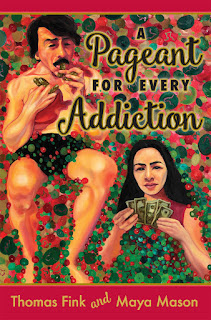
The Enduring Value of Linguistic Play: Thomas Fink and Maya Mason's Collaboration: A Pageant for Every Addiction

 It’s a remarkably cold and windy New Year’s Day, and I can’t think of anything I’d rather do than to sit with a small stack of Thomas Fink and Maya Mason’s playful and intelligent poems and let them take my mind wherever it wants to go.

I love the way their poems are an invitation to a dance: they spur a conversation with the future, the past, and the present.  I enjoy seeing how the anxieties of antecedents play out: one visual allusion leads to another, one set of topics and tropes leads to thinking of other authors, and so on. 

Sometimes this approach leads to specious connections and I wonder which corners of my mind produced them, which is something akin to finding YouTube has created “My Mix” that contains principally opera from Henry Purcell and Mexican rancheras performed by mariachi bands from the 1950s.  

Thomas Fink and Maya Mason. A Pageant for Every Addiction. East Rockaway, NY: Marsh Hawk Press. 2020. 77 pages.  ISBN: 978-0996991209

The cover art is what captivates first: It’s compelling, especially on a cold New Year’s Day when one is obliged to trot out one’s New Year’s Resolutions, even if they constitute little more than cleaning out a closet and ordering vegan protein supplements and Vitamin D on Amazon and “Favoriting” a morale-boosting podcast on YouTube. A man holds elongate objects in his hands (lumpy anise treats?) and a woman holds what appear to be $100 bills between her hands.  Multi-colored dots give the painting an effervescent, playful feel.


The first poem made me smile. “First Date Questions” – I could not even imagine anyone asking me such questions, but if some did, I would immediately pay attention. The questions move from the concrete to ones that are clearly playing with cultural assumptions, asking you to look at things in new ways:

… Don’t

you just hate when you reach the zoo,


and the zebras have been sent

out for cleaning?


I love the whimsy and way they ask one to consider the basis for our underlying mindsets:

I hate to think of

worms eating my

dog’s eyes; is that love?


The questions are a perfect form for a collaboration, and an ideal way to start a collection since they embody a kind of conversation.

Addictions are judgments. They are condemnations of sorts, and impugn the character of the addict, even if the addiction is to something as innocuous as hoarding blank journals. So, it is only fitting to see a poem entitled “You’re Morally Inferior If” and to see that each 4-line stanza contains at least one criterion upon which to judge and condemn a person.  They also made me smile.  Here are a few:


               you keep

               your fingernails long –

               rendering hands useless


or


               …. you


               buy two of the same

               necklace, you’re too

               sentimental to kill

               mere mouse.


As a geologist with a soft spot for paleontology, I was drawn to “Substitute Fossil,” wondering first, how fossils relate to addictions although I can easily envision a Fossil Pageant in the A Pageant for Every Addiction.

Fossils are fairly meaningless unless they are classified; fossils are not only remnants of the past, they are used to time-stamp a layer of the earth (formation), since many fossilized organisms lived in very defined spans of time.  Fossils then, invoke classification systems, and as such, naming and identity.

If you substitute fossils, it’s possible to completely subvert the entire classification system, and suddenly the system will have no connection to a stable time frame, orientation, or even meaning.

That’s exactly what is going on in “Substitute Fossil,” and it’s up to the reader to create a new set of relationships of time, meaning, connection.  If fossils are indicators, they can be both the alphabet and the syntax of meaning. If we substitute, we have the arbitrariness of classification laid bare:

… convict

our glad workhorses into gold


deficits – to

a new alphabet for potpourri to assum

maneaters of grammar castrate

the chairmen of prattle …


The final minimalist long poem, “A Few Promises” makes the reader smile with whimsy, sometimes schadenfreude:

“A staircase for

every stiletto”

“A straightjacket

for

every extrovert”


The verses incorporate professions, physical phenomena, and life forms. They also relate back to the realities of uncertainty, unpredictability, and gambling, including market plunges. They are not only promises to fulfill dreams, but also to solve problems (or even create them – “a shark for every bathtub”). 

In the end, the collection touches the experiences of readers and triggers one’s own “conversation” in a Bakhtinian, carnivalesque manner, while showing ways to restructure assumptions and gently subvert generic expectations.


Blog Archive