Friday, August 02, 2013

Portfolios in Training and Development E-Learning


Portfolios can be extremely effective in training and professional development, and are quite easy to implement in asynchronous e-learning, especially when access is limited, and it’s necessary to show the progress of one’s learning or skill-building over time.  Learning management systems such as the open-source Moodle can accommodate both asynchronous and synchronous (“live”) learning and are ideal for both individual and collaborative portfolios.

Portfolios can be used to show individual progress, which can be very motivating because it utilizes cognitive scaffolding and employs a building block approach.

Individual portfolios can also demonstrate how an individual achieves learning objectives, and helps target where performance is optimal, and where it can be improved.
            Process-focus
            Iterative
            Incremental changes / modifications
            Reflective knowledge
            Adaptive
            Evolutionary
            Critical thinking skills

Collaborative portfolios are very effective for the following:
            Sharing ideas
            Knowledge transfer
            Skill building
            Team-building
            Critical thinking skills
            SWOT analyses
            Strategic planning

Simple Solution
In the simplest form, an organization can put together a link to a Sharepoint or Document Exchange portal where individuals can log in and share their files with each other, and then comment.  A simple solution would also be to incorporate Google Drive, and to use Google Docs for portfolios.

LMS Solutions
It’s very easy to utilize elements with typical learning management systems.

Moodle
Moodle offers a wide array of modules and, as it is open source, it offers a number of advantages with respect to adding modules and features. There are a number of low-cost hosting solutions.

Portfolio module. For example, Moodle 2.5  accommodates portfolios in a number of ways. Once the site administrator has enabled portfolios, the user can export a cluster of files into a portfolio that automatically saves into a file archive or Google Docs / GoogleDrive.

Workshop Module. Or, alternatively, you can use the Workshop module to develop spaces where a wide variety of files and activities can be housed and shared.
Forum Module. Another approach could be to use a Forum module to create a discussion board, and allow learners to post their activities that they will then pull together into a portfolio. In a final “display”, the learner can post the documents that constitute the portfolio.

Certificate Module. A nice feature of Moodle is that you can also use the Certificate module to generate a certificate once the portfolio has been completed, and the requirements for successful completion have been satisfied.

For more directions, ideas, check out Moodle for Training and Professional Development just released by Packt Publishing.  

Blackboard
Blackboard offers a number of ways to develop and display portfolios.

Discussion.  The first, and perhaps most inclusive and encouraging of group interaction is the Discussion Board. Keep in mind that Discussion Boards can be open to the entire class, or can consist of subsets and groups within the course.

Collaboration. In addition to having the public display and interaction via the Discussion Board, it’s also possible to set up small collaboration groups using the Collaboration tool.

Journal. In addition, for individual portfolios, the Journals tool can be employed, and a student can create a set of journals. While most people associate Blackboard with higher education elearning, Blackboard has prepackaged solutions for small to medium businesses (under 200 users) and associations. In fact, Blackboard’s ProSites “lite” LMS could be ideal for small-scale use of portfolios for specific association programs.

Desire2Learn (D2L)
Desire2Learn (D2L) has similar capabilities, but one may have to be a bit more creative. For example, it does not have a Portfolio tool, as does Moodle.

Dropbox
However, it’s possible to create a Dropbox that acts as a repository for the different drafts. Because many files can be uploaded to the same Dropbox, it’s easy to manage. The Dropbox can then be associated with Grades (the gradebook).  Rubrics can be associated with Grades, which makes it simple to evaluate different aspects of the portfolio.

Rubrics
In D2L, Rubrics have both Properties and Levels and Criteria. (I’m capitalizing these items because they are categories of tools found in D2L and are accessed through the tab marked “Edit Course.” Of course, Discussions (the discussion board) allows display and peer review of items in the portfolio.  It is easy to set up Groups and Sections for collaborative activities.

*** Free eBooks from E-Learning Queen **


Writing for Human Relations (flowcharts, examples, activities)


Monday, July 15, 2013

MOOCs for Creative Writing: Interview with Lynn Levin

MOOCs for creative writing require innovative instructional strategies, and textbooks that combine prompts, examples, and flowcharts. Certain presses (such as Texture Press) are making innovative textbooks available, in both as a free e-book (Writing for Human Relations), and at low-cost printed format (Poems for the Writing: Prompts for Poets). Welcome to an interview with Lynn Levin, Drexel University, and co-author with Valerie Fox, with Poems for the Writing. 

  
1. What is your name and your relationship to writing and writing instruction?

My name is Lynn Levin, and I teach a variety of English classes at Drexel University and creative writing at the University of Pennsylvania. I am principally a poet and have published four collections of poems, most recently Miss Plastique (Ragged Sky Press, 2013), and a craft-of-poetry textbook, Poems for the Writing: Prompts for Poets, with co-author Valerie Fox (Texture Press, 2013). My previous poetry collections are Fair Creatures of an Hour (Loonfeather Press, 2009), Imaginarium (Loonfeather Press, 2005), and A Few Questions about Paradise (Loonfeather Press, 2000). My poems have appeared in Boulevard, Ploughshares, The Hopkins Review, and other journals. I also write creative nonfiction, fiction, and I am a literary translator of poetry (mostly from Spanish, sometimes from French).

2.  How do you view the process of writing?

I view the process of writing as a series of promising starts which often turn out to be false starts, which are hopefully followed by restarts, some of which gain purchase on the page and eventually lead to a finished poem, essay, or story. When I have a work in progress, I feel most alive...even with all those starts, false starts, and restarts.

3. What are some of the approaches that you have found yield interesting writing?

More than anything, reading the work of others leads to better writing and better thinking. I also believe in capturing random observations and turns of phrase that fly into my mind when I least expect them. Many of those airy notions may trigger poems and stories. It is also true that a majority of these ideas do not retain the charm I first saw in them, but some do blossom. I also stand guilty of failing to revisit many of my numerous jottings.

In another way, I find poetry prompts to be immensely helpful. They nudge me out of my usual ways of building poems. The prompts in Poems for the Writing do that for me, and, I hope, for other poets, too. They help me experiment with new ways of organizing, rearranging, or shopping for thoughts.

4. What do you consider to be “interesting” or “effective” in writing—and why does it matter?

I value the idea of making the familiar seem strange. It goes along with conveying a sense of wonder or marvel at the world. When it comes to making a literary work effective and interesting, I think of strangeness and wonder. But there’s also the human or moral level. A writer has to show compassion to his or her characters. Strangeness isn’t everything.

I have also become more aware of the importance of the beginning of the poem or the first sentences of a prose piece. The beginning establishes a voice that propels the rest of the work.

5. When, how, and why is creative self-expression important in today’s social media world, where almost all voices are likely to be drowned out or simply be a part of the general tsunami of texts, images, and voices?


That’s a great question. It does seem harder and harder for an individual artist of any genre to stand out in the welter.

Creative self-expression is thriving. Now that so many people are blogging, that is, publishing their own journals of opinion, there’s more to read than ever. It’s overwhelming. Twitter, Facebook, and all those other social media sites that I haven’t discovered are part of the same phenomenon. It’s like there are six billion media channels out there. Everyone’s crying, “Read me!” Yes, certainly voices will be drowned out. On the other hand, so many people are writing thoughtful, insightful, and witty pieces. I would never want anyone to quit writing just because of the huge wave of other voices. But then, whom should one read?

This brings up the phenomenon of narrow-casting or friend-casting (as opposed to broadcasting). I hear that audiences are becoming more and more compartmentalized. For example, a lot of people get their news from their Facebook and Twitter feeds, but not from general-interest news sources. That’s worrisome to me on one hand because it decreases one’s exposure to diverse points of view. On another hand, this gives independent opinion writers an appreciative and attentive audience of like-minded readers.

I think this proliferation of voices makes the role of the editor and publisher more important than ever. Someone has to be the arbiter of literary quality.
Someone has to do the hard and heartbreaking work of picking and choosing which voices to promote.

Then there are the loneliness and celebrity factors. People are lonely and they crave attention. Social media serves those needs brilliantly. Hence more voices calling out.

I don’t know how well these ruminations of mine answered your question, but you bring up one of the key issues of our time.

6.  Please describe the book that you wrote with Valerie Fox.

Poems for the Writing: Prompts for Poets (Texture Press, 2013) is a craft-of-writing textbook that presents fourteen classroom- and workshop-tested writing prompts for both beginning and experienced poets. The prompts range from simple concepts, such as the cameo cinquain and the rules poem, to more elaborate intertextual  prompts, such as the fake translation and bibliomancy. The book is very friendly and easy to use, and it is aimed at students (both high school and college), working poets, and teachers of creative writing. The first part of the book comprises the prompts and the second part of the book presents sample poems generated by the prompts. Those sample poems are written by college creative writing students and established poets alike. The incredible selection of sample poems not only proves that the prompts are effective, it shows how widely the prompts can be interpreted.

7.  What is your next step?

Right now, I am writing some short stories and new poems. And I am working my way through a stack of books and magazines I’ve promised myself I’d read. I am determined to read through my numerous notebooks of airy jottings. Maybe I’ll glean some phrases worth making into poems.

Thank you!

Sunday, June 23, 2013

Data Mining: What You Might Not Know

The ultimate goal of data mining is not the acquisition of data, but the exploration and analysis  of massive amounts of data resulting in patterns, rules, and relationships. One of the key outcomes is the identification of reliable and meaningful patterns.

Meaningful patterns can do the following:

* Model typical behaviors
* Identify atypical behaviors
* Express possible cause and effect relationships
* Explain past behaviors
* Describe current conditions
* Develop a predictive model for the future

While developing patterns in data drawn from different types of data can show meaningful  relationships, time-series data mining can be used to postulate

* causality
* life-cycle behaviors
* impacts of proximal or distal relationships
* cluster formation and disaggregation

Characteristics of Data Mining Data

The data may represent changes of behavior and activities over time, or, alternatively, it could  represent the relationship of different types of data which have been collected at one point in  time.

* Same type of data, collected at different points in time
* Different types of data, collected at the same point in time
* Data streams, which involve ordered sequences of items that arrive over time

* offline: regular chunked arrivals
* online: continuous flow

Planning the Data Mining Process

The development of data mining can follow a fairly clear process:

1.  Determine the problem and definition
2.  Determine the characteristics of the data
3.  Develop a plan for data mining
4.  Review of similar data mining projects and algorithms
5.  Become familiar with data, data issues, potentially meaningful data subsets
6.  Data preparation and conditioning
7.  Model and algorithm development
8.  Evaluation of model / comparison with other models
9.  Implementation, which involves generating reports, or continuing to develop ongoing activities


Data Mining: Key Tasks

Key tasks in data mining include the following:

* Identification
* Eliminate unnecessary or distracting frequent item sets
* Definition and differentiation
* Optimize storage and recovery of streams
* Classification
* Cluster recognition
* Segmentation
* Discovery of motifs (sub-sequences)
* Detection of similar clusters or sets
* Detection of outliers and anomalies
* Create predictive models

Data mining that involves continuous streams of data presents unique challenges because of the  nature of the data and types of patterns that are meaningful, given the array of patterns that are  possible to develop. It is also challenging to integrate incoming data with existing databases in  order to qualitatively evaluate patterns in a timely way. It is also challenging to avoid the  "concept drifting" problem, which means that the usefulness and validity of the results will  degrade over time.

In general,

* Sensors and surveillance: networks, physical locations, manufacturing, transportation
* Performance monitoring: manufacturing, networks, controls
* Transaction / activity monitoring: retail, web performance, manufacturing

Algorithms

A literature review of algorithms suggests that data mining for data streams is generally  performed using three different major classifications of algorithms, and that they do not yield  the same results, which could be quite significant, depending on the application.

Landmark Window Based Data Mining

What is measured is the difference between a specific time-stamp (the landmark) and the present.

Pros: Complete comparision with an a priori property
Cons: The order in which information is considered and placed into sets can lead to errors

Damped Window

This approach privileges new data over old or historical data, which means that the older data drops out of  consideration for developing sets

Pros: Efficient use of resources, eliminates old and obsolete information
Cons: Large errors may be made because the information being eliminated may be important for the  rule to be effective

Sliding Window

Sliding favors new data (as in the Damped Window approaches), but does not completely eliminate  old data. Instead, it incorporates summarized versions of old data and data relations.

Pros:  Can incorporate past data and do so relatively quickly
Cons:  The assumptions made to create summaries of old data sets can be flawed

General Observations and Conclusions

At this point in time, the ability to collect data continues to expand and sometimes dramatically,  thanks to technological advances in both hardware and software. However, a review of the processes  and the literature make it clear that the algorithms use to process and make meaning of the data  batchs and streams differ widely. Consequently, the results and conclusions that are created using  data mining techniques (both collecting and in analyzing), can be highly variable. Thus, decisions  made through data mining need to be made carefully, and more than one analytical technique and set  of algorithms should be used.


References

Esling, P., & Agon, C. (2012). Time-Series Data Mining. ACM Computing Surveys, 45(1), 12:1-12:34.

Mala, A. A., & Dhanaseelan, F. (2011). Data Stream Mining Algorithms: A Review of Issues and  Existing Approaches. International Journal On Computer Science & Engineering, 3(7), 2726-2732.

Ramageri, B. M., & Desai, B. L. (2013). Role of data mining in retail sector. International  Journal On Computer Science & Engineering, 5(1), 47-50.


Wednesday, June 19, 2013

Interview with Matt Loper, Moonlyt.com: Innovators in E-Learning Series

One might argue that it's not necessary to have a special platform for online tutoring -- after all, free platforms such as Skype and Facetime are very effective. Further, opensource web conferencing such as Big Blue Button have many of the features (whiteboard, tools, etc.), of an Adobe Connect or Omnovia. However, when it comes to locating vetted tutors and subject matter experts, it's another matter. Moonlyt.com has launched a new platform to integrate the different elements: video chat, scheduling, tutor profile, etc.

Welcome to an interview with Matt Loper, co-founder and CEO of Moonlyt.com.

1.  What is your name and your relation to elearning?
My name is Matt Loper and I am the Co-Founder and CEO of Moonlyt.com.

2.  What do you think are some of the issues that currently concern elearning program developers?
There are a lot of great companies and nonprofit organizations out there trying to completely change the paradigm of traditional education.  Change is definitely necessary as the American educational system is extremely inefficient and expensive.  However, with so much established behavior and infrastructure, there is quite a bit of inertia to completely overhauling the entire system.  Moonlyt seeks to supplement the established system so that students can get the help they need at affordable prices.  Private tutoring is a huge market (some studies show 1 in 4 American high school students have a private tutor) but it is also completely fragmented to local markets.  Moonlyt is a global platform that allows tutors to eliminate geographical constraints by teaching over video chat.  We strive to add accountability to tutoring by allowing students to comparison shop tutors based on user reviews and prices.

Moonlyt.com Home Page


3.  What is Moonlyt and how does it work?
Moonlyt is a social learning and online tutoring platform that allows highly qualified individuals to make money teaching online.  We also allow students and parents to find the very best tutor at the very best prices based on past user reviews.  On Moonlyt, tutors set their own prices and schedules and perform all lessons on our video chat platform.

Teachers / Tutors


4. Please provide two or three examples of how Moonlyt has been used (please share jpeg screen shots as well).
Moonlyt just launched a few months ago but already features a diverse set of tutors including guitar, SAT preparation, mathematics, sciences, foreign languages, cooking lessons, and career advice.  I have personally done several sessions giving career advice to college students looking to get into the financial field or entrepreneurship.

Moonlyt.com session


5. Describe plans for future developments in Moonlyt .
We are working hard to further enhance the interaction between tutors and their students.  We think that the Moonlyt platform allows for online tutoring sessions to be as effective as in-person tutoring.  Our goal is to create tools and analytics that allow Moonlyt tutors to be far more effective than in-person tutors.

6.  What is your philosophy of education in a multi-platform BYOD world?
Technology in the classroom has the ability to greatly enhance students' experience and access to information while allowing teachers to leverage their time and scale their audience.  However, we must remember that technology is a supplement to great teachers, not a substitute.  We will always need great teachers to inspire and motivate students.

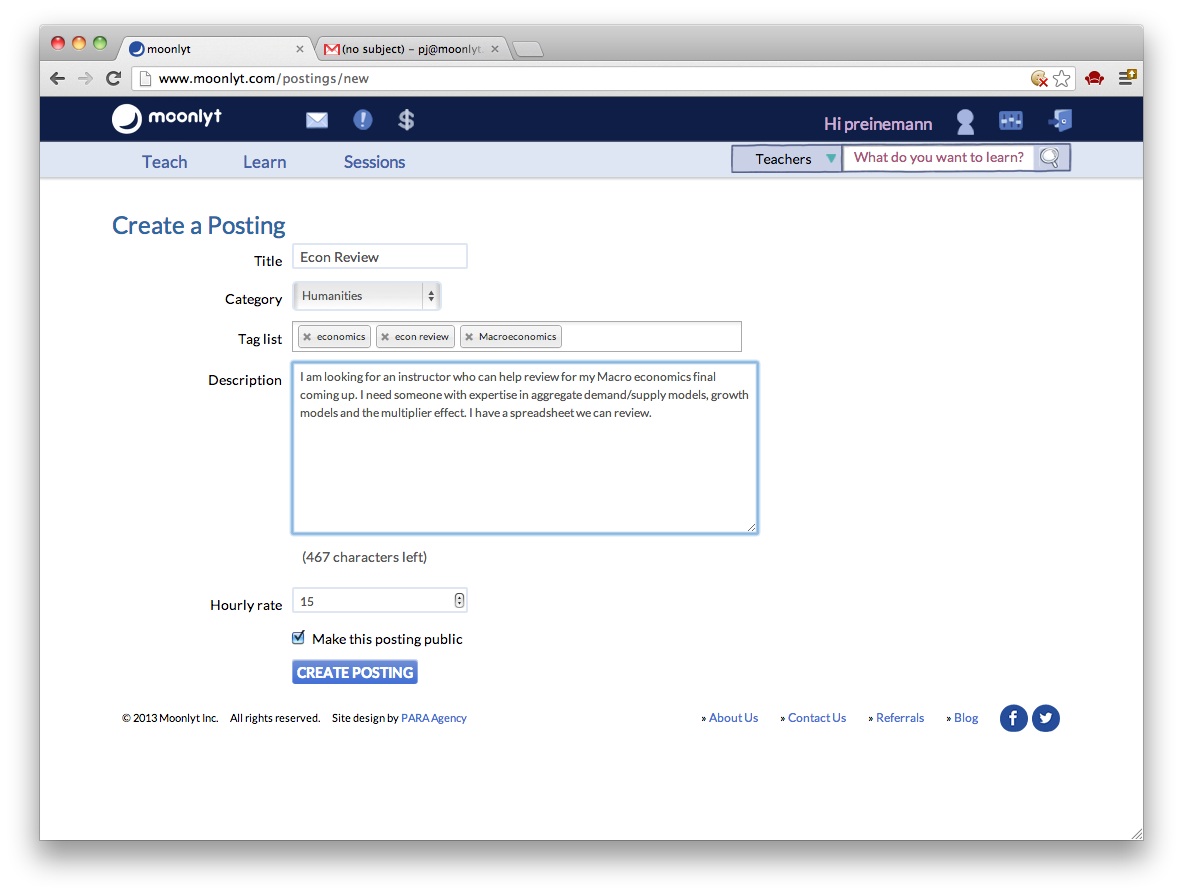
Creating a Posting


7.  What are two or three books that you'd recommend (do not have to be on elearning ;) )
Thinking Fast, Thinking Slow by Daniel Kahneman - This book gave me a deeper understanding of how we think and interact with each other
The Four Hour Chef by Tim Ferris - A book about the most efficient way to learn any new skill disguised as a cooking book.

******
Texture Press: Free E-Books
(full text available free online)

Writing for Human Relations
E-Learner Survival Guide
E-Learning Success: From Courses to Careers
The Glass Book 


Thursday, May 30, 2013

Competency-Based Education: Partnerships Are a Must


Many colleges and universities are moving toward competency-based education, and developing opportunities for students to earn credit based on demonstrated mastery of skills and knowledge areas. This moves far beyond the "credit by exam" model and even portfolio evaluation, to a deeper level of skills and broader subject matter areas. 

Dr. Robert Mendenhall, President of Western Governor's University, describes competency-based education in an article that explains the reasons for its emergence and popularity: What Is Competency-Based Education? (http://www.huffingtonpost.com/dr-robert-mendenhall/competency-based-learning-_b_1855374.html)

Capella, the College for America, and other universities are embarking on competency-based education. Other colleges, such as Excelsior College, have had credit-by-exam programs since the 1970s, and are expanding them. Whatever the form, new approaches are being developed and implemented

In theory, competency-based education could not be more practical. It tests an individual’s ability to apply knowledge, and can assess skill levels. Above all, it’s flexible, affordable, and does not require four or five years of slow-paced education. Further, competency-based education focuses on content that may lie outside a traditional degree program, but which is very useful in the workplace and/or for new technologies.

However, when it comes to highly technical careers that are in high demand, colleges and universities may find themselves unable to develop high-quality courses in a timely manner if they try to build them from the ground up.

To be cost-effective, timely, accurate, and relevant, the following strategies can be developed for competency-based education for high-demand technical education:

--- Up-to-date texts, which may consist of articles, manuals, reports, and software packages

--- Subject matter experts who review the content and assessment strategies

--- Instructors who are experts in the field to review materials, provide assessment services

--- An assessment strategy that privileges projects and synthesis / application of knowledge and skills

--- Partnering with professional associations or societies to take advantage of high-quality articles, peer-reviewed materials, recognized subject matter experts, professional certification.  For example, the demand for geoscientists and engineers is in no way met by traditional geology and engineering programs. The knowledge that is desired by industry is specific and can be provided by associations such as SEG, SPE, and AAPG.

--- Assessment should be coupled with reliable, relevant, and timely internships (which can be virtual) which include tasks that relate to the skills and competencies required by industry, and which are assessed in the program.

Colleges and universities can forge productive partnerships to assure that any competency-based offerings developed are legitimate, high-quality, and can forge relationships with potential employers. The most effective route involves partnering with professional associations that have a solid membership base of knowledgeable experts, and a wide array of corporations and other institutions that can provide graduates with experience and jobs. 

Ideally, the professional associations and societies that colleges and universities partner with are global, to assure the greatest number of opportunities for students, and the widest breadth of knowledge and perspectives. 

At the Great Wall of China, April 2013, after a conference on pre-Ordovician petroleum systems organized by AAPG, with sponsorship by PetroChina and other companies. 

Saturday, April 13, 2013

MOOCs, Mini-MOOCs, and Beyond

It is easier than ever to offer a Massively Open Online Course (MOOC), with platforms such as Coursera, which are designed to handle hundreds of thousands of users, and to export data in a way that can be easily used within the information systems of colleges and universities.  Coursera currently hosts and delivers content for 63 universities, and they content is in Spanish as well as in English. While it is true that the universities could simply host the courses themselves, Coursera is uniquely positioned at this point to deal with the complexities and expense of massive bandwidth.

For colleges and learning organizations that want to use a cloud-based platforms that automates delivery of content and assessment, and contains an e-commerce solution, there are very easy-to-use solutions from  Profprofs, Mindflash, and others software platform providers.

The persistent anxiety surrounding academic integrity has been alleviated by the widely implemented ProctorU remote monitoring / proctoring system.

If 2012 was the "Year of the MOOC," what is 2013?  So far, MOOCs are continuing to be touted as a solution to community colleges' budget problems as certain MOOCs are evaluated and approved for transfer credit. Coursera now offers almost 400 courses, which makes it a convenient "one stop shopping" experience for online courses.

It is easy to lose sight of the fact that Open Courseware has been around since the mid 1990s, and the course outlines, content, and recommended readings have served as the foundation for thousands of courses across thousands of colleges and universities worldwide.

MOOCs are ideal for colleges and universities seeking to showcase their popular professors, and elevate them to celebrity or guru status. It is a natural "upping the ante" of the "Great Courses" audio and videos of the past.

Mini-MOOCs: Specialties and perspectives change, and there are opportunities for associations and professional societies to develop MOOCs that help their own niche audience, particularly when there are huge paradigm-shifting technological changes that create new subspecialties, or allow innovation in others.

Further, the ever-changing regulatory environment, along with licensing requirements, makes continuing education and recertification a necessity. Enterprising associations that can help their members understand and proactively satisfy new requirements may also profit from offering MOOCs. It is important to make sure that MOOCs do not get stale; update them regularly and offer new ones in response to new business, technological, and regulatory conditions.

In the future, students may simply assemble their own courses based on approved components and submit them for approval and to satisfy prerequisites for taking licensing / certifying exams.

Whether or not MOOCs will put conventional colleges and online course providers out of business is yet to be seen. One rather doubts it; what will most likely happen is a surge in hybrid / blended learning experiences, with a portion of it consisting of standardized content delivery (and assessment), and the part that has to do with human contact obtain from a more specialized "niche" provider. In all of it, there will most likely be opportunities for face-to-face learning, either by small-groups that locally meet with a qualified facilitator, or in conferences and workshops.

Useful Articles on MOOCs: 

MOOCs for Credit


Problem in Paradise - Cheating in the MOOCs
ProctorU Attempts to Stop Cheating in Online Courses


"The Big Three, at a Glance"

MOOCs Have Been Around for Years
History Lessons


What Impact have MOOCs Had on Open Courseware?

Example of a c-MOOC (connectivist learning theory) -- starts with "What is connectivism?"
Stephen Downes, George Siemens, Dave Cormier

Facilitating a Massive Open Online Course (a c-MOOC)
Stephen Downes

George Siemens
Connectivism: A Learning Theory for the Digital Age

An X-MOOC focuses on Mastery
http://www.hybridpedagogy.com/Journal/files/A_MOOC_by_Any_Other_Name.html

Massively Open Online Courses Are 'Here to Stay'
x MOOCs emphasize content mastery, centralizes courses on one website and uses automated grading tools to support hundreds of thousands of students.


Wednesday, April 10, 2013

Review of Programming ArcGIS 10.1 with Python Cookbook


What makes much of Big Data extremely useful is the ability to integrate geospatial information, especially when tracked with time. To that end, ArcGIS is a "must have", and Python is a practical language that allows one to manipulate large data sets such as those found in databases, and that gathered via data acquisition module streams.

While the "cookbook" part of the title is a bit of a misnomer, Programming ArcGIS 10.1 with Python by Eric Pimpler and published by Packt Publishing does include very a total of 75 helpful recipes presented in a logical task-oriented sequence which take advantage of ArcGIS 10 features. It's useful for entrepreneurs who are coming up with innovative data mining solutions to help organizations and individuals in decision-making in many different fields and applications.


What I find most helpful is the fact that the organization of the book takes a building block approach which is helpful for someone who may need to get started, and equally so for someone who would like to simply pinpoint and extract what they want and need.

Here are some of the useful features:

* automated map production and printing: can automate the production of map production and printing (including exporting PDFs), which is helpful when creating a set of maps or map files.

* quickly using geoprocessing tools: this is a quick way to increase functionality and power without having to do everything separately; application-level environment settings are utilized quite helpfully as well.

* creating custom tools: the example shows how to filter the data for North American wildfires -- it's a useful example; I think it might be even more helpful to list some of the common sources of data and practice importing them and working with them by developing additional custom tools.

* working with attribute and spatial queries: I think it would have been good to go into a bit more detail about how / why syntax decisions are made, and to discuss the logic, the flow, and the structure; after all, mind and the mental processes are where clean code begins and ends. That said, the section discusses how Python interprets the queries and how / when it matters where a string is placed. The examples are clear, but I always need lots of examples, so I would have welcomed even more examples, but that would perhaps confuse some users, so I concluded that the book hit the right balance.

* for the more adventurous, the book includes how to use the add-in wizard. I have always been a bit leery of add-ins, believing (perhaps superstitiously) that they will create conflicts, and unleash a small troop of gremlins. This chapter shows how / where to place an add-in in a folder that is easily discoverable by ArcGIS Desktop. This is probably the key to having the thing work, and it solves a small mystery of why add-ins sometimes do not work.

In sum, I'd like to say that I find the book to be very clear, well-organized, and helpful. It's likely to have a nice, long shelf life as well.

I posted a version of this review on Amazon on the product page. Now you know I'm "Happy with Books."

Tuesday, April 09, 2013

Interview with Paul Forster, Intermission Theatre in Education: Innovators in E-Learning Series

Encouraging students to update Shakespeare for their new, urban contexts has been encouraged in theatre and in film. Baz Luhrman's Romeo+ Juliet, Gus van Sant's My Own Private Idaho immediately come to mind. It is doubly exciting to see students encouraged to update Shakespeare, make the ideas and concepts their own, and to do so in a hybrid approach that blends immersive and interactive performance with online interactive activities. London's Intermission Theatre in Education is doing just that.  Welcome to an interview with Paul Forster, Director of Education for Intermission Theatre in Education

Intermission Theatre in Education, London
Paul Forster:
We deliver Shakespeare plays with a modern twist, using urban language and modern themes to engage with a young, modern audience. 

We realised that there were other ways to engage with a modern audience, via technology. Being a bit of a geek myself I started to research what Shakespeare E-learning resources were available for secondary school age and up. There was simply nothing available of any substance or quality. So we decided to develop our own resource.

We acknowledge that everyone likes to learn in their own way. There are three main types of learning styles; auditory, kinesthetic and visual. At ITiE we recognise that young people like to learn in different ways, our resources reflect this and we have games, exercises and tasks that will suit a variety of students needs. Most people learn best through a combination of the three types of learning styles, but everybody is different. 

Auditory Learners: Hear
Reciting information out loud and having music in the background may be a common study method. Other noises may become a distraction resulting in a need for a relatively quiet place. Auditory learners would rather listen to things being explained than read about them. 

Kinesthetic Learners: Touch
Kinesthetic learners process information best through a “hands-on” experience. Actually doing an activity can be the easiest way for them to learn. Sitting still while studying may be difficult, but writing things down makes it easier to understand. 

Visual Learners: See
Visual learners learn best by looking at graphics, watching a demonstration, or reading. For them, it’s easy to look at charts and graphs, but they may have difficulty focusing while listening to an explanation. 

These three styles of learning are what we have built our E-learning around.

We have a range of activities on our site but the first page you are greeted with is The Gateway Page 


This page represents our first touring production Romeo and Juliet. 

The gateway is the portal and home to all of our games. Each room is interactive and contains searchable objects which once clicked on opens up and explanation page which tells you about the game, information or activity that you are about to play. 


Each activity is different below, we see Juliet's diary, each character had their own diary giving an account of the play from their own perspective. This helps young people understand the story, themes and what the characters go through on a personal level, such as why they make certain decisions and how other people's decisions affect them. We want young people to step into someone else's shoes to see what affects their own decisions have on other people.


This is not just about Shakespeare, this is about life skills, we have cantered our games around the curriculum subjects of PSHE (Personal, social and health education), English lit and language, Drama, Music and Religious Education. PSHE covers those life skills young people need to learn as well as substance abuse, violence, gang culture etc. Our modern adaptations of Shakespeare's plays deal with these issues so our E-learning reflects that.


We have many video exercises such as the police interview. This game centres around the death of Mercutio. The main protagonists are interviewed by the police to find out who killed Mercutio. In the game you play the game from the point of view of the interviewee. You are always presented with a question in which there are two answers, one is the truth and one is a lie, each one leads you down a different route, there are various outcomes depending on your answer. The final page will always direct the young person to government websites or information regarding the laws surrounding knife crime  (which is how Mercutio is killed). The games learning objectives are to encourage informed decision making whilst cementing the story of the play in the young person’s mind.


'Police Action II' 

How about a bit of fun? If you have ever had a workshop on Shakespeare then you may have done the exercise where you insult each other using Shakespeare? I have always loved this exercise, it allows you to play with Shakespeare's language and have fun with it, we often find that opening with this game breaks down the barrier that 'Shakespeare is really hard' and promotes playfulness. I wanted young people to enjoy the same experience online so we created a randomiser that puts together Shakespearean insults, we also made a 'Shakespearean Complimentor', which gives you encouraging and humorous compliments.


Hip hop or Shakespeare? This is a fantastic knowledge game. You are presented with a quote and you must decide if it is a popular Hip hop lyric or a quote from Shakespeare. We do this because again it brings the world of Shakespeare into our modern world. If young people can closely relate to a subject such as the language of Shakespeare then it becomes easier to understand and easier to relate to. It also makes the connection between Iambic pentameter and the use of this in rap lyrics. If we can show young people that their rap idols use a form of language that stems from Shakespeare then it becomes easier for them to understand it.


We are currently touring Verona Road, which is inspired by Romeo and Juliet


Instead of the Montagues and Capulets we have South and East side, two feuding London gangs. Postcode rivalry is the main theme but also covers knife crime, love and loyalty and forgiveness. The themes are in the original play but we have brought them into the modern world.

We have Wasted (Julius Caesar) which is the ultimate knife crime play, 

Ring of Envy (Othello) Othello is an up and coming boxer. 


The play is about social media  and text messaging being used to manipulate and bully. The playground (A Midsummers night dream) in which we tackle substance abuse, Puck has the lovers smoke weed which confuses them and messes up their relationships.

We cannot say that young people relate to one play more than another. Each stands on its own as an educational and inspirational piece of theatre. What makes the experience more inspiring and different from other theatre in education companies is that we only offer peer to peer learning.

Our company of actors is made up young people at risk from some of London's toughest and most affected boroughs. Some of our young people have lived through the very themes we tackle through our work. Yet our young people have managed to leave their past lives behind and make themselves a better future. Our audience members leave feeling truly inspired by our young actors, we leave them with hope.

This resource will be free to use and will be available in a few months time. We will be having a grand launch event in London and if you are able to attend that would be amazing.
**

E-Learning Queen:  Thank you, Paul, for an inspiring interview. The E-Learning Queen definitely wishes to attend the launch. After all, it is understood that Corgis are quite welcome in England (especially in certain palaces). We will try not to nip a Beefeater. 

Monday, April 08, 2013

Interview with Patrick Horner, Fountain Quail / Aqua-Pure: Innovators in Technology Series


In the quest to put the puzzle pieces together to help convert the saltwater (brine) that is coproduced with gas and oil into a usable product, and help solve the problem of water shortages, polluted surface and ground water, and and a host of other issues, we are featuring interviews and technology profiles that relate to questions raised by our earlier post, Getting Started in Purifying Produced Saltwater, the Overlooked Resource in Resource Plays.

When visualizing how produced water could be purified and used in useful applications, a number of questions come to mind. I've listed a few of the ones that immediately occurred to me, and I asked Patrick Horner of Aqua-Pure (Fountain Quail in the U.S.), to respond to a few questions.  Thank you, Patrick, for responding.

1.  How easy is it to get started distilling water from a well that is making 100 bbls of fluid a day, with 5% oil cut and 50 mcf gas?

Typically, on-site distillation systems for volumes of 100 bb/day are not practical from a cost/logistical perspective.  We would recommend a water management system (either pipeline collection system or truck pick-up) that brings water to a central facility capable of processing 4000 bbl/day.  A separator could be used at the well to separate gas and/or oil.  Oil could be kept with the water and separated at the central facility to minimize equipment at the well (gas/liquid separation equipment would be required at the well prior to transportation of the water).

2.  Do you have to let the water settle longer? Do you recommend using surfactants to separate the water and oil more quickly?

This is very much a function of the nature of the oil (API density etc and degree of emulsification).  The oil water separator can be designed accordingly (surfactants may assist in the separation process, again usually depending on the degree of emulsification).  There are many effective de-oiling technologies available but again these can range from simple tank systems (gun barrel type) to hydro cyclone type separators depending on the amount and type of oil.

3.  Can you use the produced gas as energy for the distillation / condensation process?

Yes, we currently use produced gas in our NOMADS to power the process.  Some level of gas treatment many be required depending on the quality of the gas.  Typically, for raw gas, this involves a coalescing type filter to remove any liquids and/or solids.  If H2S is present, this would need to be scrubbed out.

4.  How pure is the end product?  Is it potable? 

We have designed our systems to meet EPA NPDES discharge permit requirements (not potable water specifications).

5.  Does distillation remove aromatic HC?

Distillation does not remove aromatic HC.  Anything more volatile than water will carryover with the distillate (and MVR Evaporation).  There are ways to ensure aromatic HC is not present in the distillate.  This would include reducing aromatic HC prior to the evaporator (via oxidation and/or stripping) and polishing the distillate if required (oxidation and an adsorption bed such as activated carbon to polish).  Biological methods can be used to remove organics from the distillate as well but this requires the addition of nutrients which may in the end reduce the overall water quality.

6.  Do you get EPA Drinking Water approval at the wellsite, or should we take the water elsewhere for further processing / testing?

Again, a NPDES discharge permit is a realistic goal for this type of water treatment.  We haven’t  evaluated EPA Drinking Water approval. Any level of treatment is possible, it’s just a matter of what is feasible from a cost perspective.  By meeting the NPDES requirements, I expect we are close to drinking water standards but the level of oversight/monitoring/testing/QC would likely be a step up for EPA drinking water standards.  This may not be practical at small volume facilities.  I expect that if the treatment facility meets EPA NPDES, the water could be transported to a drinking water treatment facility for further processing to meet EPA Drinking Water Approval.

In North America, there is big perception issue with where the water comes from.  Singapore has a facility that recycles municipal sewage into drinking water (at a quality higher than we typically see in North America), even though they are meeting the requirements, the optics of where the water came from would be an issue in NA.  I expect the same would be the same for turning oilfield produced water into drinking water.  I’m not aware of any scenario where oilfield produced water is being turned into drinking water in North America I am aware of a few projects in Australia that are doing this but again (recharge drinking water aquifers with treated produced water), the culture is different.  I’m curious if you know more about this.

(Susan's response:  No, the only ones I can think of that might be similar are in Wyoming, where "fresh" water coproduced from coalbed methane is used to recharge surface impoundments (which would eventually recharge groundwater, and a few possible areas in Texas where produced water is used in lined stock tanks for personal use on private property.) 

Tuesday, April 02, 2013

The Fourth Industrial Revolution

We could be on the verge of a new Industrial Revolution -- a Fourth Industrial Revolution -- and it will be one that will use new technologies to restore and revitalize earth resources, and it will start with water.

I believe that the Fourth Industrial Revolution will be an outgrowth of planetary exigency rather than human convenience or greed, although we will most certainly witness the earlier Industrial Revolutions’ attributes of curiosity, energy, as we take that enthusiastic plunge “unto the breech” and encounter unanticipated boons and disruptions.

Use new technologies and techniques to:

· Rebuild the earth
· Renew wasted, squandered, or adulterated resources
· Recreate and regenerate resources through new sources (connate water, etc.)
· Regenerate minerals and depleted resources through new processes (chemical / biochemical / biogenic, as well as mechanical means)
· Revitalize habitats, renew distressed flora and fauna

We must become “merchants of light” (Sir Francis Bacon’s The New Atlantis) as we transport knowledge from one place to another. We can do it.

Brief and Ideosyncratic View of the Three Industrial Revolutions

Here is how I’m classifying the Industrial Revolutions:

The First Industrial Revolution took place between around 1770 and 1830 had to do with steam engines and the kinds of innovations that made cross-continental transportation and factories possible. It included machines that made factories possible, along with steam power that enabled travel by steamship, railway, and canal (built by machines powered by steam). It fostered innovations in banking and in the U.S., westward expansion.

The Second Industrial Revolution took place from around 1880 – 1910, and had involved the incorporation of electricity, the internal combustion engine, and communication / recording devices.  It also included innovations in infrastructure in cities such as sewers, lighting, and water systems that made cities much more hygienic and less noxious. Factories, automation, and social mobility paved the way for dramatic upheavals in the social order, with both utopian and dystopian outcomes (Marinetti’s Futurist Manifesto and early Soviet avant-garde artists could see the promise of liberating, flattening effects of technology, while many dystopian pessimists suggested technology would precipitate apocalypses and despotic surveillance societies in a way that predate Huxley and Orwell).

The Third Industrial Revolution took place from the 1960s through the early 2000s, and involved computer technology, high speed communications infrastructure, and the development of new materials, all of which made it possible to change the nature of work, economic structure, and the way we know ourselves through extreme acceleration to globalization as well as consumerism.

The Cost of a Revolution: Environmental Carnage

All three industrial revolutions were highly disruptive, which was a godsend for the visionary or simply well-positioned winners, while being absolutely disastrous for the members of society who were in the way or who possessed raw materials or assets necessary for the continued flowering of their particular industrial revolution.

All three industrial revolutions resulted in vast expanses of earth being laid waste, and the resources either squandered or subjected to outright plunder. At each step, most of the population was aware of the problems (see Elizabeth Gaskell, Benjamin Disraeli, and others describe the air and water pollution in northern England in industrial centers such as Manchester), and yet all were helplessly in thrall to the jobs, and the social change that seemed to promise more self-determination to those individuals with pluck, intelligence, and the drive to education themselves, all the while tempering the getting of resources with socially-inculcated values and ethics (for good or for ill).

Now, as we careen through the second decade of the 21st century, for every initiative to conserve, recycle, or reuse resources seems to be met with an economic shock that simply reinforces John Maynard Keynes’s observation that policies are shaped to benefit people in the short run, because in the long run we’re all dead.

I’ve observed even the most ardent environmentalist and “small footprinter” turned into a grotesque consumer of resources upon the knowledge that he/she needs certain procedures in order to live.

And, how many of us have moved from a small town to a mega-city for economic opportunity? Is a Mexico City, Houston, or Cairo in any way environmentally sustainable?  Of course not, but the fruits of the Third Industrial Revolution bamboozle us into thinking that it is.

The industrial revolutions’ fruits have also led to a shocking level of psychological hubris.  For example, just to cite one, in the jouissance of the new Baby Boomers came to consider themselves above the eternal verities, whatever those are; most having been lost in the disintegration of family and social bonds, along with the deconstruction of wisdom literature. This is not to say that questioning and deconstructive philosophy are bad things, just that the vacuum left behind was immediately filled with sensation, novelty, consumer goods.  Nationalistic ardor, patriotism, religion and family became just another set of products to be hucksterized and then worn on one’s person or placed in one’s home as a fashion statement or a lucky charm.

To add to the confusion, we have also seen a government that ostensibly protects the environment enact policies that encourage people to become passive consumers of junk food, junk images, junk ideas, and junk substances, as they weave between the formal and informal economies to the point that they lose sight that once upon a time, they were born with a brain, wits, communication skills, and at least some modicum of self-determination.

In certain ways, we can’t blame anyone for what seems to be a shocking level of blindness and unwillingness to examine their own lives. After all, extreme social inequality is one of the first fruits of all three industrial revolutions, for all the promises made that technology will result in a level playing field and equal participation.

With accelerated communication technologies, computers, and the Internet, the Third Industrial Revolution has exerted forces that have made it difficult for a person to make an honest self-assessment or to slow down long enough to examine their own life.

And, we all know the value of an unexamined life (Plato’s Apology of Socrates).

Enter the Fourth Industrial Revolution: Renovation, Renewal, Revitalization

I believe that the Fourth Industrial Revolution will involve the renovation, renewal, and revitalization of squandered, wasted, and adulterated natural resources, and it will start with water.

We will use the new computing techniques and the ability to harness collective minds, ideas, and muscle (concatenated computers) to develop new ways to replenish earth resources.

Again, it will start with water, then move to once depleted resources, and include air and soil.

It will require reversals of thinking and the willingness to identify what we viewed as a waste product, and then how to transform it into something that we will used to replenish despoiled or depleted resources.

The first perhaps most obvious has to do with water. If we can use water that is co-produced with natural gas, oil, and which must be pumped from mines, then we can purify it economically and use it to replenish and recharge surface water, which will then recharge the aquifer.

The second may have to do with ways we currently generate electricity and warm our homes. Improvements in alternative energy (solar, geothermal, wind) will be made.

· Work with mathematics to accommodate calculations that simplify working in complex systems so that modeling and potentially changing /materially altering reality is possible

· Decision-making that thinks of long-term impacts, and shaped by values and ethics that reflect a profound respect for all individuals, and for individual effort.

· Revitalizing refinding lost metals and minerals (zinc, lead, copper).

· Use the co-products of all processes for building materials and design for right-size communities

Future “Science Fiction Today, Reality Tomorrow” Elements:

· Airborne farms and crop sky-canopies can help air quality in cities.

· Require flower gardens on every rooftop and on all balconies

· Smart Life: Easily programmable monitoring and surveillance systems

· Expanded voice, image, shape, face recognition embedded in mirrors

· A handheld device (rather than implantable device) that can log and archive your behaviors

· Hovercraft / tricopters and quad copters for trips across expanses where there are not too many power lines or problems (Nevada desert, Texas Panhandle, lakes)

· 3D printers that are also instantaneous recyclers

· Personal paper product sanitizer and reconstitutor (paper waste automatically biogenically cleansed / sterilized and reconstituted into paper plates, bowls, cups, dog dishes, boxes, gift boxes, mailing and shipping containers, etc.)

· Household 3D printer for plastics (sanitized, reconstitute into frequently used and needed items – plastic wrap? Boxes? Storage? Sandals? Drink bottles?

· Elemental Harvester and Scavenger: Industrial-site specific materials scavenger for collecting metals, etc.

These will all be explored in future installments and meditations.

Blog Archive