Thursday, October 29, 2015

Interview with Patti Shank, Innovators in E-Learning Series

Welcome to an interview with Patti Shank, a learning programs innovator whose ability to bring clarity to the design and implementation process is extremely useful in a time of rapid technological change, and a context of constantly shifting knowledge needs.

1. What is your name and your relation to e-learning?
    Patti Shank, PhD, CPT.  I got into e-learning before there was an "e." ;-) We just called it using technology to support learning or digitally enhanced learning or something like that. We simply had a need (in health care) to reach people who were busy (clinicians, patients) and started using technology (mostly video, at the time) to reach them. The Internet was just becoming available but it was complex to use and not ready for prime time.

    BTW, I think it's long past time to drop the "e." The technology piece is just part of the solution. It's never the entire solution. It never should have been split out in the first place.

2.  How did you get interested in e-learning?
    When the Internet became more widely available, I started  looking into it. But in some ways, we went backwards before going forward again. The Internet was mostly text at first.

    And we're finally getting to the point where we can move social interaction into place where it should be. Learning from and with each other is a natural part of learning. I'm hoping that purely asynchronous learning will start becoming more hybrid in the near future.
 
3.  What are the most overlooked issues in developing good learning programs?
    Using good instructional practice is the most overlooked issue! It's sad how much "instructional content" (text, video, audio, etc.) is not sound from a learning perspective. A recent research project I worked on showed that learning sciences may not be as available or easy to read as we think. Practice certainly shows that it doesn't get used as much as we'd hope. (I hope to change that, one person at a time.)

4.  What are key questions to ask when putting together an educational program?

    The key question for organizations is:

    1. What business and human performance outcomes are needed? 

    Here are some others:

    2. How do you know this is a problem? (What are the signs and symptoms?)

    3. What would you consider a "fix" for this problem?
    These are very high level. There are ton of others and I could go on for hours.

5.  What is your latest book? What is it about?
    My last book isn't on learning so might I talk about what's coming out soon? I'm working on how to easily apply learning sciences in everyday instructional content.

    We're taking the most common problems of learning content (text, video, audio, etc.) and showing how to apply learning sciences to those problems. And we're writing it so anyone who writes learning content (teacher, trainer, subject matter expert, etc) can do it.

6.  What are some of the things that you have found out about yourself and life in writing the book?
    We found it's hard to make difficult topics easy. (Duh. We know this!) So it took us a while to figure out a good process. But it's been super rewarding with many eureka moments!

7.  How can the ideas in the book help the individual reader?
    We want the materials to help the average instructional content builder build instructional content that makes it easier to learn. A lot of instructional content doesn't, which we know by the number of frustrated people.

8.  What are the key secondary messages in the book?
    There are some key ideas in the learning sciences that when applied well, make it FAR easier for people to learn.

9. What are your plans for the future?
    Expand on what I am talking about in 5-8. I'll be rebuilding my site (pattishank.com) in the very near future (next 3-4 months) to make this project available to all who need it. We want to make it easy for all people who teach others to make it easier to learn. Simple as that. I feel like it's the culmination of my life's work.

        Thank you!!

Friday, October 16, 2015

Success During a Downturn: Interview with Steven Tedesco, Running Foxes Petroleum. Innovators & Entrepreneurs Series

Achieving success during downturns is a function of vision and leadership, and it requires a person to think creatively and independently. These are just a few of the insights provided by Dr. Steven Tedesco, Running Foxes Petroleum, in the two interviews presented here -- written, and also via YouTube. Welcome to an informative interview with a successful entrepreneur who has used science, technology, strategic thinking, and pro-active environmental responsibility to innovate and create a dynamic, thriving company.


1.    What is your company and its primary focus?
Running Foxes Petroleum Inc.  Our focus is shallow conventional oil and gas, waterflooding, coal bed methane and shale gas.  We focus in Eastern Kansas, Western Missouri, Southeast Colorado and in eastern central Utah.  Our goal is to target reservoirs that are simple in nature and do not require complex fracking and drilling.  Geologic risk is minimal.  The real risk is proper execution which is easier to control.

Dr. Steven Tedesco
2.    What is your background?
Geologist by training with three degrees.  BS from Northeastern University, Masters from Southern Illinois University and PhD from Colorado School of Mines.  33 years’ experience in the oil and gas business with over 2 years of experience in nuclear, mining and geotech.  I have also become very will versed doing petroleum engineering, land, marketing and contract negotiations.

3.    What are some of the lessons / insights from hard rock geology that apply to petroleum geology?
The use of technologies, such as surface geochemistry and aeromagnetics, that can be successfully applied to oil and gas.  The earth is a dynamic process and both metals and petroleum accumulations have very similar characteristics to each other.  Therefore all technologies work to some degree on an type of deposits.

4.  How would you characterize a successful entrepreneur?


 Interview with Dr. Tedesco on LifeEdge, October 15, 2015.

A successful entrepreneur has to have vision.  Seeing opportunities where others see nothing.  For example distressed gas assets can be acquired very inexpensively.  Most of the industry does not like gas.  But as history shows both oil and gas products go through cycle.  By buying gas assets now, improving them either with working over or drilling new wells at lower costs will only benefit the value of the assets when prices go higher and costs to rework and drill new wells will also rise.

5.    What are some of the opportunities that an entrepreneur would identify during a downturn?
Looking for distressed properties.  In a downturn multiple companies and individuals get over extended and this presents opportunities to acquire assets at minimal cost.  Many of these assets will be like diamonds in the rough.  With a little work their value can be greatly improved.  The difficulty is to finance these opportunities.  It requires companies to take a contrarian attitude despite the overall thought of low prices for a perceived extended period of time.  History shows those that identify the bottom of any cycle enter and exit the next boom very successfully.  Also the entrepreneur has to be committed to the vision.  People tend to follow in herds in industry.  The visionary needs to ignore to some extent the people around him or her who attempt to dissuade them from pursuing the vision.  The vision and opportunity does need to be well thought out from all angles such as geology, engineering, operations, land, regulations, costs, IRR, etc.  

6.    Do you have any books / key thinkers that you would recommend?
I believe we can learn a lot from past leaders.  I read books on George Washington, Robert E. Lee, George Mitchell, Lord Thomas Cochrane, Patton, Kennedy, General Rosecrans, Woodrow Wilson, Ho Chi Min, Churchill, Reagan, to name a few.  These are leaders despite some eventually being on the wrong side exude commitment, resolve and leadership in both good and bad times consistently.

Note:  Steve Tedesco will be presenting a paper at AAPG's Revitalizing Reservoirs Geosciences Technology Workshop in San Antonio, December 1-2. 

Wednesday, October 14, 2015

Multi-Disciplinary Mini-Competency Certificate Programs: Unique, Customized, with Real-World Value

The problem with most degree and certificate programs is that they tend to be expensive, cumbersome, slow-to-acquire, and uniform. And, it may be difficult to show you have knowledge in a unique area, say, “Geochemistry and Corrosion Control in Carbonate Reservoirs,” or “Fire-Themed Festivals for Economic Development.”

While uniformity can be good for a general education and for obtaining grounding in basic skills, it’s not good if you’re trying to differentiate yourself from the competition, and also to showcase what makes you uniquely you.

Further, if you’re trying to create a career path that is unique and explores interesting new areas, you will need to acquire a range of skills and abilities that cross categories, and which encourage you to think of things in new ways, and to relate different areas to each other.

You’ll also need to combine traditional learning activities (courses, elearning, projects) with prior learning and what you learn in teams and by applying concepts in order to solve a problem.

A way to give individuals an edge in a competitive job market is to develop a multi-disciplinary certificate that shows multi-competencies (which is to say that these are blended competencies). Customized, personalized curriculum in more than one discipline, can help the individual  transcend the limitations of conventional education and training, and to position oneself to enter unique employment areas, and also to apply knowledge in new and satisfying ways.

By making sure that the mini-competencies are flexible and quick-to-complete (as quickly as a month), it’s possible that a person will be continually creating and recreating himself or herself in a way that could be truly breakthrough in terms of human capital and a community’s ability to achieve sustainable growth.
Combine Courses with Collaboration, Applications, Demonstrated Knowledge
Learning is more than taking courses in a face to face or online setting. However, it’s easy to lose sight of that when we confine ourselves to traditional curriculum, and only track traditional coursework.

Instead, we need to find a way to officially track the knowledge that is gained in on-the-job or mentored learning, and also in teams. We also need to track what happens when the knowledge applied and shared, as in during a presentation or demonstration of a new product or process.

So, we need to make sure that we include learning events and we do it in a systematic way in order to establish quality standards and rubrics.

Incorporate Multiple Categories of Learning
To begin, let’s create categories of learning, and assure that there are measurable outcomes in order to successfully complete each one.

1.    Training/Education: Discipline 1 – include measurable outcomes (quizzes / questions / problems)
2.    Training/Education: Discipline 2 – include measurable outcomes (quizzes / questions / problems)
3.    Experiential Learning: Supervised work / mentored experience, with measurable outcome as the end product (map, report, video, etc.)
4.    Collaborative Learning: Project-based work that addresses solving a problem or investigating an emerging topic, with an outcome that could include a portfolio (joint report, video, audio)
5.    Application / Demonstration:  A paper or product / process demonstration presented at a refereed conference, convention, workshop, or symposium

Example -- Geochemistry and Corrosion Control in Carbonate Reservoirs:

1.    Face to Face Short Course in Discipline A (Engineering):  Corrosion in Mississippian Wells
2.    E-Learning Course in Discipline B (Geology):  Geochemistry of the Mississippian Lime in Oklahoma and Kansas
3.    Internship / Research Project: Talk to oil field chemical companies and discuss the different problems that occur with produced water in the Mississippian Lime (where / how / when)
4.    Attend Conference / Discussion Group (which requires interaction):  Attend an SPE Discussion Group in which corrosion control and production problems are discussed, create a report of what was discussed, along with initial literature review
5.    Make a presentation at a conference / workshop / convention: Present a paper on “The Relation between Geochemistry, Corrosion, and Declining Production in the Mississippian Lime”


Propose Your Own Curriculum, Get Sign-Off from the Sponsoring Organization
The first step is to identify your interests, and then to select learning experiences that fit the correct categories.

The sponsoring organization will provide guidance, will help identify learning experiences, will identify subject matter experts, and will issue certificates, and will archive the records.

As you complete each learning experience, you’ll provide the required documentation to the sponsoring association and then they will review and approve them (under the auspices of a subject matter expert).

The association will issue a certificate for each learning experience successfully completed, and then a certificate for the entire mini-competency. They will also collect recommendations which you can post in social media sites such as LinkedIn.

The Flexible Future of Self-Defining Competencies and Professional Identity
Organizations that are willing to work with each other and cross disciplines will be taking the first step to helping their constituencies and their communities in the development of human capital.

Key is to this is respecting the fact that individuals must find ways to differentiate themselves from others, and to customize themselves to build on their strengths and interests.


Wednesday, September 09, 2015

Better Learning Analytics for Online Courses


We need new quality guidelines for career-focused, competency, technology-forward online programs. 

Existing online program quality evaluation tools serve an important role in online program evaluation, and they have been extremely important in the growth and development of online programs in the last 20 years.  They have assisted organizations in the development of consistent programs that conform to general ideas of quality / standards. They provide a very helpful tool in the updating content, tracking curriculum, training instructors, and assuring effectiveness.  The most highly regarded rubrics and instruments include Quality Matters, the Online Learning Consortium’s Scorecard, and Chico State’s Exemplary Online Instruction.

For example, the Quality Matters Higher Education Rubric includes eight General Standards and 43 Specific Review Standards in order to evaluate the design of online and blended courses, and specifically addresses objectives, assessment, instructional materials, course activities, learner interaction, course technologies (Quality Matters, 2015). 

However, in a world of quickly evolving jobs, where industries have made entire professions obsolete, and have created demand for new knowledge, skills, and abilities, additional tools and evaluations are needed. Disruptive technologies and practices are also having a profound effect, which necessitates the development of a flexible workforce that can quickly be retrained.

Further, with online learning, which correlates with team-based collaborations and distributed workplaces, delivery options are also critical.  Learning analytics, which include quality assessments must now address a fairly wide range of programmatic attributes that are not addressed in the more traditional instruments such as the OLC Scorecard or QM’s rubric.  

Interestingly, there has been a renewed emphasis on education provided by professional societies in addition to colleges and universities. Part of the impetus has been due to the fact that there have been major shifts in the student population and their reasons for pursuing education. Further, there have been major changes in higher education, as for-profit providers and those with high student loan default rates coming under fire.

Finally, while online programs have been in place for 20 years, the constant development of new mobile technologies along with the expansion of high-speed internet and wifi networks has profoundly altered the way that learners pull information, interact with others, and participate in knowledge sharing. Further, it has changed how learners can approach content that requires problem-solving, creative solutions, collaboration, and hands-on projects. A renewed focus on outcomes as well as a collaborative, mobile, “information pull” (rather than “data push”) approaches have profoundly affected the learning process.

Learning Analytics

Learning analytics, which incorporate educational data mining, process analytics, and data visualization can be used to address some of the new concerns and focal areas in educational programs. An effective approach was employed by Scheffel, etal (2014) to analyze learning analytics for hybrid and online programs. In developing quality indicators for learning analytics, Scheffel etal made specific assumptions about the main elements to include in an instructional program, and they also assumed that both student and instructor perceptions were uniformly valid.  

In the Scheffel etal’s meta-analysis and ultimate determination of quality indicators for learning analytics, a matrix emerged with five criteria and four quality indicators (2014):

Five Criteria and Four Quality Indicators for Each (Scheffel, 2014):

Objectives
(Awareness, Reflection, Motivation, Behavioral Change)

Learning Support
(Perceived Usefulness, Recommendation, Activity Classification, Detection of Students at Risk)

Learning Measures and Output
(Comparability, Effectiveness, Efficiency, Helpfulness)

Data Aspects
(Transparency, Data Standards, Data Ownership, Privacy)

Organizational Aspects
(Availability, Implementation, Training of Educational Stakeholders, Organizational Change)

Scheffel’s work is in an early stage, and the next step will be to apply the criteria and quality indicators to application-focused educational programs

Student-Driven Metrics:  Return on Investment (ROI)

With the increasing cost of education, combined with the profound economic changes that occurred in the years after 2007-2008, learners have focused on a positive return on investment (ROI) for their investment in education.

However, there is no clear consensus on how to measure an education ROI, particularly across disciplines.

    • Job-Focused Competency-Based (ROI for investment in education)

    • Technology for Applied Knowledge (mobile / collaborative)

New Instructional Strategy Focal Points and Areas for Quality Assessment:

The technological advances in mobile devices as well as an enhanced infrastructure have resulted in the need for ubiquitous access to cloud-based assets.

While it may not yet be possible to achieve universal and continuous access to the cloud, an increasing number of cloud-hosted applications facilitate constant updating of information, as well as collaboration and information sharing.  These often form the cornerstone of the enhanced learning opportunities for professional development and competency-building for new jobs.

Additional focal points for quality assessment.

*e-texts with Collaborative Capability.  Cloud-based access of e-texts, with focus on collaborative annotations and guidance by instructor. The relevance of the texts, as well as the robustness of the collaborative capability should be assessed.

*Applications. Mobile devices that utilize applications that facilitate information sharing. How effective are the applications being used? Do they facilitate the achievement of outcomes? Some applications foster engagement and deeper learning through immediate feedback (Kovach etal 2015).

*Learning Management System transition, with more organizations using a “light” version of an LMS, and focusing more on content management in the cloud

*Collaboration:  Competency-based education often required teamwork, and thus educational / training programs should have a capstone as well as collaborative activities that reflect the types of activity that they’ll need to perform in professional and career settings (Huss, etal 2015).

*Engagement:  Students who desire enhanced access to employment opportunities as well as the chance to diversify / expand their abilities quickly lose interest if their coursework seems irrelevant, outdated, or disconnected from the marketplace. 

*Persistence: Persistence is tied to engagement, as well as motivation. Persistence (course completion) is critical, particularly in a context where education is expensive and industries are transitioning, requiring workforces to retool themselves.

*Career Competencies: One clear measure of quality (and relevance / utility for students) has to do with competencies. Competency rubrics differ, based on the overall goals and outcomes.  The development and validation of competency models has been particularly impressive in the healthcare field (Garman & Scribner, 2011).

Single-course competencies: often developed in response to compliance needs and require an assessment at the end of the course.

Competency clusters: often tie to career paths, especially those that are being disrupted by new technologies or contexts, and thus involve multiple courses, each of which includes an assessment. There is often a summative assessment at the end (Boahin etal, 2014).

*Integrated / multi-disciplinary capstones and/or supervised practice and internships: Education programs that claim to be able to place their graduates in a viable career path generally require a problem-based capstone that is often multi-disciplinary and integrative.  Further, internships and supervised practice are also often required (McKnight, 2013).

*Project-Based / Task-Based Outcomes: Seamless incorporation of prior learning / experiential learning is very desirable in career-focused professions and higher education. Thus, a project-based activity, which requires a literature review, analysis of a problem, creative problem-solving, an evaluation of different methods.  Collaboration and teamwork are often highly desirable, particularly if the career itself involves significant teamwork (King & Spicer, 2009).

A View to the Future

It is important to continue to implement the quality assessment processes that have been implemented with success for online and blended courses and programs. The standards continue to be relevant and they allow a degree of standardization in terms of expectations and practice.

However, there are gaps in assessment thanks to the changes that have emerged due to the factors discussed earlier, which include a focus on careers and a need to incorporate new technologies.

Learning analytics can be utilized in order to assess new and emerging areas of instruction, and to assure the validity of the quality assurance process. Assessment can be performed by means of quality assurance instruments. It can also be performed by means of onsite trainers and evaluators, as in the case of ADCO’s approach to oil and gas professional training (Dawoud, 2014).

 *****************    


References

Boahin, Peter , Eggink, Jose & Adriaan Hofman (2014) Competency-based training in international perspective: comparing the implementation processes towards the achievement of employability, Journal of Curriculum Studies, 46:6, 839-858, DOI: 10.1080/00220272.2013.812680

Chico State University (2015) Exemplary Online Instruction. http://www.csuchico.edu/eoi/

Chico State University (2015) Rubric for Online Teaching. http://www.csuchico.edu/eoi/facultyrecognition/index.shtml#/csuchico/www/roi/the_rubric

Chico State University (2015) Online Teaching and Learning Tool http://www.csuchico.edu/eoi/

Garman A; Scribner L. Leading for Quality in Healthcare: Development and Validation of a Competency Model. Journal Of Healthcare Management [serial online]. November 2011;56(6):373-382. Available from: Academic Search Elite, Ipswich, MA. Accessed September 5, 2015.

Huss, John A.; Sela, Orly; Eastep, Shannon. A Case Study of Online Instructors and Their Quest for Greater Interactivity in Their Courses: Overcoming the Distance in Distance Education.  Australian Journal of Teacher Education, v40 n4 Article 5 Apr 2015

King K. N., Spicer C. M.  (2009) Badgers & Hoosiers: An Interstate Collaborative Learning Experience Connecting MPA Students in Wisconsin and Indiana Journal of Public Affairs Education, Vol. 15, No. 3 (Summer, 2009), pp. 349-360

Kovach J, Miley M, Ramos M. Using Online Studio Groups to Improve Writing Competency: A Pilot Study in a Quality Improvement Methods Course. Decision Sciences Journal Of Innovative Education [serial online]. July 2012;10(3):363-387. Available from: Business Source Premier, Ipswich, MA. Accessed September 5, 2015.

McKnight S. (2013) Mental Health Learning Needs Assessment: Competency-Based Instrument for Best Practice. Issues In Mental Health Nursing [serial online]. June 2013; 34(6):459-471. Available from: Academic Search Elite, Ipswich, MA. Accessed September 5, 2015.

Online Learning Consortium (2015). Online Quality Scorecard. http://onlinelearningconsortium.org/consult/quality-scorecard/

Quality Matters (2015) Quality Matters Higher Education Rubric. https://www.qualitymatters.org/rubric

Scheffel, Maren; Drachsler, Hendrik; Stoyanov, Slavi; Specht, Marcus. (2014) Quality Indicators for Learning Analytics. Journal of Educational Technology & Society, Vol. 17, No. 4, Review Articles in Educational Technology (October 2014), pp. 117-132


Thursday, August 20, 2015

Interview with Braulio Perdigao, Petrolessons: Innovators in E-Learning Series

With the "great crew change" accelerated by the oil and gas downturn, knowledge transfer is more important than ever. Welcome to an interview with Braulio Perdigao, PMP, CEO/Founder of Petrolessons.com - the first knowledge marketplace dedicated to the oil and gas industry.

What is your background? What are your areas of experience?
I'm Brazilian and I've been in Houston for 15+ years. I have experiences in multiple industries:  over 7 years of experience in oil and gas, 6 of those at Petrobras, after that I also did communications and change management consulting for Exxon, Hess and BP.

I stay pretty busy, I'm the CEO/Founder of Petrolessons.com. I'm also the chairman of Oil and Gas Entrepreneurs organization, we are over 460 members working on innovations for the oil and gas. In addition, I'm a member of the Change Management Association Professionals, Association for Talent Development and I'm a Project Management Professional (PMP).


Video Interview with Braulio Perdigao on LifeEDGE

About me and my experience that is relevant to this topic:
I came to the US in 2000 to go to school and ended up staying, I graduated from the University of Houston Downtown in Interdisciplinary Studies - that shows my multi disciplinary interest and experiences - Some will say I am ADD, I think I am just curious and ambitious and could never be in a box. I wanted to experience a little bit of everything. In my coursework I included everything from language development, business, psychology, education, legal, marketing, design - yes it took me 7 years to graduate! I've worked in education, travel industry, logistics, web marketing, creative project management, video/photo production and finally several roles in oil and gas (communications, risk, change management mainly).

Braulio Perdigao, PMP, Petrolessons
To be honest, I never really thought I would work in oil and gas, my relationship with the industry was basically filling up my car and watching accidents and explosions in the news. But I was very lucky to be recruited in 2008 to be part of a PMO working for a major project in the Gulf of Mexico. In fact, when I accepted that offer, I was afraid that oil and gas would not be creative enough for me, I was completely wrong!

In that role, I was in charge of project communications, risk management and change management mainly (although I wore many hats). I was running countless workshops, project annual events, and one of the coolest projects was to produce a film documentary of our project which was a breakthrough project in the gulf (first FPSO in US gulf and at the time the deepest E&P project in GoM) we were exploring in unknown territory the Lower tertiary, so there were always a lot of that suspense of a new discovery. Well, doing communications for the project allowed me to get out of the office and really see and gain a tremendous appreciation for the industry. I was talking to leadership, engineers, going to vendors, going offshore, hanging from helicopters. It was by far the best experience of my life.


There are SOOOO many smart people and such a dynamic, complex, creative industry, and so many variables and so much risk it really blew my mind. I dare to say it is the most complex and dynamic industry. Most projects in O&G starts in the billions, take hundreds of companies to come together from around the world, it takes years and years to breakeven IF they are lucky because there are so many variables. So as a result and as I developed communications materials I was seeing how productivity and excitement in the office increased because now people could see what they were working on. I also thought how unjust the media and public perception was around oil and gas. So the initial idea was to create a portal like TED talks to oil and gas. I'm addicted to TED Talks by the way. I was still working for Petrobras at the time and developing the idea, doing research, interviewing people and working on Petrolessons in my off time.

The problem we are solving:
After a while I noticed the common thread around training, skills gap which in oil and gas is called The Big Crew Change. There is so much project intelligence that is lost, over 4MM professionals leaving the industry in the next 5 years and over 1.8MM coming in and there is a huge gap here. The knowledge gap in O&G is due to a hiring freeze between the 80's and early 2000's, and it represents a MAJOR challenge for the industry. Other factors: O&G projects count and depend on these expert engineers to are like birds migrating from one project to the next so a lot of project intelligence is lost and it costs a LOT of money. And now that the industry is in crisis, we just lost over 100K people that were laid off or got early retirement packages. So that knowledge gap is becoming wider and wider! It's estimated that it impacts 30% of projects worldwide, so that represents over 3 trillion in costs!

The solution:
Well, putting my background together, with advancements in technology, how easy it's become to produce video, the whole movement of MOOCs etc Petrolessons became a knowledge marketplace, so it's now an innovative platform with a B2C and a B2B offering. The B2C is a global platform available on www.petrolessons.com that allows any professionals with experience in oil and gas, associations, training centers and universities to share their knowledge, build a reputation and make $. We aggregate and curate oil and gas knowledge from around the world. The goal is to be the number one platform for oil and gas knowledge online. At least 90% of each course is video based, they can include quiz and other interactive elements. They are mobile friendly so people can access courses on the go with a 12 month access window. We are working on a native app where people will be able to access courses even without wifi. Content owners make 70% of net revenue from sales of their courses. Even if they have other platforms they are publishing we can be an added channel and revenue stream as long as it's relevant to O&G industry. As for topics of courses think engineering, geology, subsea, facilities, wells, refinery, safety courses, but also think project management, business skills, cyber security,trading, leadership, HR, Supply chain, IT, finance, logistics, language, culture...all of these are very relevant. Because it takes a lot of parts to support the industry.


Since launching in Dec 2014, I've been focusing on building a library of courses that are relevant for O&G. I'm working with over 60 instructors from around the world, and several colleges and associations. And we have over 40 courses in post production now.There are over 150 people signed up representing all major oil and gas companies and service companies and this is very organic, I haven't really done much marketing yet since my focus now has been to build the library of courses.

What do you see as potential for companies?
The B2B offering is a private label version of the platform offered as a SaaS model to oil and gas operators and service companies where they can now capture internal knowledge create video courses and disperse to their workforce, they can also drag and distribute courses from the global platform. We can offer just the platform or offer a turnkey solution with our partners to identify gaps, build strategy and create courses. If companies are spending at least 1 million dollars in training we can generally save them 50% of training costs and do it 60% faster.

What are some opportunities for people who would like to share their experience?
Shout out to all Subject Matter Experts: many of you have been laid off and this is a great opportunity for you! Also associations and colleges, share your content beyond your members! There are so much knowledge that is silo'd and doesn't get enough exposure. Further, there are many people around the world who do not have knowledge readily available. Let's bridge the knowledge gap!  By going to petrolessons.com/teach you can start the process of publishing your course on Petrolessons and we help you in every step of the way. We help people DIY their courses or we are happy to partner and refer media houses to help create video content.

There are tons of bells and whistles to this platform that makes is super unique and relevant to the oil and gas industry.

I'm looking for content owners, experienced professionals to publish their own courses on Petrolessons and pilot companies for our B2B offering. Instructional designers, consulting firms working on this space as well as media houses should get in touch and see how we can work together.

For example, we are helping promote some of AAPG's e-symposia to help people learn about some of the resources that AAPG (American Association of Petroleum Geologists) has available.

Do you see potential with STEM education?
I'm in talks with organizations that are working on STEM education so we can partner to share Oil and Gas knowledge and help folks appreciate the industry that is the source of everything we know today.

The mission and ambition is big! I think we can change the world by changing how training is done. Oil and Gas gives origin to most of the things that touches our lives today. From technology to food, living, transportation etc. Ultimately by helping companies produce oil more efficiently, less costly will help them lower costs of the supply chain, make operations safer, and everything down the supply chain will be optimized.
URL: www.petrolessons.com and www.petrolessons.com/teach (this last one is for content owners who want to publish their video courses on Petrolessons.com)
Media links: https://www.youtube.com/watch?v=Hwfeg_xOFps

Wednesday, August 12, 2015

Infographics as Working Memory Boosters & Engagers for Learning

Infographics can serve a unique purpose in an online course or training program in that they both engage learners and provide a very handy mnemonic which assists in the storing and retrieving of information.

Infographics are easily incorporated into courses, and can be deployed via social media and within learning management systems. Further, it is a simple process to store your infographic in a cloud-based repository such as SlideShare (slideshare.net) which allows links, embeds to an easily downloaded pdf, along with allowing you to share accompanying notes and information.

For an audio recording, click here.

Here are two examples which were used for the petroleum industry, where it is often challenging to communicate information cogently and without clutter.
http://www.slideshare.net/beyondutopia/geology-and-engineering-mustknow-realities-for-reservoir-development

Geology vs Engineering Reservoir Realities
http://www.slideshare.net/beyondutopia/geology-and-engineering-mustknow-realities-for-reservoir-development
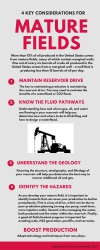
http://www.slideshare.net/beyondutopia/four-key-considerations-for-mature-fields
 4 Considerations for Mature Fields
http://www.slideshare.net/beyondutopia/four-key-considerations-for-mature-fields

Working Memory and Infographics
Baddeley and Hitch (1974) described the mechanism used by short-term memory as a process they denoted as “working memory.” In their view, working memory is a process driven by the “central executive” which collects, temporarily stores, and directs data to the cognitive subsystems of the a) visuo-spatial sketch pad, and the b) phonological loop.

As a highly visual artifact with engaging and unique organization of visual information, an infographic is an ideal tool for facilitating the smooth functioning of working memory.

The central executive can easily incorporate a well-designed infographic in the visuo-spatial sketch pad, which is, in essence, the inner eye.  The visual spatial sketch pad not only functions in the retrieval process, it also is used in navigation – in locating spatially where information might be.

The central executive takes and replaces information in the visuo-spatial sketch pad, and then relates it to long-term memory. The central executive can move material back from long-term memory to working memory, so the infographic can be used not only to store new information, but as a memory-trigger to retrieve information from long-term memory.

Baddeley emphasized that the central executive also functions as a system to keep attentional processes engaged, and to continually organize and prioritize (McLeod, 2012). It can also relate processes together, so that a infographic that is primarily attached to the visuo-spatial sketch pad, also can be related to the phonological loop processes.

Guidelines for Developing Infographics for Working Memory

1.  Keep your information tied to one or two categories 
2.  Use a clear color scheme
3.  Avoid clutter
4.  Maintain a minimal main message
5.  Connect / refer to details (don’t include all the details in the infographic)
6.  Use colors, white space, lively design
7.  Use phone, tablet, and laptop-friendly hosting / delivery
8.  Make your infographic multi-purpose, reusable
9.  Encourage sharing / comments / collaboration

Tools for Building Infographics
Infographics were originally designed almost exclusively by graphic designers, but now there are a number of free and premium services that provide cloud-based services that include professionally designed templates which utilize unique graphics, layouts, and fonts.

Examples include:

Canva (www.canva.com): Templates and unique fonts / images for infographics and presentations.

Piktochart (www.piktochart.com): Templates, images for infographics, reports, presentations

PicMonkey (www.picmonkey.com): Photo-editing that also includes a number of unique fonts, images, and clip art, and easy creation of collages that can also be designed as infographics

Final Thoughts
Infographics can be very practical as well as engaging and fun. For example, if you save them as a pdf files and print them out, you may use the infographics as a point of departure for an impromptu mind map.

The key is to design with an eye to inspiring and triggering thoughts – about the present, past knowledge, and collaborations. Used well, infographics can be an effective tool for deep learning.

References

Baddeley, A. D., & Hitch, G. (1974). Working memory. In G.H. Bower (Ed.), The psychology of learning and motivation: Advances in research and theory (Vol. 8, pp. 47–89). New York: Academic Press.

Baddeley, A. D., & Lieberman, K. (1980). Spatial working memory. ln R. Nickerson. Attention and Performance, VIII. Hillsdale, N): Erlbaum.

McLeod, S. A. (2012). Working Memory. Retrieved from www.simplypsychology.org/working%20memory.htmlwww.simplypsychology.org/working%20memory.html

Blog Archive