E-Learning Corgi focuses on distance training and education, from instructional design to e-learning and mobile solutions, and pays attention to psychological, social, and cultural factors. The edublog emphasizes real-world e-learning issues and appropriate uses of emerging technologies. Susan Smith Nash is the Corgi's assistant.
If global analogues such as the Permian Basin or West Africa are any indication, Bolivia’s certified reserves will undoubtedly increase dramatically with a better understanding of the geology and with the application of new technologies.
Bold New Exploration in Frontiers; Revitalization in Mature Fields
I recently had the opportunity to participate in the First International Forum for Gas, Petrochemicals, and Green Fuels, August 28 – 31, in Santa Cruz de la Sierra, Bolivia.
Bolivia Hydrocarbon Minister Luis Alberto Sanchez in press conference about reserves
Foro Internacional del Gas, Petroquimica, y Combustibles Verdes / 28 - 31 Ago 2018 / Bolivia
A few months earlier, the American Association of Petroleum Geologists (AAPG) hosted its first ever Geosciences Technology Workshop in Bolivia. It took place June 6 – 8 in Santa Cruz. Some of the presentations are available here: http://www.searchanddiscovery.com/specialcollections/lar.htm
I was impressed by the opportunities to drill for new gas reserves in the southern part of Bolivia, to improve production in the mature fields, and to invest in gas pipelines. I was also impressed with the biofuel (biodiesel and sugar cane-derived ethanol). LifeEdge inteview:
Transportation Hub in the Heart of Bolivia
Bolivia’s goal is to become a natural gas hub for all of South America. This is a very interesting plan, which takes advantage of the twin blessings of Bolivia: mineral resources and central location.
By having pipelines crisscrossing the country, it’s possible to have natural gas travel from fields in Bolivia to major markets, which include Brazil, Argentina, Chile, and Peru. It’s also possible to facilitate the transport of gas from fields in Argentina to Peru, or from Peru to Brazil, etc.
Logistically, becoming a gas pipeline hub makes sense.
There are a few challenges, however:
1. Pipelines need to stay full of gas. Is there sufficient supply? Are there enough pipelines? Enough gas? Enough pressure? There is for now, but the future will require more.
2. Political stability is vital. Bolivia has a huge advantage in this area. For example, Ecuador is now experiencing problems in its petroleum-producing provinces. Peru has become more stable than in the past, but there are still some outliers of violence. In Colombia, insurgents murdered three young professional petroleum geologists in September who were working in the Antioquia province. That said, there are some remaining issues with Chile (see article).
3. Economic stability is critical. If there is hyperinflation, there are always problems with day to day operations, as well obtaining spare parts, due to liquidity issues.
4. Nationalization factor: A plan to decrease the royalties (or taxes) paid to the government act as a tremendous incentive. If the government has (or states that it has plans to) nationalize foreign operations or companies, capital (as well as expertise) tends to flee the country.
5. Transparency factor: Governments that maintain transparency in the way that they attract investment, award contracts and concessions, are very likely to maintain stable investments.
6. Wall of tariffs: The world’s great empires tended to grow into empires through trade. Yet, paradoxically, when they feel threatened, they tend to engage in protectionism. Walls and trade barriers can be digital as well as physical and can apply to just about everything.
7. Streamlining bureaucracy: Bolivia, like Peru, has done a great deal to streamline the process of doing business in Bolivia by reducing the number of permits needed. It’s a good idea. After all, if you need 50 permits in Country X, while Country Y requires 5, where do you think people will likely do business? Time is money. Delays are painful, and, where there are tedious documents to be filled out and submitted through a bottleneck, there are often “facilitators.” So, requiring too many permit may trigger corruption.
8. Natural gas can be used as feedstock for urea and other fertilizers. Special transportation is planned for urea, which will have a positive influence on the extensive agricultural sector near Santa Cruz.
9. Natural gas can be feedstock for petrochemicals; specifically for low-density polyethylene (used for plastic bottles and bags) and also for polystyrene; used in cars, etc.
10. Using sugar cane as feedstock for ethanol. Being able to sell to more than one buyer creates a tremendous opportunity for small producers to diversify and also to justify much-needed capital improvements.
A Bright Future, Given Solid Governmental Partnering
The outlook for Bolivia looks very bright on many fronts. In fact, one can already see progress as the city of Santa Cruz de la Sierra continues to experience tremendous growth, not only in natural gas, but also in the manufacturing and agricultural industries made efficient by the availability of energy.
AAPG Young Professionals paper presentation at YPFB - Santa Cruz, Bolivia
Susan Nash at YPFB, Santa Cruz, at AAPG YP meeting
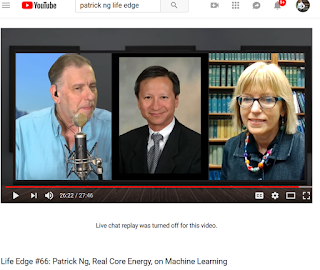
The United States is now the world's largest producer of oil and gas, and machine learning played a large role in the transformation, which has occurred because of new techniques and technologies.
Welcome to an interview with Patrick Ng, geoscientist and pioneer of innovative ways to use analytics and specifically machine learning, to find new oil and gas reserves and to produce them more efficiently and sustainably.
Background - I am a geophysicist by training, and experienced A to Z in geosciences. 1) As - AVO amplitude versus offset to reduce risk, azimuthal features to map natural fractures, 2) transform seismic to rock properties, and 3) prestack depth imaging / model building to map subsalt reservoirs leading to 3 giant discoveries total over 2.5 billion boe in the Gulf of Mexico, and 4) the Z is drilling wells and learning from the drill bit all the way to total depth (Z).
And I learn through the drill bit that we drill anything but an average well, or rather a range of IP initial productions. The risk lies in the spread, and I make it a business managing risk at Real Core Energy.
Q1: how about examples of using Python in industry?
The hackathon focus was production forecast of a well. Given the flow rate data (courtesy of Halliburton, sponsor) and Python Notebook as template, and bootcamp to bring everyone up to speed. The exercise is to try use geoscience in machine learning, and play with the number of layers and neurons in neural network, and improve the forecast accuracy.
Q2: why Python?
Python is like the foundation, that my teenage daughter uses for make up. Depending on the event, she will put on other colors and things (not sure what to call those… so I won’t). And the real power of Python comes from a set of libraries. For example:
1)Numpy, numeric Python for vectorized numerical computation
2)Pandas for handling lots of columns and rows
3)SK learn for machine learning algorithms, ready plug-n-play.
Think of.Python example, say write a few lines of codes, in a loop do something to each element in an array one at a time.
Numpy can collapse that into a single line, operates on an entire time series as a vector all at one go.
Often we may have a thousand wells, each with its production profiles. Think of wells as columns across the top with number of barrels per day, week or month hanging down. Pandas can operate on the entire collection of series of data all at once, like getting the mean, median, statistics with one line on an entire group of data. We also get the top 25%, next 50% and bottom 25% percentiles. Quickly we get a feel for how well the producing assets perform.
Q3: why is Python so popular with machine learning?
It has to do with the availability of powerful libraries like Keras and Tensorflow well suited for neural network and deep learning. While SK Learn has been around for some time, Tensorflow was released by Google to open source consortium in November 2017.
Lets take deep learning as example. Microsoft had success using 158 layers in a deep neural network. Using keras, we specify one layer at a time, and we’d have 158 lines of codes.
But with Tensorflow, we can do that in one line albeit a long line, by listing the number of neurons in all 158 layers all at once. Again fewer lines of codes. But if we want to customize, and tune each layer, then we can do so with Python in a more granular way.
So we go from Python (the foundation), to Numpy, Pandas, Keras and Tensorflow, each provides the tools to do more, faster with fewer line of codes. In a nutshell, Python opens up a whole new way for geoscientists to explore data, do rapid experiments and gain new insights.
Q4: can machine learning make the industry more safe and clean?
Here are two examples. First predictive maintenance, we can better anticipate and schedule downtime for routine maintenance and repairs of equipments. Just as we do annual check up for our AC in Houston and keep them running top shape. That will prevent potential leaks and minimize surprises, so keep us safe.
On cleaner environment, one possibility is that we drill fewer wells and produce the same volume, if we can better predict the outcome with machine learning. Doing so, we reduce the footprint and impact on the environment.
(One more thought came after the Chat, is refracking. If we can use machine learning to better identify refracking candidate wells, we shall improve recovery factor and may also drill fewer new wells. Again reduce footprint and lessen impact on the environment.)
Q5: is there benefit of reprocessing data and machine learning together?
Yes. It has been standard business practice that every few years, with improved algorithm, we reprocess data, get higher resolution and a more detailed look. Like going from 4K to 8K HDTV, instead of 80 to 100 feet resolution in seismic, we may get that down to 40 ft. With higher resolution data, we’d retrain machine learning and get better results. Both go hand in hand.
That brings up a good point. In the world of geoscience, if we change the model, we also get different resulting imaged data. Unlike typical data used to feed machine learning algorithm, say what I bought from Amazon or movies streamed from Netflix, what I read and watched became record. That won’t change. But when imaging seismic, the model and resulting data are tightly coupled. Change one, we change the other.
So learning with machine beats machine learning alone.
Before 1995, the thinking in Gulf of Mexico was that salt bodies would become detached because of buoyancy (density of salt is lighter than that of surrounding rocks). So over time in geologic scale (millions of years, not weeks), salt moved up from great depth and ended up what looks like cup cakes (picture inside the lava lamp). But with the Crazy Horse (now called Thunder Horse) discovery, we learn there is salt mountain that goes forty five thousand feet deep below the seafloor. No cup cakes.
Python is a tool that can geoscientists explore and test their ideas with data. Better understanding of the geology and producing more. Last but not lease, is that Python while really powerful for numerically intense applications, it can go all the way to voice. Using Python-Flask libraries, I put together numerically rigorous app and deliver via Alexa. That I see can draw more highschool students interested in geoscience.
Closing
As a closing thought, remember the old saying “The journey of a thousand miles begins with one step.” I see learning python is the first step. Just do it!
Bolivia intends to expand its exports of LNG, electricity, petrochemicals, and green fuels in 2019 and beyond, announced the Bolivian Vice President, Alvaro Linero Garcia. In addition, exploration to develop reserves of gas are being encouraged through partnering with companies to conduct studies and to drill exploratory wells. In addition, mature fields will be the target of study and investment to revitalize the reservoirs through enhanced recovery methods.
Panel discussion with Luis Sanchez, Minister of Bolivian Ministry of Hydrocarbons, with experts discussing opportunities and expanded reserves.
The announcements were made at the closing ceremony of Bolivia's First International Forum on Gas, Petrochemicals, and Green Fuels, a four-day event in Santa Cruz (August 28-31) that had as a goal to encourage investment, and in doing so, presented a wide array of potential game-changers for partner companies, investors, and Bolivia.
With a goal of stimulating investment in exploring for hydrocarbons, the Minister of Hydrocarbons, Luis Sanchez, detailed the opportunities to participate in more than 10 blocks in Bolivia, many in the prolific Tarija and Chuquisaca regions.
First International Forum on Gas, Petrochemicals, and Green Fuels / Santa Cruz, Bolivia
Green fuels, including new ethanol sources from sugar cane grown by small cane farmers in the Santa Cruz region.
LNG terminals are being expanded, with the long-term goal of being a gas transportation hub for all of South America on the drawing board.
Exhibitions featured green fuel, LNG technology, pipelines, compressors, equipment for enhanced recovery, and more.
The importance of incentives for investors was stressed, along with access to new studies and data which can be reprocessed and analyzed to reevaluate existing reservoirs, and to identify stacked plays, shale plays, as well as improved producibility using new technologies.
Susan Nash, Ph.D. (center) after giving a talk on case studies of successful exploration with new technology. Accompanied by YPFB engineers Ing Isabel Prudencio and (unidentified).
Having the opportunity to live and work in a number of different countries and cultures generates an awareness of the way that culture, context, and logistical realities affect leadership decisions. Welcome to an interview with David Allard, shares lessons learned from his diverse experience as a geologist in many different countries and contexts.
1. What is your name and your background?
David Allard has a college degree in geology and worked in the petroleum business his entire career. Colorado is the 7th US state he lived in including a couple moves with the family growing up.
2. What did your career entail? Where in the world did you work and why?
David Allard worked for over 35 years as a petroleum geologist and from 1988 to 2006 worked internationally in more than 20 countries, including living with his family in Egypt and Scotland. Allard has had a varied career as a petroleum geologist, playing a part in many new field discoveries, publications, and public presentations.
David Allard began working in industry as a petroleum geologist in San Francisco, CA then moved in 1981 to Midland, Texas to work for a major oil and gas company, and in 1988 to Houston working international projects. In 1998, after joining an independent oil and gas company, he moved his family to live in Egypt, followed five years later by a Scotland assignment. David took on management roles of increasing responsibility starting in 2000. After returning to the US in 2006 work locations have involved 3 different states.
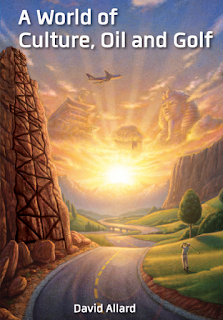
He recently published a nonfiction book: A World of Culture, Oil and Golf that covers a 20 year period of international and domestic USA business and historical aspects from the perspective of a staff geologist and in the latter half of his career in leadership roles. Beginning in 2017, book marketing efforts include speaking events as an expert in petroleum geology and international experiences. He currently lives in Denver and still loves golf.
3. What was your main job responsibility? Could you have done it from Houston? Why or why not?
As a manager in the petroleum business, I could do the job from Houston; especially now with the communications and computer tools we have today. Early in my career I spent a lot of time on rigs to acquire the geology data for exploration. That experience got me in the international oil business initially, which lead to extensive travels. The interactions with locals resulted in some project benefits in the long run.
4. What were some of the things you learned about people, culture, and different ways of doing business?
It is important to engage every member of the team in either remote drilling sites or in the office. Remote drilling sites in 3rd world countries require a variety of services and those are sourced locally. It takes time to vet the area and line up support, before the heavy equipment is moving to the location. Negotiations with government petroleum companies are helped if you know the local rules, who has what authority and who to trust as you portray what is in it for the host country.
5. Please describe two or three of your most important "lessons learned" –
Respect the host culture and customs of the host country when working internationally.
A successful team needs effective communication and to understand the strengths of each person on the team. People are motivated to work by things other than money.
International business of oil and gas requires understanding both above ground and below ground (geology) risk. International exploration discoveries are an exciting moment, but are only one step on the long road to profitability.
6. Why did you write the book? When did you get the idea? Where can we buy the book?
During my first international business trip in 1988 to Turkey, after an unusual encounter on the drive from a remote airport into the mountains to the well site; I decided to start keeping a journal. I expected many unusual things might happen along the way. Over the years I compiled 14 journals from a variety of assignments, business trips and postings overseas which are the basis for the book.
I feel lucky to see so many places and have the variety of business experiences and I want to share this oil and gas business description / inside look. The key aspects of my book that I want to share: A) how the international oil business works and B) various “you were there” cultural observations including political change and government stability issues in the host countries where we were exploring. For example, the fall of Communist Russia, turning Hong Kong back to China, and rebel encounters with the government.
The book focus is on the international business experiences and cultural observations over a 25 year period. The international oil and gas exploration business carried the author to many places tourists will never see and an inside look at a variety of business dealings and cultural aspects. This fascinating first person account shares what it's like to be an insider traveling the globe. At times there are security risks, humor and occasional golf!
“A World of Culture, Oil, and Golf” is available in hard copy or Ebook on all the usual digital outlets including Amazon or autographed copies from the web site: DavidAllardAuthor.com
7.Where is your hometown? Currently Denver and west Austin. I grew up in Massachusetts, Mississippi and Erie, Pennsylvania before moving to San Francisco for my first job.
Who and/or what inspire you most?
I am most impressed with people that make a difference in the world; as well as accomplished artists and pro athletes. As far as writing about the oil industry: people that published insightful books Daniel Yergin, author of The Prize, Michel Thomas Halbouty the great wildcatter, Thomas Petrie’s Following Oil and Lisa Margonelli, author of Oil on the Brain, to name a few.
Why do you write?
I enjoy telling the story that others may be interested in. I was compelled to get my world of oil story out because I was lucky enough have seen so much. The oil business is of interest to many others these days being a political issue – globally; and I want to tell a positive oil story of exploration and value creation.
Do you hope to inspire other writers? What advice would you give for people thinking about writing a book?
Take time to write down your story, share it with others and grow from the feedback
What obstacles have you overcome to write this book?
To make the details of business travel and international exploration into a story of interest, a book format worth reading – that others value is the challenge. Finding time to write!
Any hobbies or extracurricular activities you'd like to share? There are many. I almost switched to art major as a Junior...but finished in Geology. Others: running, golf, skiing, photography, film, guitar and trying to be a better fisherman.
Please view the interview with David on Life Edge.
Look, Mom – I’ve built a robot dinosaur that roars! Young learners benefit from hands-on experiences, especially those which encourage experimentation. Bin Feng at Microduino has been at the forefront of a wide array of hands-on robotics, manipulatable, and modifiable, which engage young students and encourage them to study science, technology, engineering, and math. Welcome to an interview with Bin Feng, co-founder and CEO of Microduino.
Q: What is your name and your background?
A: My name is Bin Feng, and I’m the co-founder and CEO of Microduino, Inc., an award-winning global designer, developer, manufacturer and seller of stackable electronic building blocks, related accessories and peripherals, and in-class science, technology, engineer, and mathematics (STEM) learning systems which encourage and enhance inventors’ creativity, imagination, and ingenuity through project-based learning.
As one of Microduino’s principal product architects, I’ve helped guide Microduino from a fledgling start-up founded in 2012 to a rapidly-growing global brand with an expanding STEM/STEAM education product portfolio and a diverse roster of education market customers and international distributors and value-added resellers (VARs). Since the company’s founding, my partners and I have built Microduino’s following of students, teachers, inventors, and electronics enthusiasts into an engaged community of over 1,000,000 members; and developed a comprehensive STEM/STEAM product line and education platform for use in schools around the world.
As CEO, I oversee the strategic development and implementation of Microduino’s business strategies, plans, and supporting programs, and I ensure their alignment with the company’s mission, values, and short- and long-term objectives. On a day-today basis, I direct the company’s operations, product design, business development, sales, marketing, and financial management activities.
Prior to starting Microduino, I was the general sales manager of Leadgo American, the U.S. subsidiary I established for the highly-regarded manufacturer of advanced composite materials used in the aerospace, marine, and wind-power industries. Previously, I held sales and product management roles at Parker Hannifin, the Fortune 250 developer of motion and control technologies for the industrial and aerospace markets. I began my career as an applications sales engineer at General Photonics, a designer and builder of innovative optical instruments and modules to fuel the growth of optical networks, sensor systems, and biomedical diagnosis systems. While there, I managed a multimillion-dollar book of business which included important business relationships with such well-known government agencies and corporations as NASA, Northrop Grumman, Boeing, NEC, and Kodak.
I have a B.S. degree in materials science from Fudan University in Shanghai, China, and a master’s degree in electrical engineering and applied physics from the University of California San Diego (UCSD).
Q: What is your company?
A: Founded in 2012, and based in Westlake Village, Calif., Microduino is an award-winning global designer, developer, manufacturer and seller of stackable, LEGO®-compatible electronic building blocks, related accessories and peripherals, and in-class STEM learning systems.
With tailored offerings for individual consumers and academic institutions, Microduino offers a broad range of modules, sensors, and project kits which improve critical thinking and problem-solving abilities, and enable creators to bring their inspirational and pioneering concepts to life. Because of their ease of use, unique patented hardware design, and nearly unlimited applications and configurations, Microduino products have spawned a passionate and highly-innovative worldwide community of students, faculty members, makers, hobbyists, engineers, and electronics enthusiasts of all ages, backgrounds, and skill sets.
Microduino targets, and sells its STEM educational toys and learning systems to, two core markets:
-Consumers: Individual consumers, including children and their parents, interested in educational toys such as building blocks and interesting do-it-yourself (DIY) kits, projects and applications.
-Education Domain: Elementary, middle, and high schools, as well as colleges and universities.
Q: What is your philosophy of learning?
A: At Microduino, we’re all about fun, enjoyable hands-on STEM learning that encourages children to understand and explore the intersecting worlds of electronics, product design, and hardware coding — and sets the stage for higher education in STEM-focused disciplines and eventual careers in STEM-related fields, such as engineering, software development, and scientific research.
With products that are aligned with the latest Next Generation of Science Standards (NGSS), International Society for Technology in Education (ISTE), and Common Core guidelines for STEM instruction, our comprehensive line of products and learning systems act as a STEM/STEAM education continuum in which children can learn basic product design and coding skills right from the very beginning and at an early age, and then progress through the entire platform by learning more advanced skills and techniques along the way.
From our perspective, it’s not enough, particularly in the STEM education realm, to build a robot, car, drone or some other project. While those activities are certainly fun and educational, to a certain extent, we believe the how, why, and control behind the design are even more important, especially in enabling children to understand the logic, sequential nature, and programmable aspects of a product’s design and operation. How and why does this project work the way that it does? Can it be programmed to operate in a different manner? If so, what new code must I write to instruct the vehicle to behave differently? Can I combine these sensors and modules to create something entirely different?
Moreover, we intentionally developed Microduino products to provide children with endless design and configuration possibilities. As a result, they’re able to leverage their newly-acquired knowledge of electronics and coding to create a whole new array of projects and applications. With Microduino, an individual’s creativity is limited only by his imagination!
Simply stated, with Microduino, a child’s creativity is limited only by his or her imagination! Our motto: If you can think it, you can create it!
Q: What are your products, and how do they tie to your philosophy of learning?
A: Microduino has four main product lines:
-mPuzzle: Designed for children ages 5 and up, mPuzzle is a collection of easy-to-use, snap-together magnetic components that teach basic electronic circuitry concepts.
~With mPuzzle, children come to understand how things work by seeing cause-and-effect relationships and outcomes.
~mPuzzle offers everything kids need to construct common objects found in our everyday world, such as a street lamp that illuminates at dusk, or a TV remote control with a red LED light that shines when it’s turned on.
~mPuzzle’s use of ordinary objects gives children instant familiarity with their forms and functions, while challenging them to learn how they actually work by building them from the ground up.
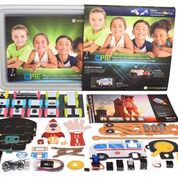
-mPie: Designed for children ages 7 and up, mPie builds upon mPuzzle’s foundational circuitry lessons and hardware components to teach kids introductory hardware coding and more advanced electronic and product design concepts.
~With mPie, kids discover the world of hardware coding, which helps them visualize the logical and sequential order of things in a physical and engaging way.
~mPie’s intermediate lessons enable children to link concepts between the physical and virtual worlds by constructing everyday items, such as a rocket, ambulance, and fly swatter, with which they are already familiar.
~mPie projects increase in complexity so children learn the importance of sequential design and fabrication, and how to identify and resolve problems when those sequences are not followed.
-Itty Bitty City (IBC): Created for hobbyists, makers, inventors, and tinkerers, Itty Bitty City is a fun-filled collection of Microduino mCookie modules, sensors and accessories which creators use to build eight exciting projects, including a windmill, lighthouse, night light, piggy bank, and music box. Because of its fun and unique applications, Itty Bitty City is also widely used by students and teachers within schools’ STEM/STEAM programs.
-Microduino Mix Kits: Targeted at students ages nine and up, Microduino Mix Kits come in four levels, Mix 1-4, with each kit including 12 projects pre-coded in Scratch 3.0, electronic components, and complementary lesson plans. A cornerstone of the product’s STEM value is its focus on coding, and teaching students how to program various projects and their respective components. A code is the written sequence of commands created in specialized coding editors, such as Scratch, that tell individual electronic components how to behave.
In support of its learning philosophy, these Microduino products are fun, enjoyable, educational and hands-on, and inspire and encourage children to further explore the intersecting worlds of electronics, product design, and hardware coding. More importantly, we’ve intentionally designed these kits in such a way so that children can master all the concepts taught by one product; move on to the next series, which teaches more advanced coding and electronics principles; and so forth until they develop a comprehensive understanding which they can use to design more imaginative creations. In other words, these are progressive learning products, and as such, they serve as the perfect STEM/STEAM learning tools for all classrooms, and fit seamlessly into today’s cutting-edge, industry-standardized STEM/STEAM curricula and lesson plans.
Q: Please provide 3 or 4 examples of successful implementation.
A: As we’ve said before, a child’s creativity is limited only by his or her imagination! Microduino fans can find all kinds of cool projects to pursue in the company’s IdeaLab at https://idealab.microduinoinc.com. Here are several examples of successful Microduino implementations:
Welcome to an interview with Dr. Gary Stading, Dean of the College of Business, Engineering, and Technology of Texas A and M Texarkana.
1. What is your name and your background
Dr. Gary Stading comes to Texas A-M Texarkana after a distinguished career in industry, including transportation and supply chain management. He has been recognized by a number of global organizations for his contributions.
2. How can an MBA prepare a person for changing times?
The Texas AandM Texarkana MBA program is designed to help build and enhance the skill set you need to compete in today’s fast-paced marketplace. Whether you are managing your own business or trying to advance your career to the next level, completion of the Texas A--M Texarkana MBA program gives graduates a competitive edge through its unique class design approach, flexibility, affordability, and diverse concentration options.
What makes Texas A - M Texarkana different?
The College of Business, Engineering, and Technology (CBET) faculty concentrate on preparing students to be valuable leaders in both business, and community service initiatives. The CBET offers quality undergraduate and graduate programs through academically and professionally qualified faculty. The tenured and tenure- track faculty members are active scholars that consider intellectual scholarship an asset for providing excellence in teaching. The faculty pursues continuous improvement, and they realize that the curriculum must emphasize critical thinking skills and emerging technological solutions to prepare students for today’s complex business environment. In addition, the faculty recognizes the importance of being active in community service.
3. What do you see as the importance of Energy Leadership at this point in time and in the future?
The College of Business, Engineering and Technology works closely with members of energy based organizations, such as the American Association of Petroleum Geologists (AAPG) and Southern Gas Association (SGA), to offer an MBA with a concentration in Energy Leadership. to meet the needs of many growing businesses. This degree is developed for professionals already in the energy arena or aspiring for valuable and exciting careers in the energy and petroleum based industries, including oil and gas. The coursework develops skills vital to successful leadership in energy related fields. These topics include such areas as risk assessment and the management, accounting and financial planning specific to energy related fields, and management of capital and personnel resources. The program is offered online which enhances and encourages student interaction from all over the globe.
4. How can Supply Chain Management make a different for students in their professional lives and careers and how is SCM changing? Supply Chain Management (SCM) provides an exciting and rewarding path of study, in which students learn skills that directly affect and can increase business profitability. Careers in SCM take many paths and end up with a multitude of career options. The curriculum teaches students to properly balance materials, finances, and information throughout the supply chain to achieve growth of company profitability. Skills acquired via the Supply Chain concentration are in high demand. By completing a degree in Supply Chain Management, students will set themselves apart to succeed in business. Students will develop analytical skills in learning about inventory management, logistics, quality, purchasing, and transportation. Students in supply chain management have the opportunity to learn and then subsequently return value to both their own personal investment portfolios or to grow their company business. Supply Chain is changing the way businesses compete. Students learn how businesses leverage relationships with suppliers and customers by forming teams to compete in the marketplace.
5. What are some of the new directions in business leadership that you see emerging?
I don’t know that I would call these perspectives “new directions,” but I’ll talk about some of the newer academic topics and perspectives being discussed in leading business education journals. One such topic is that the authors are arguing that it is important for business leaders to keep the forces of technology from dehumanizing the workplace. De-emphasizing the human element out of the workplace is strongly discouraged because it basically eliminates a key sustainable competitive advantage for businesses. Another stream of leadership discussion warns against “hero worship” of business leaders. This rhetoric discusses how the practice of romanticizing business leaders gives too much credit and too much blame for failures on high profile leaders of companies. A third area of discussion is really a research area. A group of researchers are evaluating how a transfer of workplace knowledge is occurring and should occur between the retiring baby boomer generation and the millennials stepping in to take their place.
6. Please recommend a few books for our readers.
I personally would like to recommend of recent resurgence of a genre of books out about some historical leaders. I have read some recently published books about U.S. Grant, Hamilton, Jefferson, Lincoln, and others (each has different authors and titles). While their places are cemented in history, the stories of these historical political leaders and recently researched leadership styles provide a fascinating perspective on effective leadership styles. Two, in particular, are the recent biographies about Grant and Lincoln. These stories also provide analysis of some of their failures, discussing how these leaders overcame or coped with the trials and tribulations of these eerily similar obstacles experienced by modern day leaders. The stories about Lincoln and Grant involve some surprising similar problems that modern day leaders face. For instance, Grant, when he was president, was deeply involved in equality issues of all kinds (e.g. both race and gender). Anyway, I believe we can learn a lot about leadership by studying some of our historical leaders.
With new excavations and discoveries in the Yucatan Pensinsula and in Guatemala and Belize, our understanding of the Maya culture continues to expand with surprising discoveries and findings. Welcome to an interview with Dr. Andrew Kinkella, expert in Maya archaeology. In addition to this written review, we have two interviews on LifeEdge. (Please excuse the technical difficulties, though! We had audio issues on the first one, and Susan had serious webcam issues on the second one).
1. What is your name and your background?
My name is Andrew Kinkella, and I have a PhD in Maya archaeology. I have worked in Belize at Maya archaeological sites there since the 1990s, when I was an undergraduate student at UC Santa Barbara. I have also done archaeological work in southern California, Germany, Baja California, Arizona, and a shipwreck in northern California. Besides archaeology, I also have a background in acting and improv comedy, and I am an active scuba diver with a Divemaster certification. I am currently a full-time college professor of archaeology at Moorpark College in southern California, and I have been doing that job since 2004.
2. How did you become interested in archaeology, and where did you start?
I first became interested in archaeology because it seemed like a way to do “meaningful travel,” where I could go somewhere and be more than just a tourist. When I was in college I wanted to see the world, and I was able to join a field school for three months at a major Maya site in Belize in the spring of 1993. That first trip was pretty transformative for me, because I found that I liked all sorts of things about archaeology, and all sorts of things about difficult travel in the jungle. I liked that the jungle is an unforgiving natural force (like the ocean), so it was a test of your mettle to just traverse it, or to get something done that would be so much easier in another environment. Maya sites have a very romantic aspect to them as well, literally being lost cities in the jungle. It was very exciting for me to work at a “lost city,” and help to answer questions about the past with real objects that we were uncovering.
3. What do you find the most unique and intriguing aspects of the Maya?
As I matured in Maya archaeology, I really got into cenotes and how they related to Maya culture. Cenotes are large sinkholes filled with fresh water that look like lakes, and they occur throughout the Maya world. Since I was already a scuba diver, I used my diving knowledge to explore these pools. It was very exciting to practice underwater archaeology deep in the Maya jungle, and I was the first person to ever dive in these remote locales. I like exploring the cenotes and learning about the ritual aspects of how the Maya used them. The Maya saw these pools as sacred places, as places where there was a close connection to the gods, where our world touched theirs. Because of this, they would throw sacrificial objects into the pools for the gods, including (sometimes) human beings. I also like being a realist about the cenotes - sometimes they are just for drinking water or to water crops - not every cenote has to be an important ritual location.
4. Which areas and time periods in the Maya civilizations do you specialize in?
The area of the Maya world I specialize in is the east coast of the Yucatan peninsula (because that is where Belize is located).
My time period specialty is the Terminal Classic Period (800-925 AD or so), which is the time period right before the Maya collapse. We see an uptick in the Maya use of cenotes for ritual purposes during this time, because there were a series of droughts and they were in need of rain to grow corn.
5. Did the Maya really practice human sacrifice, or is this just an example of cultural chauvinism on our part? How do we know?
Yes, the Maya practiced human sacrifice, but they did not do it as often as television and movies would have us think. It would have happened at very special times, often as part of a ritual to bring rain for corn. The sacrifice would be bloody and gory, because it must be in order to “count” and be meaningful. We know that human sacrifices happened because archaeologists have found human remains of sacrificial victims in the cenotes, and the Spanish recorded accounts of human sacrifice at these cenotes when they were invading the Maya world in the early 1500s.
6. What do the stelae and codices tell us?
They tell us all kinds of things, from Maya history to religion to calendar dates. The Maya hieroglyphics were also written on simple objects like ceramic plates and bowls, and can sometimes say simple things like “this bowl is for chocolate.” My favorite part of Maya writing is Maya history as written by the Maya themselves. The stelae give us a succession of kings and queens (royal lineages), sometimes unbroken for hundreds of years. Of course the history is couched in quite a bit of propaganda (Maya kings are no different than kings of any other state!). When reading Maya history as written by them, I’m reminded of the history of the British monarchy, with its surprising historical twists and turns, moments of glory and foolishness, and strange bedfellows.
7. Why did the Maya have several calendars that they used at the same time? Should we do the same? Would it benefit us?
The use of three major calendars all at the same time is a function of history (some of the calendars are older than others) and need (some calendars are more ritual or astrological focused, while others are more focused on the farming cycle or the 365 days of the year). My favorite calendar is the Long Count, which is just a count of the days since a mythical start date on August 11, 3114 BC. It is simply “Today is day 3,453,249 since creation. Tomorrow will be day 3,453,250.” Super easy! The complex part of the three Maya calendars is that they all work on a series of cycles, so you get cycles upon cycles and it gets hard to keep track.
I don’t think there is any worthwhile reason for us to change our calendar - whatever divides up 365 days into meaningful chunks for the society at hand seems to be fine.
8. What was the Maya belief about the nature of reality, and the interaction between humans and nature (for example, animals in the forest)? How might such a mindset benefit us today in our world? How might we work with our existing institutions to start incorporating some of the Maya beliefs? (I guess it has already happened to a point with the syncretism that occurred in the early years after the arrival of the Europeans.
This is a really big question! The Maya saw the natural world as more animated than we do, with living mountains and caves, and gods that inhabited the natural world and were closely tied to the natural world. If we saw our own world more like the Maya did, we would be more supportive of the environmental movement, and more proactive in saving our environment for the long term. We would see ourselves as more tied to the environment, as a living part of the greater whole. We are very divorced from this kind of thinking in our culture. We could also learn from the fact that the Maya ultimately destroyed their environment after thousands of years of living within its means - they made the exact kinds of mistakes that we are making today.
9. What are your plans for the future?
I’m really happy with my job as college professor, and I would like to keep doing it! I like teaching archaeology and giving public lectures on these topics. I am planning to write some books on archaeology and the Maya for the general public. I would like to expand my public presence by giving more public lectures and telling my story to larger audiences, and especially to influence young people to take the initial step of “meaningful travel,” like I did back in the beginning. https://youtu.be/cCgrGwCMYVs
"On this long volcanic rock, they would lay down the person selected for sacrifice. She would extend her legs toward the temple, and hold her head back here where the rock dips down. That's when they would cut her throat. Take off the entire head." The Huichol shaman was telling us about the past. We were an hour and a half from Puerto Vallarta, an hour from formerly sleepy surfer town of Sayulita, but we might as well have been on another planet.
A breeze rattled the dry leaves along the dry creekbed in this isolated corner of the coastal state of Nayarit, Mexico. It sounded like rain. That's exactly what the gods who controlled the rains wanted. They wanted the blood to turn that sound, that suggestion of rain, into a reality. I wondered if this was true and how they knew. I also wondered why there were so many "decapitator gods" in the Americas. What was described reminded me of the Moche civilization of Peru.
If you were a part of the ceremony, how did you go from a calm quotidian existence to being a part of a decapitation ceremony? Just how much pulque, peyote, or whatever else they used would you have to imbibe? In my mind thumped the joyous hooks and beats of the Swedish artist known as Avicii, of "Levels" and many others, and I could certainly understand the mass energy and euphoria of crowds. Was the spraying of the victim's blood a cause for euphoric ululations? Of a faster pace of dancing and euphoric drumming and piping? Or, was the ceremony dark and horror-tinged? I shivered. How did we get here in this unknown tributary flowing into the Pacific Ocean in a part of Mexico where Canadian and American tourists flocked to be a part of a so-far safe stretch of coastline, quickly converting itself into a tourist bubble?
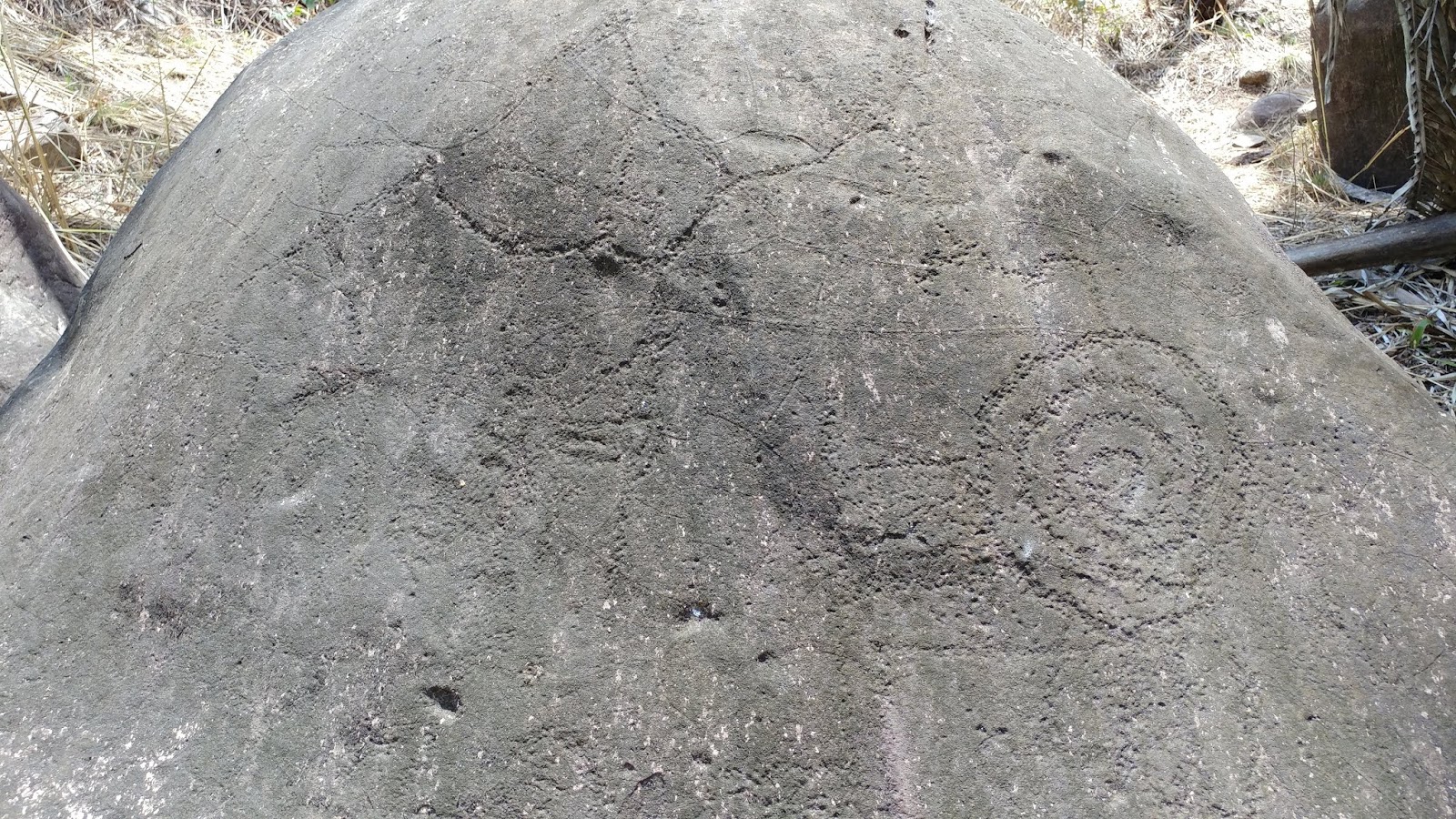
Near Las Varas, where the new highway will shave an hour off the journey from Guadalajara, along with the dangerous curves and mountain passes of the Sierra Madre del Occidente, is the little mountain village of Alta Vista (high view), which lies around 10 km from the two-lane highway that takes people from La Peñita to Las Varas. And, tucked away along the banks of a rocky little stream, and a more or less dry riverbed (in the dry season) are petroglyphs - carvings from the Huichol Indians, or from their preHispanic forebears. Or, based on the way they have eroded in the last 10 years, it's possible that they were carved by some industrious stoneworkers who thought it might be a great way to attract government support. I am not an expert, but Miguel did say that they look a lot more faint than they did just 10 years ago. Were they worn away by visits from tourists? Have they become so popular with the shaman "soi-disant" the self-styled but well-meaning purveyor of emotional, psychological, and for the really self-actualizing (or at perhaps absolutely shameless), physical healing.
We tried Google Maps. It showed the town and a ceremonial center and museum. We went there. Nothing. We tried Googling Alta Vista petroglyphs. There were many blog posts, Wordpress postings, websites that featured photos of the petroglyphs, and many with a blow-by-blow description of the hike. But, there were no maps and no details about how to actually find the petroglyphs except to assure the reader that there was absolutely no way to find the petroglyphs without the services of a guide. We were not convinced. We went down one little cowpath and dirt road after another. No luck. Finally, we asked someone in the town of Alta Vista how to find the petroglyphs. They said to go back down to the place where the road split into two directions and to inquire at the snack stand located there. It's weird to describe it this way, but that's the only way I know how to describe the little commercial center at the fork in the road. It was an impromptu food stand that sold the kind of food people love to buy on the street -- tacos al pastor and such -- with the basics of water, soft drinks, etc.
We asked directions and immediately a young man offered to be a guide for 80 pesos, which was about 5 dollars -- and for all day. I thought it was a sad commentary on income inequality - a young man was willing to work all day for 5 dollars (but in reality it only took 2 hours) when a toll road that took 30 minute to cross cost 200 pesos (around 11 dollars). There is something wrong with that. But, I am not really in a position to comment about that. We drove down the same highway we had gone down before, and just across the road from a field with a herd of "vacas flacas" (skinny cows), there was a small path with a gate fashioned of wood and barbed wire. Christopher hopped out and opened the gate. It was not locked and presumably open to the public but there were no signs at all and presumably the public would need to know about this. Plus, the public would need to know that there were no cartels, drug trafficking or other kinds of trafficking to happen upon. It would not be good to stumble upon marijuana or opium poppy cultivation. Presumably Christopher would only take us places where he (and his clients) would be safe.
We headed down the path. To our left was a large guanábana orchard. Christopher entered and plucked a rather large and still quite green guanábana. "It will be ripe and ready to eat in 3 or 4 days," he said. We drove farther down the path, past a mango orchard. We parked under a large, spreading mango tree (un mangal). We found ourselves at another fence, this time without a gate. Christopher lifted the wires so we could enter, and we did so without any problem at all. Once past the wire, there was a small path into a clearing. This was the so-called "Ceremonial Center" of the "Pilar del Rey." There were hand-painted signs with neat lettering - white paint on black metal, in Spanish and then in English. The signs explained the function of the petroglyphs, the presence of a ceremonial center, and the culture of the people who lived here, who were antecedents of the Huichol. The clearing was rather large, and so I supposed it must be a favorite location for small events or gatherings, although it was hard to imagine that it would be very easy to access. The signs led us toward a creek bed where there were more signs and large rocks. The first sign described the meaning of the carvings, which were the petroglyphs. It indicated that the glyphs referred to the sun, the moon, directions, some sort of god figure, and human sacrifice. It seemed highly interpretive to me. We made our way through the leafy underbrush and I was quite glad we were in the dry season. It was warm, but not hot, and while it was a bit humid, it was very bearable. I imagined that it would be more or less pure torture during the rainy season. The leaves slapped my legs, but fortunately they were not thorny or wet. I was wearing khaki colored capris and they stayed unblemished.
We passed by more petroglyphs, some indicating the god of corn, others indicating a cross. The theory was that somehow some sort of Christian saint had visited before the arrival of Spaniards. "Ockham's Razor," I thought to myself. I could think of at least five more likely explanations for the appearance of what seemed to be a Cross of Malta on the rocks (and for the petroglyphs themselves). It seemed much more likely to have carvings by Spaniards and settlers, even if simply to amuse themselves. But, I'm no anthropologist. The rocks they claimed were part of a pyramid looked like the normal joints you'd see in volcanic rocks, but again, if you asked me what the mounds near Saint Louis were or what the hillocks were in Chiapas and the Yucatán, chances are, I would have attributed all to geological and geomorphological processes.
We arrived at a small pool fed by springs where a clutch of gaudily tattooed Mexicans and Canadians were smoking marijuana and stretched out on the rocks. On a ledge where people offered "ofrendas" (feathers, stacked rocks, yarn "eye of god" crafts, a dreamcatcher or two) a young man wearing a Huichol priest outfit with gorgeous embroidery was talking about the spiritual beliefs of the Huichol. He said that he often participated in dances in Sayulita and wore a deer skull. I asked if the Huichol believed in the animal spirits and visions of animal spirit guides. He said, "yes."
I thought of the Navajo sand painters who combined the painting with spiritual healing and thought he could go far if he combined some of the petroglyph shapes here with a kind of sand painting ceremony for healing. I did not share my idea, though. I had already asked him too many questions and I think I seemed a bit weird. We made our way back and I laid out some coins that amounted to probably $1.50 at best. My ofrenda looked nice and shiny on the rock, and it was nice to think that it was Earth Day as well. As we made our way back through the creek bed, past the ceremonial area and then squeezed through the barbed wire and opened up the car, I took a long drink of bottled water and reflected on the experience. There was no doubt that it was totally inaccessible to someone who did not know precisely where it was. GoogleMaps had the ceremonial center far to the north of the town of Alta Vista. The road to Alta Vista continued up into the mountains where they grew coffee that was supposedly some of the best in Mexico. I wondered if there were also poppies, as a bit farther along the coast in Sinaloa or Guerrero. What would your garden grow? I'd rather have a crop of petroglyphs.