Thursday, July 27, 2017

Mary Elizabeth Braddon's Thou Art the Man: Sensation, Epilepsy, Genetic Determinism, and Feminine Spunk

For the podcast, click here: http://zenzebra.net/podcasts/braddon.mp3

Mary Elizabeth Braddon (1837-1915) is known for her sensation novels – novels written for all levels of Victorian readers, randing from those grabbing a cheap book bound in yellow covers and sold in railway stations to those who read work serialized in popular magazines (one of which she founded and ran). 


Her novels explored the dark sides and inner workings of Victorians at all levels: prim and proper professionals, landed gentry, impoverished women, people in desperate poverty. Her novels also explore secrets and the question: “What on earth do you do if you find yourself in an impossible situation?”  In that manner, she is not so far from Jane Austen, who explored the issue of women in states of abject powerlessness almost a century earlier in Sense and Sensibility. 
Mary Elizabeth Braddon in her early years when she earned her living as an actress. 

I often wonder what kind of father Mary Elizabeth Braddon had. Her books are chock-full of absolutely amoral (if not immoral) fathers, who are frauds, imposters, scam artists, wastrels, cheats, bigamists, and, in some cases sociopathic murderers.


In Thou Art the Man (1894), Braddon’s father figure plunges to a new low. He has used his friend’s fishing knife to stab a beautiful young woman to death in a dark grove simply because she rejects his proposal of marriage, which was motivated by a combination of self-interest (she had been promised a large dowry by her adopted (who turned out to be her real) father) and lust. The father figure, Hubert Urquhart, the heir apparent of an impecunious earl who married stunningly well, into wealth, beauty, and breeding, is a dissipated, gambling, vice-prone former cavalry officer, who is also a widower with a young daughter.


To listen to a reading, please visit the Librivox recording of Thou Art the Man click here


Urquhart gets away with it because his friend, Brandon Mountford, whose fishing knife he used, suffers from epilepsy and has memory losses after his convulsions. Not surprisingly, when Mountford happens across the dead woman, the sight of it triggers a grand mal seizure. He comes to consciousness with no idea what has happened. He does not think he had any reason to kill – but Victorian psychology held that epileptic seizures turned people into demons (remember, this was the age of Dr. Jekyll and Mr. Hyde) who slipped into uncontrollable homicidal rages, that generally targeted lovely (and often hot-blooded) women who happened to stray into their way.


In fact, the mystery in Thou Art the Man revolves around the question of guilt and also the nature of epilepsy itself. Mountford has lived in a kind of existential horror as he has witnessed his seizure disorder slowly destroy his dreams of being an attorney, and then of love, since he was determined never to marry, have children, and potentially pass along the disease. He read the medical literature of the day which detailed the progress of the disease and the prevailing belief that the seizures transformed the sufferer into a violent beast with no self control, and later, no memory of their actions.


Exploring debilitating conditions brings to mind other sensation writers, namely Wilkie Collins. 

Three years later, Urquhart’s young daughter, Coralie, happens upon the aftermath. Mountford, thinking himself to be a ravening monster, runs away (with the help of the murderer, who wants to make Mountford look guilty). Sibyl, the wealthy heiress in love with Mountford, marries Urquhart’s brother, the Earl, because she thinks that the community thinks that she was somehow part of the murder because she helped Mountford get away. So, in this loveless situation, she moves forward with her life, until a few fate-triggering incidences happen – she helps Urquhart’s unfortunate daughter and invites her to stay with her, and a mysterious note is delivered to her by a wild-eyed possibly mad vagrant.


I’m providing a little bit of plot summary just to give you an idea of how tangled and dark the webs are that Braddon weaves, and how every little sticky thread has a secret, a hidden past, a shameful horror, and a glittering prism of feelings, ambivalence, and confusion about one’s own identity and the identity of one’s loved ones.


Unlike many of Braddon’s earlier novels, in Thou Art the Man, it’s hard to know who is the hero. I maintain it is Coralie, although in theory, it could be Lady Sibyl.  Sibyl is not as interesting, though, and even though she is the one who really solves the mystery of the murder, it is Coralie, whose ambivalence and questionable morality both problematize her and make her sympathetic. After all, she knows she is her father’s daughter, much to her growing horror.


So, when the story opens, we meet Coralie, who had been relegated to a finishing school, where she is constantly on the verge of being ejected for lack of payment, and whose clothes are so worn that she is mocked by her fellow students.  By the way, this condition is nothing extraordinary in Braddon’s novels. I can think of at least a dozen young women in Braddon’s novels, who, talented and sensitive, must bear the horrors of abject dependency on the good will of the female owner of a young ladies’ school. In Thou Art the Man, Urquhart’s daughter, Coralie, is rescued from this cold, humiliating limbo by Lady Sibyl, who gives Coralie a place to live and a dress allowance – just enough, as Coralie says, to keep her completely aware of her dependence.


And this, I think, is a good place to talk about what is really revolutionary and fresh about Braddon’s novels, and Thou Art the Man in particular.


Coralie’s voice constitutes a large part of the narrative. It’s not all of it, nor is the structure something like Wilkie Collins’s The Woman in White, which is, in essence, a series of letters, reports, and documents, none of which give us the calming “we live in an ordered universe” feeling of the omniscient narrator.


Coralie has her own thoughts. She innately distrusts (wise girl!) her father. When her father asks her to observe Lady Sibyl’s household and send reports, she decides to keep two journals: one for him, and one for herself. It’s fascinating to read her reports to her father, and then to read her personal diary and learn what she really thinks, and how she truly questions what is happening.


I’m not aware of any other novel that contains such a technique. What is interesting, too, is that Coralie herself has doubts about her own integrity. She readily admits that she tends to prevaricate, and that it is difficult for her to be transparent. The reader sympathizes immediately because the poor girl has been absolutely abandoned in the world except for a very damaged (and damaging) scion. Like many of Mary Elizabeth Braddon’s heroines, such as Violet Tempest in Vixen, Coralie is perhaps not a hothouse orchid, but is a quick-witted and intelligent young woman, who, if not a classic beauty, an energetic, practical and attractive woman, drawn to horses and long, revitalizing walks in nature.  


Darwinian ideas are alluded to in Thou Art the Man, and they are challenged at every turn. Braddon champions the idea of self-determination, and provides refutations at every turn of the over-deterministic notions that you are and must be the product (or consequence) of your perverse parental genes.


Secrets, deception, and hidden motives are standard fare in the Victorian sensation novel. In Wilkie Collins's novels, the core dilemma is often a challenge to middle class mores and a secret longing for polygamy (or at least legitimized bigamy). The requirement for monogamy destabilizes identity and has all sorts of pernicious consequences; one being murderous tendencies, and the other, a sad longing for oblivion, usually in the form of laudanum.


Mary Elizabeth Braddon’s world is animated by secrets, but most are driven by the need to survive, and can be often excused as misdirected pluckiness. That is, except for the truly dissipated and scoundrel father figures, which are often undeservingly forgiven at the end.


In Thou Art the Man, perhaps the most satisfying moment comes when Hubert Urquhart meets his end. He is now an Earl. He is powerful.  He is rich. And, he is miserable and in hideously poor health, thanks to years of vicious living. The fact that he murdered the one true love of his life and then murdered his own brother never escapes the reader; nor does it escape the reader that he is part of the British aristocracy.


Yes, Braddon is subversive, but not in ways that favor anarchy. She uses sensation to problematize hierarchy, and thus encourages her female readers to dream and to envision their own personal path to self-actualization and empowerment.


****

Just a quick response to TinkieToes’s review: Thank you.  I recorded on Librivox as beyondutopia. I held myself back – I thought that some of the passages were almost pleading for an exaggeratedly operatic delivery.  Sensation invites the “camp” response. 

But – Coralie’s diaries and her realistic voice militated against high camp, so I read in what I thought was the most modulated and almost flat way possible. I’m a bit surprised that it was considered at all dramatic. Well. It’s good to know how others respond. At any rate, I’m very appreciative of the opportunity to read, and also of the positive response. Thank you.

*****

Gender

Now, just a very quick aside -- Brandon Mountford is portrayed in terms that are usually reserved for the feminine. As such, the dominating rhetorical mechanism is that of pathos. The character functions to trigger feelings of empathic helplessness, objectification, abject dependency upon the action of something or someone else...  and in that dependent state, there is an erotic trigger that is, above all, unhealthy. Braddon recognizes this.


So, when Mountford is held captive in an underfunded curate's crumbling extension of his cottage, it is not too surprising that he is utterly helpless and in his impotence, he is weirdly eroticized.


I suppose at the heart of it is the idea of power dimensions and differentials: the difference between Brandon's power (absolute ZERO) and anyone else's was something utterly empowering (and intellectually eroticizing). His seizure disorder stripped away his self-determination and made him weak and vulnerable. 

The implicit message is that you can have your way with him. That may not have been true, but it was the message. And, it was the message usually reserved for females. Does it take this sort of psychological atrocity to wake us up? It is good we know how it works.




Friday, July 21, 2017

Drones for Surveys, Methane Detection, Reservoir Characterization, More


Drones are becoming an almost indispensable tool in the oil industry, especially when it is necessary to inspect land, equipment and infrastructure in hazardous or hard-to-access conditions. Drones are also important for safety and security because the information is quick, accurate, and can be easily archived. But, those applications tend to be in the mid-stream (transportation and processing) and downstream (refining and distribution) segments of the industry. But what about upstream, in the exploration and development phase of the industry? Drones are used extensively there as well; they are just more subtle, and they do not create such a ubiquitous presence. This presentation reviews the main applications of drones and UAV-derived information in upstream oil and gas, which includes drilling and operations, as well as using drones for outcrop studies that are then used to create more accurate geological models, and better reservoir characterization. Be sure to watch the video which also includes a review of quadcopters with the best flight time

This presentation covers some of the most quickly growing uses of drone / unmanned aerial vehicle (UAV) uses in oil and gas exploration and development:


 Surveys
Site surveys in tricky terrain: Building locations, determining the best places to put the equipment and all the trucks during hydraulic fracturing, as well as positioning gates, fences, and cattle guards can be significantly expedited by using drone surveys. Seismic surveys require an evaluation of the land ahead of time. Archeological and endangered species surveys are required on many federal lands.

Oil and Gas Exploration: Direct Hydrocarbon Indicators
Surface geochemistry has been used since the very beginning: the methane seeps around the Caspian Sea in Baku, Azerbaijan, were indicators of vast reserves in the subsurface; in Tulsa “Creekology” usually meant going up the creek from where you saw an oil seep.
Now, a combination of methane seep detection and airborne gravity magnetics can be used to find “pinpoint play” reservoirs, such as pinnacle reefs in Michigan or serpentine plugs in South Texas.

Fugitive Methane Emissions
Methane detection is also used to detect fugitive emissions, which create safety hazards in pipelines and facilities.

In addition, EPA and BLM regulations require monitoring and reduction of methane emissions in oil and gas operations. While it is possible to mount static methane detectors or sniffers in compressors, gas gathering systems, and pipelines, they need to be maintained each year, and also installation can be slow. If it is necessary to install several thousand of them, the time sink can be significant. So, having airborne surveys has become a popular option. In the past, helicopters were used, because the sensors were heavy. Today, there are a number of quadcopters that have methane sensors onboard. There are different types of methane sensors, which range from sniffers, laser detectors, thermal (FLIR) with infrared, to hyperspectral.

Environmental Applications
Upstream operations must concern themselves water management, site restoration, archaeological surveys, rare / endangered species surveys, floodplain management, offshore / coastal erosion, flooding, spills, fires, and monitoring. In addition, drone surveys are useful in determining volumetrics, such as the amount of water in a pond.

Constantly Evolving Technology
Quadcopters are increasing in capacity, with longer flight times and better payloads (high-definition cameras, thermal cameras (FLIR), methane sensors, and more).  The weak link continues to be the issue of battery life: the lithium batteries average 25 minutes of flight time, and then must be recharged.

Sensors are evolving rapidly, and in the case of methane sensors, there is a rivalry among them, with spectroscopy, sniffers, optical sensors, infrared, hyperspectral, laser, and more.

Drones for Better Reservoir Characterization
Digital outcrop studies are useful in and of themselves, but when integrated with subsurface data of the same formations, the resulting models are truly surprising. They can be used to characterize reservoirs, and thus predict and depict heterogeneity, facies changes, lithology, fracture networks, and faults. The information can be used to calculate porosity and permeability, as well as to predict fluid flow and reservoir conditions.

While custom drones are used, many studies use off-the-shelf quadcopters, which are surprisingly affordable and have up to 30 minutes of flight time (bring extra batteries into the field).  

The key to developing an integrated reservoir model that includes digital outcrops and other information is developing a flexible and appropriate workflow.

  • Collect traditional information (outcrop data)
  • Digitize and georeference the conventional outcrop data
  • Collect satellite and drone-derived digital images of the same location (process and georeferenced)
  • Incorporate LIDAR (process and georeferenced)
  • Incorporate still photography (process and georeferenced)
  • Integrate all the surface data
Build a model using geocellular modeling with a program such as Schlumberger’s Petrel
After the surface digital outcrop 3D model has been created, it can be possible to find the corresponding sections and sequences in the subsurface, and then to create a cross section that reflects the seismic (synthetic seismogram) that has been correlated with the petrophysical and lithological data.  Relating the digital outcrop to the digital subsurface model can result in highly detailed seismic geomorphological models that reflect structure as well as subtle stratigraphic sequences and facies changes.

Getting started?
Drones for sale.

Friday, July 14, 2017

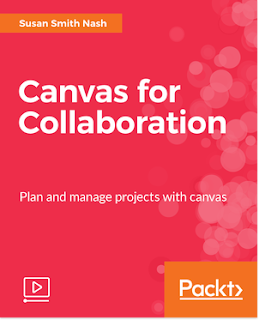
Loving Canvas LMS!: New Training Courses - Collaboration & Quick-Start Guide

Many colleges, universities, and training organizations are moving away from the learning management system they have used for years and are adopting Canvas.

Canvas, which is a learning management system, can also be considered a virtual learning environment (VLE) because offers cloud-based hosting and can integrate with a number of cloud applications, such as Google applications (Docs, Drive, Sheets, Slides), Microsoft 365 applications, and media hosting (YouTube, for example). In addition, Canvas encourages webinars (live and archived) by building in Big Blue Button.

Also, Canvas offers free hosting to instructors who can create their own courses (which are, in effect, MOOCs if they catch on) and offer them through Canvas’s portal.

Canvas is not as flexible as Moodle, and it does not have as many built-in templates as Moodle’s Virtual Learning Environment competitor, MoodleCloud, but it does offer remarkable simplicity.
In addition to making collaboration very easy, the SpeedGrader function in Canvas is a huge hit with students and instructors alike.

That said, changing to a new LMS can be daunting, even if you are very familiar with Blackboard, D2L, Moodle, as well as the commercial solutions.

Easing the pain of transition was one of my main goals of putting together training courses.  I also really wanted to help unlock the joy of discovery, unleashed creativity, and productive collaboration which is possible with Canvas.

Rather counter-intuitively, I started with Collaboration with Canvas.  I wanted to help students, instructors, and administrators jump in and explore the many ways in which Canvas facilitates collaboration.

People learn from each other. Moodle has long made a discussion / forum-focused approach the cornerstone of connectivist / connectionist learning theory.  Canvas embraces this approach, as people can easily share and collaborate on documents and presentations in order to create group projects and portfolios.  Also, Canvas makes it possible to use the discussion board as a blog and to subscribe to it via RSS feed.

Canvas for Collatoration
Canvas for Collaboraiton
 At any rate, I explored these and many other ways to collaborate in Canvas for Collaboration, which is a 6-unit, 30 module course:
  • How Canvas works for many different applications
  • Canvas and collaborative activities for academic applications
  • Group editing best practices
  • Using Canvas for event planning
  • Using Canvas for building a product with distributed team members
  • How to collaborate to demonstrate learning goals and compliance
  • How to assess the end products of collaborations
  • Collaborating using different types of media
  • Compliance training
Quick Start Guide for Collaboration
Quick-Start Guide for Canvas
Then, I backed up a bit and created a 6-unit, 30 module course on getting started in Canvas. Entitled Quick Start Guide for Courses in Canvas, https://www.packtpub.com/game-development/quick-start-guide-courses-canvas-video, the objective is to provide all you need to create great courses in Canvas.

This course is a practical guide filled with examples. It covers the basic and advanced concepts of Canvas. Every recipe is as simple as possible without compromising creativity.

In this course, you can
  • See the best way to plan and design an online course
  • Discover the unique features of Canvas and how to use them
  • Get to know the best way to organize content
  • Understand how to incorporate multimedia
  • Know how to use Canvas’ social media features
  • Make sure that students achieve their learning goals and objectives
  • See different forms of assessment in Canvas
  • Use Canvas’ features to motivate and encourage students
I truly enjoyed creating the courses, and I hope that taking them and participating in them is as enjoyable for the learner.


Monday, July 10, 2017

Some of Today’s Most Profitable Quadcopter Drone Uses

Drones, in particular, quadcopters, are quickly becoming the standard way to obtain high-quality images and other data for areas that have been hard or expensive to access. There are many quadcopter on the market, and their capabilities are unfolding rapidly, and companies such as WingsLand offer a wide array of capabilities, ranging from a mini-quadcopter that can fold up and fit in one's pocket, to larger drones capable of longer flight times (check out Drones for Sale).

Small drone services providers maintain at least four drones to assure there are sufficient back-ups and also redundancy in order to cover more than one job at the same time.  Technology is changing so quickly that it’s a good idea to have a plan for quick payout of the drone (along with the cameras and sensors), along with software licenses and cloud-based storage so that you can plan to upgrade your equipment and maintain a high-quality product.

It is important to keep in mind that FAA regulations still involve a number of restrictions, and it is illegal to fly near airports, over stadiums, and in cities. There are also a number of privacy and security issues which must be considered when developing the flight plan and workflow.

You also need to have a good idea of the flight time for your drone. Which are the drones that have the longest flight time, and what payload can they carry? You must investigate this aspect very carefully. Here is a link to the longest flight time drone and others.

Photography and 3D Imaging

Real Estate:  Drone photography is used in many ways in real estate, including surveys, sales and in evaluation of projects.  In addition, drone photography is used in conducting inspections of the structures as well as the grounds.
Sales and Surveys
High-end residential
Commercial buildings, especially for planning renovations
Reconnaissance / Opportunities assessment, especially in rural or coastal areas
Acreage / ranches / development
Inspections
Roofs
Commercial buildings: façade, windows, roof

DJI Phantom 5:  Built-in camera, easy to get started.

Events:  Drones are often used at weddings, festivals, sporting events, but the usage must be carefully planned in order to avoid legal issues. First and foremost are safety and privacy issues.  It is important to obtain signed releases from the people who will be photographed.
Weddings
Festivals

Natural Disasters:  Drones are extremely useful in determining the scope and impact of a natural disaster, and can be extremely helpful in identifying impassible infrastructure. They are also used in search and rescue operations, and can help identify the direction of quickly moving wildfires. Drones used are often equipped with infrared / FLIR sensors as well as high-resolution cameras.

Inspections: Equipment / Operations:  In addition to real estate inspections, drones are being used to inspect inaccessible locations and ones requiring 3D visualization.
Insurance companies: Buildings, infrastructure
Bridges
Solar panel inspections
Wind turbine inspections
Pipelines

Infrared / FLIR / Multispectral Sensors

In addition to high-resolution photography, using sensors that allow you to detect thermal variations can help you generate false color composites from which you can extract a great deal of very useful information. Here are some of the most popular uses. It is usually a good idea to combine multispectral images with photogrammetry. 

The FLIR Duo is a new product that combines thermal and visible light imaging and has been designed for drones.  FLIR is a leader in thermal imaging, both for professional and personal use. 


Watch video: https://www.youtube.com/watch?v=8UCcyZboM9k

  • Agricultural: Precision agriculture; monitoring crop health and irrigation needs.
  • Security and Surveillance:  These sensors pick up heat sources, which include bodies – human, animal, or otherwise.
  • Environmental:  Determining coastal erosion, chemical spills, the depth of water bodies, and distressed vegetation.    
  • Herd Tracking (Commercial and Feral): Have a feral hog problem? Are deer eating your favorite bushes? Drones, combined with fixed surveillance cameras / sensors can help you identify the nature of your intruders.  
  • Leak detection in buildings: Thermal signatures are used to pinpoint leaks in roofs and other structures.
  • Hydrothermal resources / hot springs (and possible affiliated mineralization): Thermal anomalies are used in identifying geothermal resources and also places with possible mineralization due to the action of hot, mineral-saturated waters. 
  • Search and Rescue:  Heat signatures can help identify individuals needing to be rescued, especially at night. 
Fugitive Gas Emissions / Hyperspectral
Hyperspectral and multispectral sensors are being used to detect fugitive methane from operations and also natural gas seeps. The process is used for methane leak detection as well as identifying possible areas where oil and gas may be found in commercial quantities.

The Future
As the equipment and sensors improve, the cloud-based 3D imaging will also improve. The spoils are for the innovative, creative, and those who clearly identify the problems that are best solved by means of drones. Of course, drones will generate their own unintended issues -- but a problem is always another opportunity.


Tuesday, April 11, 2017

Big Data and Deep Learning: Industry Downturn Means Uptick in New Analytics

From the Midland Register Times / April 2...
 Permian Basin operators are drilling deep and long — laterals — in order to recover more of the region’s crude and natural gas.

They’re also going deep — as in deep learning — as part of those efforts.

High-tech advances such as big data, deep learning and artificial intelligence are increasingly finding their ways into upstream exploration and production operations. For example, Exxon Mobil Corp. recently set a record for high performance computing for reservoir simulation.

Big data
Technological advances have created a wide spectrum of data for operators that goes far beyond well logs, seismic surveys and pressure readings.

“(It’s) massive amounts of data generated by different methods,” said Susan Nash, director of education and professional development with the American Association of Petroleum Geologists.
 “It’s so massive it’s contained in the cloud and other ways of organizing the data.”

That data can come in structured form, as in databases, or in unstructured forms, as in emails or PDFs, anything that can be digitized, she said.

To continue, click the link: http://www.mrt.com/business/oil/article/Industry-drills-deep-to-improve-production-11039830.php

Monday, January 30, 2017

Interview with Abbas Manjee, Kiddom: Innovators in e-learning Series

Welcome to an interview with Abbas Manjee, Kiddom. Kiddom is a new platform that helps teachers pinpoint their students' needs and to track the impact of their teaching adaptations. It's a performance-based approach to teaching, but without the pain.

1.  What is your name and your relationship to e-learning?

Name: Abbas Manjee
Role: Chief Academic Officer
Relationship to e-learning: Before Kiddom, I taught high school math serving at-risk youth in New York City.

2.  What is Kiddom?

Kiddom is the easiest way to plan, assess, and analyze learning. We integrate assessment, curriculum, communication, and analytics in one easy-to-use platform.

  •     Teachers save time with an integrated library of free, standards-aligned resources.
  •     Teachers access beautiful, actionable reports to pivot and tailor instruction.
  •     Teachers are able to commit more time to designing richer, engaging assessments.
  •     Teachers can provide students feedback in real-time with built-in communication tools.
3.  How did you get the idea for Kiddom? Who are the users?

Users:
Kiddom’s users vary from elementary school teachers to high school teachers: we have tens of thousands of users spanning across K-12. We also support SPED teachers (track IEP goals), homeschoolers, and school counselors (who wish to track social emotional learning standards).

Here are a few examples:

  •     A high school literacy teacher reflects on using Kiddom  
  •     A teacher submitted a personal use case on EdSurge as a case study   
  •     An elementary school teacher writes about her experience working with us 

History:
Three years ago, I wrapped up my fourth year of teaching high school algebra in NYC. Meanwhile, my best friend Ahsan was developing mobile math games in San Francisco. I owed him a visit, so I flew out to California that summer to spend some quality time with an old friend.

Ahsan and I talked at length about my experience teaching at-risk youth and shared our thoughts on the future of education. I was more pessimistic than Ahsan; upon hearing my day-to-day challenges, he introduced me to some innovative educational technology tools coming out of Silicon Valley, most of which I had never heard of. And while I was thankful, my immediate response was not solutions-oriented: I was already working investment banker hours.


These new tools only added work. I was not incentivized to use these “gadgets” because ultimately, I would be doing the grunt work of transferring data into my school-mandated gradebook. I was already burdened with data entry, which constrained the time I had to work with my students individually. I spent hours in Excel crunching numbers to truly understand and predict my students’ achievement.

This conversation created Kiddom: a platform for teachers to integrate content, aggregate data, and use real-time analytics. Ahsan’s previous entrepreneurship experience coupled with my teaching experience will help us develop Kiddom into an indispensable tool for  teachers to meet the demands of 21st century education.


4.  What makes Kiddom different?  How does it differ from other products in the same space? 

Great teachers working with the students most in need are constrained by archaic workflows and tools that are ineffective or redundant. As a result, these teachers inefficiently spend their precious time working in and around those constraints, expediting their burnout. If these teachers could access transformative tools that could simultaneously personalize learning, expand access to content, foster collaboration, and open a channel to share best practices and resources, they could level the playing field for students, particularly those at-risk.


We’re building Kiddom to be that transformative tool. The Kiddom platform allows teachers to track student assignments along with the standards they assess for, then access a range of analytics that inform teachers which standards need more work, which students need more help, and which students should be pushed forward. In addition, we integrate the analytics with content, so if a teacher does not want to reinvent the wheel, they are free to utilize our premium, standards-aligned content library to send resources, videos, quizzes, and more directly to students. We do not define ourselves as a learning management system, because by definition, those products tend to want to keep teachers locked into their system, whereas we encourage teachers to use third-party apps and content providers directly from our platform. We’re also 100% free.

5.  What are the instructional design concepts that are incorporated in the product?

We follow and designed the Kiddom platform based on the ADDIE model.

Standards-Based Grading Guide
Social-Emotional Learning Guide


6.  How does Kiddom tie to things we know about how people learn and cognitive psychology?

We recognize the traditional teacher-centric model (GRR / “I do, We do, You do”) does not always optimize learning for individual students. GRR has its shortcomings since it erroneously assumes all students learn and work at the same pace. At the same time, teachers devote a lot of energy to keeping their entire class engaged throughout a lesson grounded in GRR. This usually proves difficult to achieve and often creates unnecessary classroom management challenges. We believe personalizing instruction within this model is a Herculean task and so we have designed our product to make learning personal, expand access to quality content, and foster community collaboration.

Thursday, January 19, 2017

I Fly High On Fire-Scorched Wings: Companies Re-Invent Themselves in the Delaware Basin

The Delaware Basin is the habitat of the fire-scorched Oil Phoenix, which rises from the ashes of a 3-year oil industry meltdown that has savaged companies that have held acreage, operations, and infrastructure in the costly resources plays of Colorado, Texas, Pennsylvania, North Dakota, and more.

The mythical Phoenix (image credit: wikipedia)
It is also the place where companies that have invested heavily in gaining expertise in the latest techniques used in shale plays (such as the Eagle Ford) can have a tremendous pay-off, as their knowledge allows them to effectively produce a complex stacked play, that combines conventional reservoirs with resource plays. Companies such as Devon can use their knowledge and experience to bring in wells that can initially flow 6,000 bopd in the prolific sub-basin that straddles southwest Texas and southeast New Mexico reaches of the Permian Basin. The formations "stacked" in the Delaware Basin are the Delaware, Glorieta-Yeso, Bone Spring, Wolfcamp, and the Abo-Yeso.


The competition for the sweet spots in the Delaware Basin is fierce. In January alone, several massive acquisitions were announced, including WPX Energy's acquisition of Panther Energy Permian holdings for $775 million in cash, Noble Energy's acquisition of Yates Petroleum for $2.5 billion (partially debt-financed), and the record-breaking ExxonMobil's acquisition of the Bass Family's Permian assets for $5.6 billion in stock. Last September, EOG Resources bought Yates Petroleum for $2.5 billion.

The result is that there are 105 active horizontal rigs in the Permian, and the number is expected to rise as companies acquire acreage before the price of oil goes any higher, while there are still productive leases to be had.

Why invest so much in a basin where land prices have risen dramatically in the last year to in some places as much as $40,000 per acre?

The answer has to do with the persistently low price of oil and the presence of stacked pays. The Delaware Basin is one of the only places in the U.S. where companies can drill, complete, and produce at a relatively low price. In some cases, some operators are able to make money even at $25 per bbl.   With companies able to hedge at $50 per barrel through the 2nd quarter of 2018, it's all about doing efficient factory drilling, and really understanding your reservoir, which involves very detailed geological, geomechanical, and geochemical studies as well as typical reservoir simulations. Economics are based on right around 1,900 Boe/d at more than 70% oil.

So, in an environment where most experts do not expect to see oil prices rise much in 2017, the Delaware Basin is a perfect place to test just how low one can go in operating costs.

 The Delaware Basin also a great place to implement green technologies, and on any given day, you'll hear the whine of drones doing facilities inspections to detect and report fugitive methane emissions, and churn and whir of new water recycling plants.

Now, if you are one of the companies that has invested heavily in the Delaware Basin, you are going to need to learn from the successful operators. And, you're going to have to learn fast.

The quick, effective knowledge transfer from the engineers and geologists who are doing the hands-on work in the Delaware Basin is the goal of the one-day AAPG Midland Playmaker Forum to be held in Midland on February 22.  Companies such as Devon and Parsley Energy will be making presentations. Parsley will discuss how it plans to complete 120 - 140 gross operated horizontal wells (Midland and Delaware Basins) in 2017, with an average lateral length of 8,000 feet, which is 75% more lateral footage than the previous year.

So, imagine yourself as a refugee from a currently uneconomic play such as the Haynesville or the Mississippian Lime. You're currently riding on the fire-scorched wings of an Oil Phoenix ready to rise to where technology and fey luck will take it.

You yourself feel scorched from the last few years, and more than a little bit skeptical, but like all the new developments in recent times, much has to do with the mysteries of disruptive technology and innovative financing. Maybe this time you'll be one of the lucky ones.

Monday, January 16, 2017

Tools and Tips for Creating Group Presentations for an Online Course or Distributed Projects

Creating presentations does not have to be a terrifying experience, and your presentation does not have to be long or detailed to be effective. The key is to be able to define your objective very clearly and to know exactly why you are making the presentation in the first place. What do you want to accomplish?

Then, as you organize your content, be sure to arrange it in a sequence that is logical and easy to follow. Keep your overall objectives in mind in each separate step.  If you are collaborating with your presentations, it may be necessary to develop a clear workflow so that your roles and responsibilities are clear, and also that you flow together.

Depending on the comfort levels of the team members, it can be possible to collaborate on a single video-enhanced presentation that you work on together. You can use a cloud-based application that allows each person to upload slides and record audio.

Or, if you want to do it the simplest possible way, you can use a cloud-based storage area such as Google Drive to upload your presentations and audio into a project folder. The individual contributions can be combined, or simply viewed sequentially.

Presentation Objective: Informational
This type of presentation involves providing definitions of topics, and it requires you to be able to place the concepts within a framework. Your presentation will have the following overall structure:
   
•    Main Idea / Primary Thesis
•    Definition of the concept
•    Definition of elements within the concept
•    Examples (at least two)
•    How it should work in the future

Presentation Objective: Recommendation for Plan of Action
This type of presentation requires you to both define your problem and also to formulate a strategy that is easy to follow and which is backed up by evidence and support.

•    Problem to be Solved
•    Evidence that it’s a problem
•    Why something has to be done
•    Consequences of doing nothing
•    Recommended Actions
  • Step 1
  • Step 2
  • Step 3
  • Step 4
•    Reality Check: How do we test to make sure it’s working?
•    Conclusions
   
Technical How-To with Free and Almost Free Video-Enhanced Online Presentations:

1.  Powerpoint with Audio: Each individual contributes to a single Powerpoint.

•    Each team member contributes content to a shared outline document
•    Final version of the shared outline is place into a PowerPoint presentation
•    Bullet points of what to cover in the script should be in the notes
•    Each individual records audio. Record directly onto the slide that you’ve been assigned.  Save as a different name and upload in a shared folder, perhaps in Google Drive or Dropbox. To record audio, use the recording function on your computer.

2.  Each person creates his / her own PowerPoint with Audio.
    The easiest approach is to create the PowerPoint and the audio separately.  You can record the audio on your phone using an app such as “Voice Recorder.” You can upload the recording to Google Drive.

•    Step 1:  Create a brief PowerPoint that covers your share of the team content
•    Step 2:  Record an audio that covers your content.
•    Step 3:  Upload both your PowerPoint and your Audio to Google Drive in a separate folder.
•    Step 4:  Share with your team members.
•    Step 5:  You can make a single PowerPoint presentation by combining the presentations. You can also combine the audio files by using Audacity or uploading them sequentially to Youtube.

3.  Each person makes a video presentation.
In this format or structure, you walk people through your presentation and audio.  Here are a few free or almost free software packages:

Recommended Free and Almost Free Presentation Software / Apps

Knovio: http:/www.knovio.com  -- Knovio Lite allows you to upload slides and then record audio. You can save them and then download the file. It is very simple to use.


Kizoahttps://www.kizoa.com – can easily create a presentation using photos – excellent for creating an online open house demo for real estate or discussing images


Emazehttp://www.emaze.com – very easy to use with many templates


Camstudiohttp://www.camstudio.org – good for creating screen captures and demos where you need to do things like point to certain features in a map.

Conclusion
As you can see by the number of helpful applications and the online collaboration and storage tools, there is absolutely no reason to be fearful about creating joint projects. The key is to develop a clear workflow and process that everyone on the team understands quite well. 

Wednesday, October 12, 2016

New Methods for Generating Heat -- Do They Work? Here's One ...

Oil wells often confront the problem of "gumming up the works" -- it can be due to paraffin buildup (waxy goo in the pipes) or the fact that the oil itself is like tar (low gravity) and does not flow unless it's heated up.

We know heat is the answer.

 But -- where's the cheap heat?
Where's the heater?
How can we apply heat where it matters?

Here's a suggestion -- Hot Pipes!

Pyrophase .. https://my.visme.co/projects/90y8xqgp-hot-pipes-set-me-free


Thursday, September 15, 2016

Drone Review and Reality Check: Capabilities, Flight Times, Costs, Best Brands - Interview with Michael Nash

Separating drone realities from drone hype is critical in an area that is seeing rapid development of technology, applications, and a legal framework that supports more uses of drones. Welcome to an interview with Michael Nash, Mechanical Engineering Ph.D. candidate with extensive experience in robotics (including drones).  In this interview, Nash provides a reality check as he details the capabilities of drones, their limitations, and discusses their potential.

Michael will be presenting a paper, "Drone Reality Check .. .What Drones Can't, Won't, and Flat-Out Refuse to Do" at the AAPG Workshop: New Opportunities with Drones:  New Needs,  FAA Rule Changes, New Technologies, Dec. 1-2, Houston, Texas.

1. What is your name and your relationship to drones?
My name is Michael Nash.  I am a doctoral candidate at the University of Oklahoma in Mechanical Engineering with a concentration in robotics.  I have experience in aerospace system design and control systems and have practical experience combining the two in the design and development of drones from raw materials and mathematical modeling by integration as embedded firmware performing the sensor fusion to filtering to actuation.


DJI Phantom 3
2.  What is a drone, from your point of view? How is a drone not quite what the public generally thinks it is?
The common conception places drones as somewhere in between automaton and remotely-operated vehicle.  Most of the time they are imagined to be masters of their environments that live aloft. 
The way people should define a "drone" is between a hobby RC aircraft and self-piloting aircraft following GPS waypoints.  Both capable of collecting data with lightweight sensors, but none capable of spending a significant amount of time in the air (unless specially built by an aerospace/mechanical engineer).

3.  In your opinion, what are some of the most realistic claims that are being made about what drones will do for you?
Drones can provide non-flying humans with an "eye in the sky".


4.  What are some of the most outlandish?
Delivery drones come to mind.

5.  Please list and very briefly describe the types of challenges facing drone pilots?
Pilots of drones are pilots; piloting takes skill that takes time to develop.  The lay-man cannot pick up drone controls for the first time and fly a drone effectively.  Hundreds of hours of practice on a particular platform (be it rotorcraft or fixed wing) stand between the first-time enthusiast and competency.  Ironically, pilots needn't be college educated but can often be found at the local middle or high school.

If the entity wishing to deploy the drone does not wish to employ an experienced pilot, they should plan for repairs.  For rotary-wing aircraft such as helicopters and (tri, quad, hex, octo)x-copters, and propeller-driven fixed-wing aircraft, nearly all crashes will break propellers.  Fixed-wing aircraft will frequently lose wings or receive damage to control surfaces; x-copters will break motor shafts, motors, and arms.  The electronics are fairly robust, but very often get pulled.  The most severe crashes will damage the on-board battery resulting in fiery explosion.

Hobby drones purchased for less than $100 made solely for flying in a gymnasium or low-wind field will be more resistant to damage and can possibly crash 100 times needing only propeller replacements, but they will not be capable of carrying special sensor systems (max payload likely less than 1kg).  Drones capable of a significant payload (yet still less than 5kg) will be less user crash-friendly and can be $1500 up. An example is the newest of the DJI Phantom series, the Phantom 4, with a fly time of 30 minutes.

No multirotor aircraft will fly for an hour (see the information at bottom).

No radio controlled aircraft will be controllable outside a couple hundred meters; if the controller signal is not attenuated, you won't be able to see it.  Professionals may argue this, but professionals don't need to use their drones to collect scientific data.

6.  Please list and very briefly describe the challenges facing the people programming the drone?  (please explain how a drone is or is not a robot)
If one is personally programming the drone's logic, then the skill can be shaved with programmed responses such as low-altitude altitude hold using distance sensors (such as infrared or ultrasonic rangefinders to continually monitor how far the ground is), interpreting pitch and roll relative to global positioning using GPS, or even converting the controller to an input to select waypoints defined as global coordinates to which the drone could travel.  None of these include interaction with sensory equipment, though for the most part it could be effective in a fixed position.

7.  What are some of the challenges involved in working with drone-derived data?

Drone derived data has its own unique set of challenges. 
The most significant is noise.  If your sensors are analog signals being measured by on-board computer, you will be struggling to shield the sensor lines from electromagnetic interference from the motors.

Parrot BeBop Drone

The high current pulses can also wreak havoc on magnetometers. 
Propellers or motors that are slightly off-balance will cause vibrations in the entire craft that can reduce image resolution on cameras at best, and rattle loose hardware at worst. 

Review of drones (quadcopters) with flight times and prices

A google search for "high flight time quadcopter", result #1 (for me):  http://www.dronesglobe.com/guide/long-flight-time/

Quadcopter Price (USD) with Flight time (min)

Holy Stone HS170
$40-$50 6-8 minutes

MJX X101C $140 8-10
Parrot AR Drone 2.0
$270 Up to 20 minutes

Traxxas 7908 Aton
$400 14 minutes

DJI Phantom 3 Std
$500 20 minutes

Chroma Camera Drone CGO2+
$600 30 minutes

Yuneec Q500+ Typhoon
$1400 20-25 minutes

3DR Solo Drone
$800 20-22 minutes

DJI Phantom 4 Pro
$1400  30 minutes

DJI Phantom 3 Pro.
$800 25 minutes

DJI Inspire 1 T600
$2000 25 minutes

From the next link, "5 Longest Flight Time Drones to Buy in 2016!" (http://www.topdronesforsale.org/longest-flight-time-drones/)

Quadcopter name with Flight time (in minutes)

DJI Phantom Aerial UAV Drone
15 minutes

Parrot Bebop Drone
18 minutes

DJI Phantom 3 Advanced
23 minutes

Yuneec Q500 Typhoon Quadcopter
25 minutes

Chroma Flight-Ready Drone
30 minutes

Would you like to learn more?  Working with Drone Data 101 Course | 30 November 2016.  This course is a primer on processing UAS acquired data, and leveraging it in common business platforms such as ArcGIS, Google Earth, SketchFAB and others. In this course the participants will learn about the types of data that can be acquired by drones, how to render that data into 3D models, and more…Register today.

Tuesday, September 13, 2016

Rubrics As Full-Process Compositional Power Tools

Start, rather than end, with the rubric?
A rubric can be used in the invention phase of writing, not just in assessments.  It is just a matter of perspective, and whether or not you’re willing to create a rubric that piques the imagination and triggers a series of ideas of how to structure and build the essay or other piece of discourse.

The ideal rubric can be both a “triggering rubric” and a “checklist rubric” and can be used in the invention, outlining, drafting, and revision phases of writing. Here are the uses of a good rubric:

1.    Brainstorming / invention:  Reading the rubric can trigger thoughts and ideas, and help with narrowing / focusing the main idea and clarifying the desired outcome or goal of the writing
2.    Outlining: Developing an appropriate sequence, as well as connections back to the main idea and the writing purpose or goal
3.    Drafting:  Thinking of the best possible examples and supporting evidence, deciding where to place statistics, examples, case studies, and references to published reports
4.    Revising:  Triggering thoughts and ideas about where there might be gaps and a need for expansion, and also where it might be necessary to cut, prune, or re-organize

Customized Rubrics: Reinforce mission, passion, vision, and the “rhetorical situation”
Working with a rubric does not have to be a dry, boring experience. Yes, it can certainly be used to check boxes and to carefully assess whether or not a paper has met expectations at each level of competency.

For example, you can use your rubric to incorporate additional criteria besides the typical “purpose statement” and “organization.” You can add rows for additional criteria:

1.    Reflects ethical values, respect for diversity, and a sense of fair play
2.    Demonstrates competency in the technical area in the topic
3.    Exhibits rigorous research design and method
4.    Discusses competing perspectives or views in a thorough-going manner
5.    Uses several types of supporting evidence, which can include statistics, case studies, examples, and research study results

Don’t forget the Meta-Cognitive potential of the rubric

1.    Internalize the writing process
2.    Apply experiential learning
3.    Incorporate prior learning
4.    Situate the learning – place in a context

The following rubric is one that can be used for expository writing; specifically, for college-level courses at both the undergraduate and graduate levels. It can be used as a point of departure.

By adding additional criteria, which tie directly to a specific writing occasion, it’s possible to use the rubric at every step of the writing process, as detailed above.


Thursday, September 08, 2016

Composition Invention Strategies: Power for the Paper You Must Write

There are many ways to kick off the writing process.  Some of the best approaches involve simply listing ideas or free-writing without any kind of censoring or restrictive thought. The key is to start the flow of ideas and to discover everything you can about what you want to learn about the topic, what you want your audience to do, what kind of discursive outcome (rhetorical situation) do you think you’ll be able to accomplish, and what uncovered (and creative) connections there may be.

Key elements:
* flow of ideas
* topic discovery
* audience persuasion / “do” something
* ultimate outcome
* unique and undiscovered connections

Techniques
There are many effective techniques in the “getting started” phase. It is often a good idea to try more than one when writing.  

Topic bulls-eye: 
This is a great way to narrow your topic. Write down the first main idea or topic that comes to mind. Then, consider the topic and whether or not it is too narrow or too broad. Write down other terms or words that approximate or approach the main idea. Soon, you’ll start honing in on the topic that makes the most sense, given your goals.

Goals Description and Your Own Personal “Rhetorical Situation”:
What do you want your paper to do? Lloyd Bitzer wrote of “the rhetorical situation” in his now classic article (yes, please Google it now. It will do you good. I can provide a link but you’re better off looking it up yourself, and then thinking about how it ties to your own prior knowledge). The “rhetorical situation” is something I like to refer to as the “persuasion equation.” It’s the end-product and result of the actions and activities.

For example, if you want your piece of discourse to persuade a group of people to vote for a certain candidate, you’ll approach your writing activity much differently than if you want to persuade someone to purchase a new smoothie at a local organic grocery store. You’ll need to know something about your audience, their values, their goals, the context, and competing ideas or “rhetors.”

But, before we get too complicated or digress into some of the outer reaches of the “rhetorical situation,” let’s step back and break it down. To get started, we need to simply look at our goals and objectives. What do we want to accomplish?  Here’s where bullet points can be useful.

Quick-list of goals:
    * audience attitudes to change
    * audience actions to inspire
    * values and emotions to incorporate
    * author reputation to shore up

Uncensored Freewrite: The Deep Dive Into Your Unconscious
Can you write for 5 minutes without stopping? You might be surprised how difficult it is to do. Sometimes it’s almost impossible if you’re easily distracted by social media or the Internet. And, sometimes, you have to trick yourself and put your freewrite in a form that simulates a situation you care about. For example, you may need to create a situation in which you’re writing a letter to someone about a situation you care about. Or, you may need to pretend your writing in your journal about things that you observed but that bothered you, or which triggered emotions.

Of course, this is probably the most difficult of all things to do -- after all, we spend much of our lives trying to avoid emotions or at least to channel them. Self-control is a good thing, but sometimes it keeps us from really understanding ourselves, and it pushes us into a rut of predictable, proscribed responses.

If you have committed yourself to a freewrite, be sure to tell yourself that you do not have to show it to anyone, and also that grammatical errors, spelling, facts, etc. are not as important as you might think they are. They can always be revised later. What you’re trying to accomplish right now is a deep dive into your unconscious.

MindMaps: Triggering connections through graphical representation.
There are a number of tools that can help you if you prefer computer graphics to a pen and piece of paper in which you write words, and then associated ideas or concepts which you then branch out. The mindmap helps you visually see the way you relate your concepts or ideas, and the visual representation triggers more thoughts and ideas. After you complete the mindmap you can save it, or use it after you’ve completed your first draft in order to identify where you have gaps or unexplored connection.

Here’s a free mindmap program (http://drichard.org/mindmaps/) which does not have all the functionality of a MindMeister (or your own piece of paper and pen), but it’s a great way to get started.  If you don’t need all the functionality, you can always simply use Google Slides or PowerPoint to start some ideas and then share with your collaborators to start creating interactive brainstorming.

Here’s an example just using a word processing program (Okay, MS-Word):

Sunday, September 04, 2016

Escaping "Helpless Poverty" in Safety-Net-less Victorian England: Mary Elizabeth Braddon's Dead Men's Shoes (1876)

Victorian England was a time of industrialization and social change, which brought prosperity to some, and the end of traditional livelihoods to others. Social and income inequality created a huge chasm, the spectre of which inspired true dread because it could mean falling into wretched poverty and social oblivion.

Secrets, masks, deception, and deeply buried pasts with all their convoluted relationships lurked at the fringe, always threatening to destabilize an individual or a family, and cast them downward in social and economic hierarchies.

This was writer Mary Elizabeth Braddon's world, and her special perspective was one that plunged deep beneath the surface to explore the fear, greed, treachery, and longing of Victorians with secrets. Braddon, born in 1835 and dying in 1915, lived in the latter part of Queen Victoria's reign, and also into Edwardian England. Braddon's world was marked by the transformational magic of technology (transportation and manufacturing, in particular) which created opportunities for people to disguise themselves and their identities in order to achieve their desires.
In Victorian England, one could be "transported" to Australia, escape, and return to avenge oneself, or go to India to become either a nabob or at least someone capable of approximating a shipping mogul in the eyes of the individuals who felt both awe and vague resentment, jealousy, or distrust of those who left for the far reaches of the British Empire.

But, above all, the yawning chasm of poverty could be encountered at almost every step. Women were most vulnerable.

There were quite a few ways to fall into the chasm of sickness, poverty, and social isolation. For women, if one did not marry, and marry well, a live of grinding servitude awaited. There were more ways to earn one's own living, but still there were not many, and of those, many carried the unpleasant miasma of social opprobrium.

If you were a woman and from a "gentle" class, you could become a governess and slowly starve. You might start a small school for young women. Or, you could scandalize yourself and "tread the boards" (become an actress), write salacious novels (hoping for best-sellers in three-volume sets), become an artist or musician, or, lower yourself and start small shops or tea rooms.

Writing "sensation novels" - an emerging profession for literate women. Many published anonymously or as "Mrs. Fulana de Tal"  to avoid social censuring.
Or, you could involve yourself in intricate plots to capture the heart of someone who might leave you a legacy. Before reading Mary Elizabeth Braddon's Dead Men's Shoes (1876), I really did not know what the term meant. Basically, hoping for a "dead man's shoes," means to become a vulture and hover around, waiting for someone to die so you can take their shoes and wear them.

Mary Elizabeth Braddon captures the fear, social humiliation, and desperation of people living on the margins of gentility. In Dead Men's Shoes, the heroine, Sibyl Faunthorpe, who has made an unwise marriage to an impecunious but kind-hearted and creative gentleman, and because of his inability to find work, she is literally starving even as she is about to give birth to she and her husband's child.

The desperate need to do whatever she can is what forms the motivation for what appears to be greed of truly staggering proportions. The plot is absorbing and quite complicated, but to summarize, she returns to her childhood home where she was raised by her uncle, the local physician, and with her two younger sisters.  Sibyl arrives, concealing her marriage (and the fact she has just given birth) to try to ingratiate herself to her uncle, Stephen Trenchard, who has recently returned from India, now elderly and in poor health, from India. He he presumed to have converted himself into a nabob of sorts, and is presumed to be a wealthy magnate of a shipping company, and Sibyl schemes to position herself to be the legatee and to be the one who inherits his riches. By all appearances, he is truly a spectacularly wealthy tycoon, albeit a skin-flint.

It is probably useful to note here that Anglo-Indians (Britons who emigrated to India and settled there) do not fare well in Braddon's novels. They tend to be morally reprehensible and to bring shame of not complete and total disaster upon their extended families. The novels that feature truly evil Anglo-Indians include John Marchmont's Legacy, Henry Dunbar, A Phantom Fortune, and Dead Men's Shoes. In contrast, those who work in Australia usually come back with experience and honor. Examples of Australian success include Fenton's Quest, Lady Audley's Secret, and Dead Men's Shoes.

Sibyl's husband, abandoned, but still in desperately (albeit improbably) in love, tries to find her, but eventually gives up and goes to Australia where he is a successful agent for a trading company. Eventually he returns to find that he has inherited a title and an estate. Sibyl, of course, does not know this. She is trying to ingratiate herself and inherit her uncle's millions, hovering and hoping for a quick decline of health. In the meantime, she pays someone to take care of her little baby, who is quickly growing into toddlerhood.

Sibyl believes her enterprise is worthwhile because if she achieves her end -- the dead man's shoes -- she and her husband will be reunited, she will reveal that they had a little boy, and all will be nirvana, particularly with the balm of the peculiar and unpleasant old uncle's money.

If the avarice in this scenario seems preposterous, it seemed so to others who found out about her plans. And, it did not help that the rich uncle dies of cyanide poisoning, and Sibyl has, coincidentally taken a vial of the stuff from her uncle's pharmacy.

And, the dead man's shoes turn out to be worn out at the end of the day. He died almost penniless; and was banking on the bit of money he wrested from his illegitimate son back in India, and his reputation and fame for credit from the local shopkeepers. 

I won't go into details, but there is a very happy ending for all, or at least the promise of one. And, before you dismiss Braddon as a sensation novelist of over-the-top hyperbole, I'd like to mention that her ability to portray psychological depths and to show the complexity of heart, mind, and conflicting views of society is quite stunning. She also creates a role for the pure of heart and the individuals who cling to a vision of relationships and reality that rewards the stalwart and good of heart.

In addition to the psychological realism, the description of the social milieu gives incredible insight into the details of life in Victorian England at basically every level of society. In addition, one sees just how times of rapid technological change impact all levels, and while the disruptions create opportunities for others, the close doors and engender desperation in others.

Blog Archive