
A new collection of essays, Feminist Cyberspaces (Cambridge UP, 2012) addresses innovations in technology and how they can be used to expand access to education. In addition, the collection brings together new views / approaches to feminist theory in light of technological innovation.
1. What is your name, affiliation, and relation to education and/or e-learning?
Caroline J. Smith, Assistant Professor, The University Writing Program, The George Washington University
At GW, I teach a first-year composition course. In our program, instructors are encouraged to plan their courses around themes that interest them. I've taught courses about women's contemporary popular fiction, food writing, and even the television series Mad Men. Many of my courses focus on gender representations. And, I am a big advocate of online resources. We use blogs each semester as a place for students to practice their writing and read and respond to each other's work. I've also taught an online version of the course over the summer.
2. What was your role in Feminist Cyberspaces?
Sharon, Alvina, and I - along with another colleague, Carolyn Bitzer - presented on a panel together at the National Women's Studies Association. The panel focused on teaching, technology, and the Women's Studies classroom. There was such interest in it that we decided to edit an anthology. I served as one of the editors and co-wrote the conclusion for the anthology.
3. How does the body of work / the work you did with the collction complement your own research, teaching, and other activities?
As a graduate student, I taught for the Women's Studies program at the University of Delaware. Though I teach writing courses now, I feel they are very much influenced by the teaching that I did at Delaware and my scholarly interest in representations of women in contemporary popular fiction (I have a book about chick lit and another coming out about food memoirs). In each of my writing courses, we analyze, research, and write about texts often in relation to gender. I find feminist philosophies of pedagogy to inform the way I structure my courses and conduct myself in the classroom.
4. What are some of the key issues addressed in the collection?
I think an overall theme that I took away from the anthology was the idea of community. Each essay discusses really interesting approaches to using technology in the classroom, and while it may seem that technological advances could separate individuals (i.e. you might imagine each student typing away on her laptop from the comfort of her own home rather than engaging with each other in the physical classroom space), many of the essays explicitly or implicitly discussed how students still felt connected to one another. For me, this continuing theme was interesting to discover and speaks to just how important community is for feminism.
5. How do some of the core concepts of feminism and gender equity theory apply to technology?
Some of the essays in our anthology address the way in which technology can be an "equalizing" factor for women. For instance, Sharon's introduction talks about the way in which women are making their presence known in virtual worlds. Other essays, though, talk about the ways in which real life gender inequalities can manifest themselves online.
6. Where has the Internet fulfilled and failed to fulfill some of its early implicit promises?
This is a good question. I'm not sure I have the best answer, but I do think that - for those women with access to the Internet - that the Internet can offer some amazing opportunities for publishing to a wide audience. I'm working on a project now where food blogging is a component, and I find that many food bloggers started writing for themselves, publishing on the Internet, and realized how much their work resonated with others as they started getting more and more feedback. It's exciting to me that so many women have embraced blogging - many who might not have had a chance to be formally published.
7. What are some of your teaching, research, and other activity plans for the future?
This year, I've been on leave from teaching at George Washington. I had a baby last May, named Henry, so I had the fall off from teaching for family leave. This spring, I am on sabbatical, working on a project about contemporary women's food memoirs. When I return to teaching in the fall, I'll once again be teaching my course of Mad Men.
Monday, March 12, 2012
Tuesday, March 06, 2012
Interview with Mickey Levitan, Courseload: Innovators in E-Learning Series
Delivering course materials is being accomplished in innovative ways. Welcome to an interview with Mickey Levitan, co-founder and CEO of Courseload, an aggregator and distributor of digital textbooks and course materials.
1. What is your name and your relation to e-learning?
Mickey Levitan, Co-Founder/CEO of Courseload. We are a device-and content source-neutral aggregator and distributer of digital textbooks and course materials. The Courseload model and and platform address the major impediments that have slowed the transition from print to digital course materials in higher education, helping colleges and universities to lower the cost of education and leverage tools that contribute to better educational outcomes.
2. What is Courseload? How does it work?
Courseload is an end-to-end solution that enables schools to harness the benefits of digital course materials. It is software platform that works in conjunction with a school's Learning Management System (LMS), aggregating requested content, distributing the content to students based on classes they have selected and providing a set of tools for highlighting, annotating, collaborating, searching and evaluating that can be used across content from multiple sources. It also handles interfaces with publishers and school systems.
3. What do you think are some of the core issues facing e-learners and e-learning organizations today?
Not unlike the issues faced by the music and film industries a decade ago, the education industry is currently constrained by measures put in place by publishers to constrain piracy – measures that impede adoption and diminish user satisfaction. Courseload’s approach was conceived to overcome these major impediments that are inherent with all digital content. The approach is designed for schools that can charge students for their course materials along with tuition, thereby eliminating the economic incentive for illegal copying. If all students have already purchased the content, who needs to steal it?
This approach changes the economics for publishers who lose revenues to the used book market and piracy and then react by raising prices on new texts. With 100% sell-through guaranteed and illegal copying eliminated, publishers can lower prices dramatically and improve their own profitability. They can also eliminate the cumbersome restrictions on copying, printing, offline access, number of devices, or length of access that historically have made digital content less attractive to end users.
By creating conditions in which eTexts can be more widely used, schools can harness the teaching and learning advantages that come with broader application of digital tools and richer course content. By creating a platform that can aggregate and distribute content from all sources – proprietary, open source, self-generated, audio and video – academic institutions can take advantage of the growing choices the digital world provides.
4. What are some of the "disruptive technologies" that will continue to impact elearning in the next few years?
Successful and disruptive platforms in Courseload's space will:
• Show demonstrable contribution to improved learning outcomes
• Enable learners and instructors to collaborate outside the traditional classroom molds
• Accommodate a variety of teaching and learning styles
• Leverage technology to provide insight into how students are learning and how instructors can help them succeed.
• Can consume a variety of content types and formats - both text-based and interactive multimedia – so that users have a common experience with a single set of tools to perform basic functions. These platforms will need to consume proprietary, open-source, and self-generated content
• Help control escalating cost of education
5. What are some of the new digital platforms for course texts?
The focus among newer platforms is on "self-publishing". As self-published texts proliferate, it will be interesting to track what new models emerge to ensure the kind of rigorous editing & review process that has been the hallmark of proprietary content. Some of the newer platforms include: Apple iBooks2, Thuze and Inkling. The Flagship Flock includes Courseload, CourseSmart, VitalSource, Kno and Nookstudy. A major distinction between platforms is whether they are designed to go direct to consumer or for institutional partnership. The latter offers potential advantages on cost, collaboration and analytics.
6. Is it necessary for students to be connected to the internet in order to access the textbooks via courseload? How do you deal with the issues of bandwidth and people who do not necessarily have universal and persistent access?
Courseload is a cloud-based SaaS platform that is content source, device-, and LMS-agnostic. It can be accessed both on and offline. The Courseload platform does not have bandwidth issues in and of itself as it is a cloud-based, light weight platform that does not consume much bandwidth. Where access or bandwidth issues arise, Courseload has an offline capability. Thus far, we have not encountered bandwidth issues with schools using our platform. In schools where all students do no have access to a computing device, the potential cost savings of $600/year with digital provides ways, through financial aid, to justify the up front purchase of a capable device.
7. Are there contingency plans for individuals who are using a smartphone for access and whose provider has blocked or slowed access? How do we keep from creating "bandwidth hogs" when we insist that everything be streamed / accessed from the Cloud? How can we overcome the problem?
Courseload's contingency plan for access is our offline capability. Once the user logs in to the online version of the Courseload platform, the Courseload application can be quickly downloaded to the user's personal device. All digital content associated with the user's courses is then also available without being tethered to the internet. Courseload has not encountered bandwidth issues because our platform is very light weight in terms of the bandwidth required.
8. What do you see as high-growth areas in terms of textbooks / course content / course materials?
We expect the growth to come in three areas:
1. Applications that support school priorities and preferences, e.g. content-source, device, and system agnostic; offer capabilities that truly make a difference in cost and educational outcomes
2. Publishing tools that make it easier to create, harness and adapt digital courseware (interactive, multi-media, adaptive, self-paced, assessment, analytics, etc.) that will supplant traditional textbooks
3. Platforms that provide a common set of digital tools that can be used across content from all sources across all courses and that are built to integrate with the veritable explosion of offerings and applications
9. What would you like to see happen in the near future?
One of the potential benefits of moving from digital to print is to lower supply chain costs. There is a potential win-win for content developers and content users if there is a fair and equitable redistribution of the available economic rents. If this happens quickly, it will accelerate the transition to digital.
 |
| Screen Capture #1: Courseload |
1. What is your name and your relation to e-learning?
Mickey Levitan, Co-Founder/CEO of Courseload. We are a device-and content source-neutral aggregator and distributer of digital textbooks and course materials. The Courseload model and and platform address the major impediments that have slowed the transition from print to digital course materials in higher education, helping colleges and universities to lower the cost of education and leverage tools that contribute to better educational outcomes.
2. What is Courseload? How does it work?
Courseload is an end-to-end solution that enables schools to harness the benefits of digital course materials. It is software platform that works in conjunction with a school's Learning Management System (LMS), aggregating requested content, distributing the content to students based on classes they have selected and providing a set of tools for highlighting, annotating, collaborating, searching and evaluating that can be used across content from multiple sources. It also handles interfaces with publishers and school systems.
3. What do you think are some of the core issues facing e-learners and e-learning organizations today?
Not unlike the issues faced by the music and film industries a decade ago, the education industry is currently constrained by measures put in place by publishers to constrain piracy – measures that impede adoption and diminish user satisfaction. Courseload’s approach was conceived to overcome these major impediments that are inherent with all digital content. The approach is designed for schools that can charge students for their course materials along with tuition, thereby eliminating the economic incentive for illegal copying. If all students have already purchased the content, who needs to steal it?
This approach changes the economics for publishers who lose revenues to the used book market and piracy and then react by raising prices on new texts. With 100% sell-through guaranteed and illegal copying eliminated, publishers can lower prices dramatically and improve their own profitability. They can also eliminate the cumbersome restrictions on copying, printing, offline access, number of devices, or length of access that historically have made digital content less attractive to end users.
By creating conditions in which eTexts can be more widely used, schools can harness the teaching and learning advantages that come with broader application of digital tools and richer course content. By creating a platform that can aggregate and distribute content from all sources – proprietary, open source, self-generated, audio and video – academic institutions can take advantage of the growing choices the digital world provides.
 |
| Screen Capture #2: Courseload |
4. What are some of the "disruptive technologies" that will continue to impact elearning in the next few years?
Successful and disruptive platforms in Courseload's space will:
• Show demonstrable contribution to improved learning outcomes
• Enable learners and instructors to collaborate outside the traditional classroom molds
• Accommodate a variety of teaching and learning styles
• Leverage technology to provide insight into how students are learning and how instructors can help them succeed.
• Can consume a variety of content types and formats - both text-based and interactive multimedia – so that users have a common experience with a single set of tools to perform basic functions. These platforms will need to consume proprietary, open-source, and self-generated content
• Help control escalating cost of education
5. What are some of the new digital platforms for course texts?
The focus among newer platforms is on "self-publishing". As self-published texts proliferate, it will be interesting to track what new models emerge to ensure the kind of rigorous editing & review process that has been the hallmark of proprietary content. Some of the newer platforms include: Apple iBooks2, Thuze and Inkling. The Flagship Flock includes Courseload, CourseSmart, VitalSource, Kno and Nookstudy. A major distinction between platforms is whether they are designed to go direct to consumer or for institutional partnership. The latter offers potential advantages on cost, collaboration and analytics.
6. Is it necessary for students to be connected to the internet in order to access the textbooks via courseload? How do you deal with the issues of bandwidth and people who do not necessarily have universal and persistent access?
Courseload is a cloud-based SaaS platform that is content source, device-, and LMS-agnostic. It can be accessed both on and offline. The Courseload platform does not have bandwidth issues in and of itself as it is a cloud-based, light weight platform that does not consume much bandwidth. Where access or bandwidth issues arise, Courseload has an offline capability. Thus far, we have not encountered bandwidth issues with schools using our platform. In schools where all students do no have access to a computing device, the potential cost savings of $600/year with digital provides ways, through financial aid, to justify the up front purchase of a capable device.
7. Are there contingency plans for individuals who are using a smartphone for access and whose provider has blocked or slowed access? How do we keep from creating "bandwidth hogs" when we insist that everything be streamed / accessed from the Cloud? How can we overcome the problem?
Courseload's contingency plan for access is our offline capability. Once the user logs in to the online version of the Courseload platform, the Courseload application can be quickly downloaded to the user's personal device. All digital content associated with the user's courses is then also available without being tethered to the internet. Courseload has not encountered bandwidth issues because our platform is very light weight in terms of the bandwidth required.
8. What do you see as high-growth areas in terms of textbooks / course content / course materials?
We expect the growth to come in three areas:
1. Applications that support school priorities and preferences, e.g. content-source, device, and system agnostic; offer capabilities that truly make a difference in cost and educational outcomes
2. Publishing tools that make it easier to create, harness and adapt digital courseware (interactive, multi-media, adaptive, self-paced, assessment, analytics, etc.) that will supplant traditional textbooks
3. Platforms that provide a common set of digital tools that can be used across content from all sources across all courses and that are built to integrate with the veritable explosion of offerings and applications
9. What would you like to see happen in the near future?
One of the potential benefits of moving from digital to print is to lower supply chain costs. There is a potential win-win for content developers and content users if there is a fair and equitable redistribution of the available economic rents. If this happens quickly, it will accelerate the transition to digital.


Wednesday, February 15, 2012
Interview with Dr. Stuart Johnstone, Univ of Wollongong / NeuroCog Solutions - Innovators in E-Learning
Using brainwave-powered feedback is easier than ever thanks to affordable sensors and headsets, plus free apps that work on virtually any system, from smartphones to tablets to laptops. This is a breakthrough for elearners wanting to make sure that they can effectively maintain attention and focus while maintaining a calm, relaxed state that is ideal for learning, especially for elearning, where distractions can be problematic. Welcome to an interview with Dr. Stuart Johnstone, research psychologist at the University of Wollangong, who is heavily involved in developing software such as Focus Pocus that can help learners improve their memory, focus, attention, and emotional state. It can also be used to improve impulse control.
1. What is your name and your relationship to learning?
Dr. Stuart Johnstone. I am an research psychologist at the University of Wollongong (Australia). I do research into neurocognitive training for improving learning outcomes for children with AD/HD and also those without AD/HD. We look at behaviour and brain electrical activity, or EEG, to see if the training has had any benefits for the children. We’ve also looked at using EEG as a way of improving the training outcomes. I’ve consulted with Dr. Joseph Graffi, CEO of NeuroCog Solutions, on behalf of the university in the design of commercial software based on our research outcomes.

2. What are new findings about measuring brainwaves outside the head? Why does it matter? How can the knowledge help you?
People have been recording the electrical activity of the brain from the scalp for nearly 100 years. A really important recent development is the appearance of consumer devices for doing this in an easy and convenient way with dry sensors wirelessly. No need to be stuck in a lab using messy gels and wired up to huge machines!

EEG matters as it gives us information about the neural activity going on in the brain, and tells us things like whether or not a person is calm, or concentrating, for example. We can use that information in a few ways. One is to let the person know how well they were concentrating during some other sort of task, like a memory or maths task. The other is to give them constant feedback about, for example, their concentration level so that they become aware of how it feels to have low and high concentration and possibly learn to control it a bit more effectively.
3. What is the equipment? How easy is it to use it?
The consumer device we’ve used in our research, and that’s used in Focus Pocus, is the NeuroSky MindWave or MindSet. They are simple headsets that record EEG from the forehead area and send that information wirelessly into the computer. They do some calculations to provide a couple of useful measures, one is “attention” which ranges from low to high and the other is “meditation” which ranges from tense to calm. We use them in the software in the ways I mentioned earlier.

The headsets are very straight forward to use. They only take about 10 seconds to fit. No fiddly wires or messy gels like you’d see in the lab or at the neurologist. This was really important for our research as we wanted kids to be able to use it at home on an almost daily basis – put the headset on, start the software and get going.
4. What is Focus Pocus? Describe what is and how it works?
Focus Pocus is a PC game created by NeuroCog. The user is a wizard in training! There are 12 mini-games and a boss level.
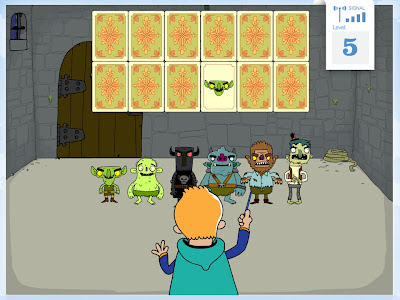
It was designed to be a fun way for kids aged 6 to about 12 or 13 years of age to exercise important psychological processes that help them to get the most out of learning situations. Things like being calm and concentrating, holding things in your memory, controlling your impulses and ignoring distractions.
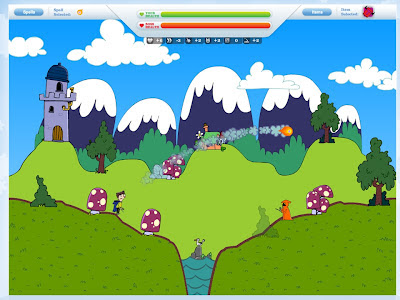
There’s a training mode as well as challenge and multiplayer modes just for fun. The training mode takes a child through 25 sessions of fun training, ending each day with the boss level, where they get to battle the evil necromancer using items they’ve earned during the days training.

The better they do the better their spells and tricks! The training mode is similar to the training used in the research studies which showed that the children’s behaviour improved.

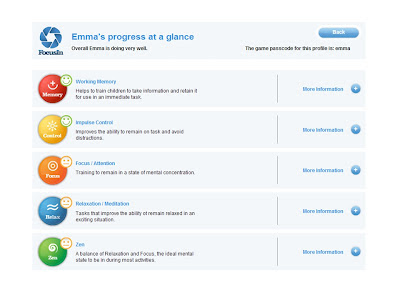
Parents can track their child’s progress using on online app called FocusIn. There is a report generated every day and at the end of the training. Parents of kids in our research studies at the university said that was really important to them, so NeuroCog built it in.

5. How can Focus Pocus be used by adult learners to improve their state control, working memory, and impulse control? Are there techniques that work with adults that are not used with children?
Focus Pocus could be used by adults, but the wizard in training theme was designed mainly with children in mind.
6. What do you see as the future of Focus Pocus and the applications?
I started doing this type of research because parents were constantly telling me they did not want to have to medicate their children who had AD/HD. My hope is that this type of training can be helpful as an alternative to medication, or as an adjunct to it. NeuroCog have done a great job of taking a fairly boring research tool and making it great fun for kids to play.
The good thing is that the principles behind the training methods are relevant for all children so Focus Pocus gives all kids a chance to improve those skills while having fun.
1. What is your name and your relationship to learning?
Dr. Stuart Johnstone. I am an research psychologist at the University of Wollongong (Australia). I do research into neurocognitive training for improving learning outcomes for children with AD/HD and also those without AD/HD. We look at behaviour and brain electrical activity, or EEG, to see if the training has had any benefits for the children. We’ve also looked at using EEG as a way of improving the training outcomes. I’ve consulted with Dr. Joseph Graffi, CEO of NeuroCog Solutions, on behalf of the university in the design of commercial software based on our research outcomes.

2. What are new findings about measuring brainwaves outside the head? Why does it matter? How can the knowledge help you?
People have been recording the electrical activity of the brain from the scalp for nearly 100 years. A really important recent development is the appearance of consumer devices for doing this in an easy and convenient way with dry sensors wirelessly. No need to be stuck in a lab using messy gels and wired up to huge machines!

EEG matters as it gives us information about the neural activity going on in the brain, and tells us things like whether or not a person is calm, or concentrating, for example. We can use that information in a few ways. One is to let the person know how well they were concentrating during some other sort of task, like a memory or maths task. The other is to give them constant feedback about, for example, their concentration level so that they become aware of how it feels to have low and high concentration and possibly learn to control it a bit more effectively.
3. What is the equipment? How easy is it to use it?
The consumer device we’ve used in our research, and that’s used in Focus Pocus, is the NeuroSky MindWave or MindSet. They are simple headsets that record EEG from the forehead area and send that information wirelessly into the computer. They do some calculations to provide a couple of useful measures, one is “attention” which ranges from low to high and the other is “meditation” which ranges from tense to calm. We use them in the software in the ways I mentioned earlier.

The headsets are very straight forward to use. They only take about 10 seconds to fit. No fiddly wires or messy gels like you’d see in the lab or at the neurologist. This was really important for our research as we wanted kids to be able to use it at home on an almost daily basis – put the headset on, start the software and get going.
4. What is Focus Pocus? Describe what is and how it works?
Focus Pocus is a PC game created by NeuroCog. The user is a wizard in training! There are 12 mini-games and a boss level.

It was designed to be a fun way for kids aged 6 to about 12 or 13 years of age to exercise important psychological processes that help them to get the most out of learning situations. Things like being calm and concentrating, holding things in your memory, controlling your impulses and ignoring distractions.

There’s a training mode as well as challenge and multiplayer modes just for fun. The training mode takes a child through 25 sessions of fun training, ending each day with the boss level, where they get to battle the evil necromancer using items they’ve earned during the days training.

The better they do the better their spells and tricks! The training mode is similar to the training used in the research studies which showed that the children’s behaviour improved.

Parents can track their child’s progress using on online app called FocusIn. There is a report generated every day and at the end of the training. Parents of kids in our research studies at the university said that was really important to them, so NeuroCog built it in.

5. How can Focus Pocus be used by adult learners to improve their state control, working memory, and impulse control? Are there techniques that work with adults that are not used with children?
Focus Pocus could be used by adults, but the wizard in training theme was designed mainly with children in mind.

6. What do you see as the future of Focus Pocus and the applications?
I started doing this type of research because parents were constantly telling me they did not want to have to medicate their children who had AD/HD. My hope is that this type of training can be helpful as an alternative to medication, or as an adjunct to it. NeuroCog have done a great job of taking a fairly boring research tool and making it great fun for kids to play.
The good thing is that the principles behind the training methods are relevant for all children so Focus Pocus gives all kids a chance to improve those skills while having fun.
Friday, February 10, 2012
Interview with Michael Schutzler, Livemocha.com, Innovators in E-Learning Series
New approaches to online learning take advantage of new mobile devices and the willingness of learners to engage across platforms, technologies, and infrastructures. Learning languages is no different, and the focus now with new technologies, which are used in online forums, bachelor degree programs, graduate programs (for example, and online master's in Spanish), and even Ph.D. programs is all about interactivity. Welcome to an interview with Michael Schutzler, CEO of Livemocha.com.


 The Livemocha Scholarship Program, which launched on January 11th, 2012, is needs-based and will give US high schools and community colleges the ability to apply for free or deeply discounted language learning solutions with the goal of rebuilding language training programs to serve our nation.

What is your name and your relation to eLearning?
My name is Michael Schutzler. I am the CEO of Livemocha.com, the world’s largest online language learning community. I have been formally trained as an instructor in several disciplines including Telecommunication Systems Troubleshooting, Water Safety, Zen Meditation, and Executive Coaching. I am an avid technologist, internet entrepreneur and angel investor. I am PASSIONATE about providing teachers useful technologies to make learning both exciting and effective.
What is Livemocha?
Livemocha.com is 13 million people helping each other learn skillful conversation in 38 languages. The company was founded in 2007 and is dedicated to creating a world in which every human being is fluent in multiple languages.
What is Livemocha's instructional philosophy? How does it help with learning language?
First, the team at Livemocha believes that language is a performing art, not merely an intellectual pursuit. Therefore, we emphasize skill development - in particular, we emphasize conversational competency.

We encourage and reward every language learner to try to communicate using the tools he or she learns in each lesson. Since the advent of the Internet and especially with the explosive growth of Skype, Twitter, Facebook, LinkedIn and many other forms of communication - we encourage both typed and spoken conversation skills. Of course, we also encourage each learner to share their own native language skills with other members who are eager to learn.
In this way, everyone gets to fumble for a few minutes with a new language and then shine for a few minutes when they share insights into their own language.

In what directions would you like to see education go? Why?
About sixty years ago, our nation had a wake-up call called Sputnik. Suddenly, we were in a race to ensure that our kids were the best at math and science so we could beat the Soviet Union in military and technical development. Meanwhile, funding for public schools has eroded in the past few decades and the result is a public school system obsessed with math and science curricula while jettisoning the humanities.
We do so at our peril. The rest of the world considers bilingual a baseline requirement for higher education and professional advancement. Those powerful communication technologies I already mentioned (Skype, LinkedIn, etc.) are making it possible for even the smallest company to reach global markets. Among the Fortune 500, more than 30% of the current job openings have bilingual as a requirement. Our education system cannot meet that demand.
Livemocha wants to ensure that every person reaches their full potential through skillful conversation in multiple languages. That’s why we created the Livemocha Scholarship program. By donating 5 million dollars worth of Livemocha services to underfunded community colleges and high schools in 2012, we’re hoping to give teachers the resources they need to help students become global citizens.

What is Livemocha doing to promote language learning?
We are partnering with many organizations throughout the country and around the world. Livemocha is already in use in thousands of high schools, colleges, corporations, libraries, non-profit organizations, government agencies, and more.
Our most recent endeavor helps schools build stronger language programs with the help of native speakers and teachers from around the world.
 The Livemocha Scholarship Program, which launched on January 11th, 2012, is needs-based and will give US high schools and community colleges the ability to apply for free or deeply discounted language learning solutions with the goal of rebuilding language training programs to serve our nation.
 Schools can find additional information and apply for the scholarship program. Simply visit www.livemocha.com/scholarship or email scholarship@livemocha.com.
Wednesday, February 08, 2012
Enter for a chance to win $100 gift card from Follett Bookstore!
Enter for a chance to win a $100 gift card from Follett! Share your favorite study location and earn an opportunity to win! Send an email to susan@elearningqueen.com that describes your ideal study place and conditions, and we'll put your name in a drawing for the gift card. The winner will be announced on March 15, 2012, and e-Follett will send you the card.
In the meantime, feel free to share your thoughts about and experiences with CafeScribe by posting a comment below. E-Learning Queen will send the link to them to Follett's representative. Your feedback is important!

Monday, February 06, 2012
Teacher Salary
What do you think? Share your own story (post a comment).
Click here for the orginal graphic, with an interesting op-ed piece:
http://www.onlinedegree.com/infographics/teacher-salary

Teacher Salary Infographic created by Online Degree
Tuesday, January 31, 2012
Interview with Shawn Alyea, Innovators in Education Series
Using art and art therapy to reach at-risk students and to help achieve academic goals is an extremely important strategy. Not only does it allow freedom of expression, it is also motivating and it helps develop self efficacy. Welcome to an interview with Shawn Alyea, who develops approaches using different types of art and expressive media to develop innovative instructional programs. You can see samples of his work by visiting his Flickrstream.
1. What is your name and your relation to education?
Shawn Alyea. I have a Masters in Counseling Psychology, Special Education and a Bachelors in Special Ed. I taught for 10 yrs, grades 1-12 at various times. Both of my parents were educators.
2. What is your philosophy of education for at-risk children and families?
To explore new and innovative ways to access and apply information needed for the task at hand. An at risk child especially needs to see how the activity they are becoming involved in can benefit them.
For some that is escaping a chaotic or hostile home life by concentrating on academics, for some it may be learning skills for employment, or to express themselves in the arts to find their own voice. If you can demonstrate to the parents that you are involved in their children’s life (and theirs) as a positive force not a judgmental one; the student and the teacher are more likely to receive parents support.
If you can help a student find or encourage something they excel at and then attach that to a cause bigger than themselves they are more likely to be motivated to rise above the challenges they may face in the home environment.
3. How does one's advancement in education result in a ripple effect in one's family?
Family systems therapy would compare the advancement to a change or a dance. If the child surpasses the parents in knowledge it may be seen as a threat. You have to work to reframe that in a positive light or you are likely to lose your opportunity to help the student flourish.
If the parents are frustrated because their child has not made the progress they had expected and you can show that progress occurring, then you’ve become an ally to the family and the student. The wise educator will be sensitive to any changes in the family.
The student’s advancement in education may also enable their children to have a higher income
or career choices than their parents or grandparents.
4. What is your view of the relationship between art and one's identity and self-concept?
Art in all of its forms would be a portrait of the soul at a given time and place to me. It is very personal, exposing and honest. Often unconscious, and mystical it reaches into the spiritual realm, and at the best of times God seems to join you in the creation. So I see art as a mirror to observe yourself as you engage in the process. This observation may notice changes, themes and emotions you otherwise might not have noticed about yourself.
Here a few works of art that explore the mystical: (Note that more can be seen at Shawn's Online Gallery / Flickrstream)


6. How can art projects be used in both online and face to face courses?
Academically various techniques can be taught. Depending on how detailed, or demanding they are you can observe how the student interacts with the media or techniques.
The student really tells you much about themselves if you simply observe them. Are they patient? Do they struggle with being impulsive? Do they typically lack focus except when engaged in something of great interest? What media are they attracted to? How do they organize and then execute the activity?
This is more difficult in on line course unless you can adapt the camera’s to show the student’s work environment. On the other hand on line allows you to interact with people across the globe, and to access cultures and views that you could never dream of in a face to face setting.
7. Who are some of your favorite artists? Why? How?
Rouault , Van Gogh, Matisse, Chagall. George Ohr Potter. I like their free forms of expression and colors.
Monday, January 23, 2012
E-Learning Queen's E-Learning Crossword Puzzle
Here's a holiday gift for you!

Click the link to access a crossword puzzle that tests your knowledge of e-learning terms.
E-Learning Queen's Crossword Puzzle (created by Seth Lynch)
Click the link below for the answer key:
Answer Key to E-Learning Queen's Crossword Puzzle (created by Seth Lynch)
2012
Monday, January 16, 2012
Interview with Elaine Bontempi, Ph.D., Instructional Designer; Innovators in E-Learning Series
As elearning and mlearning move into new forms of delivery, and the appearance, capabilities, and the functionality of the interfaces (including learning management systems (LMSs) evolve, it's useful to take a look at how instructional designers, technologists, and administrators are considering the impact of the interface when developing and teaching online courses. Welcome to an interview with instructional psychologist and designer Elaine Bontempi, Ph.D., who has applied her research in motivation, cognition, and non-traditional students to developing highly effective learning strategies for distributed forms of education including accredited online colleges. Developing elearning and mlearning courses for distance and hybrid delivery, Elaine has explored both issues vital to effective interface and instructional strategy development.


What subject matter do you prefer to work with?
Psychology, Human Motivation, Sociology & Women’s Issues
Who are the intended learners? What level are they?
I have developed online and hybrid courses for a variety of institutions including several universities and museums as well as government institutions. The majority of courses I have developed are predominately targeting undergraduate and graduate students at universities.
How do you use graphics when you design a course?
When I am selecting graphics I always choose graphics that promote learning. In other words, the graphics must correspond to the subject I am teaching, and they are used as introductions, discussion material, or to make a statement. When selecting graphics I always select those that are high quality—sometimes black and white and at other times color, but it depends upon the topic. For example, when promoting learning in natural sciences, color images are preferred because they can help students learn properties of minerals, etc. When using color images, I always try to use images with natural colors rather than colors that are not natural, because natural colors are recognized by the brain as being normal and therefore, are more easily remembered (Richman, 2006). For example, when discussing induction motivation in the military I incorporate images of recruiting posters used throughout the years. These are great for helping students to identify different types of induction motivation that are being promoted. However, black and white images can sometimes capture the moods of people better, so if dealing with the social sciences, sometimes I will select black and white images.

What learning objectives do your graphics serve in an online course?
The graphics I select are used to promote learning. I also use graphics to help students organize information. Tables, charts, and graphs help separate and organize information, and can be a form of concept mapping, tying in concepts.

What kind of graphical content do you use? Banners? Color-coding? Specific images? Special arrangementthat displays information in a certain way on the screen?
When incorporating images into the lectures (ppt slides) or in the website, I select images that again, tie into the topic being taught. I am careful to select images that correspond well with one another…that flow well. Otherwise, images that are not the same size, quality, etc. become distracting to viewers. I never allow images to run off the size of the page and when including an image that has direction (ex: a person’s eyes looking one way or another, their bodies positioned in one way or another, a car or animal moving in one direction or the other, etc) I never allow the image to pull the viewer’s focal point off of the screen. In other words, images with movement point into the text rather than off of the page. Since the majority of students I teach read English or other languages that read from left to right, the text and the images flow from left to right or top to bottom, rather than right to left (as would be preferred in Hebrew or another language that reads from right to left). The colors I select are also important. They are not distracting, complement each other well, and are easily read and viewed. No distracting neon colors, etc that would distract a learner from the content are used.
Numerous studies have identified links among culture, user preferences, and web site usability. There was a very interesting study conducted by Dong and Lee (2008) on the role of culture on cognitive processing and webpage design. People from collectivist cultures tend to be more holistic (or global) learners—looking at the whole picture rather than individual components. However, those from individualistic cultures (with the exception of those from collectivist subcultures such as Native American, Hawaiian Natives, and Alaska Natives) tend to be analytical or sequential learners, wanting to learn things in sequence rather than seeing the “big picture” first. These cognitive differences also influence the way we actually process visual information.
The eye movement of people from various cultures has been studied and results have shown that those from collectivist cultures (holistic learners) tend to have more eye movement over the entire image and have better recall of elements of information from all over the webpage. However, individuals from individualistic cultures who are more analytical learners, have more eye movement in the center of the webpage or image, and have less recall of information that was positioned on the outskirts or edges of the image or webpage. Similarly, Nesbitt and Masuda (2001) conducted a study that examined eye movement of American and Japanese students when shown a picture of an underwater scene “that included focal objects-three big fish-and background objects like rocks, seaweed and water bubbles” (Winerman, 2006, p. 64).
When researchers asked participants to describe the scenes, American participants were more likely to describe the fish in the center, whereas Japanese participants were tended to describe the entire scene. The Japanese participants were also able to describe more details about objects in the background and surrounding rather than simply those images in the center. In other words, whereas the American participants focused more on the objects in the center, the Japanese participants paid more attention to the context.

This is important information to consider if you are developing and presenting information to students or individuals from various cultures. For example, if you were developing an online course for students you knew were from collectivist cultures you may want to position your images differently than you would for learners from the United States or Western European cultures. Faeiola and Matei (2005) found that American and Chinese users exposed to websites created by both Chinese and American designers indicate that users perform information-seeking tasks faster when using web content created by designers from their own cultures.
Please describe your philosophy of using graphics in online courses.
My philosophy regarding the selection and inclusion of graphics in an online course is that graphics and images should are a great way of gaining the attention of learners and promoting learning. Text heavy websites that omit or only scarcely include images are often boring and lose the attention of learners. When selecting images to include in an online course or training program, the images should be high quality and in most cases, the use of color images is preferred (unless the subject is more artistic or perhaps historical, at which black and white images might be preferred). The images should be properly placed on the website so that the readers’ focal point is not drawn away from the webpage. Ideally, images should be small (thumbnail) and readers should be able to click on the image to blow it up if it is a part of the actual content. If the image is an introduction to the topic it may be larger to gain the interest of readers.

Can a good graphic go bad? Why, when, and how might that happen?
Absolutely. When a good image is used in an inappropriate manner, the graphic or image has lost its ability to teach and motivate. If an image does not correspond with the material it becomes a distractor, or if an image is placed incorrectly in the webpage it becomes distracting.
How do graphics "mediate" the e-learning space? In this case, "mediate," describes the way that graphics influence and even alter the way that learning takes place -- between learners, instructors, and the content itself.
As I mentioned earlier, graphics and images have the ability to gain and maintain a student’s attention, drawing them into the subject. A good image or graphic also helps explain the subject, or provides an example and sometimes tells a story by itself. We are visual creatures, and learn not only by reading, but by seeing, observing, and watching. When we learn we take mental pictures of what is happening at the time, so images and graphics can be used to promote learning and organize information. Some people are more visual than others, and the use of graphics, tables and charts can serve as forms of concept maps, linking concepts and information together in a visual way that is easier to recall. For example, in an online counseling course that teaches assessment and evaluation, students might be taught to develop genograms of clients. These genograms may help them to see things that they may not have otherwise noticed…family patterns of health issues, behavioral patterns, etc. in a visual “snapshot.”

Do you believe that the graphics that are used somehow influence how individual learners perceive the instructor? Do they attribute attributes of the graphics to you, your personality, your values?
Perhaps. However, not all instructors have say in the course development since adjuncts commonly teach courses that were developed by other professors. I think that more than anything, the personality of the instructor is revealed through interaction with the students in discussion boards, chats, feedback on papers and projects, video conferences, etc.
How does the interface (the website, course management software, e-mail, the computer screen presentation) affect how you present yourself? What are the elements in the interface that you have to compensate for? How do you compensate for them? Please describe one such experience.
Each university has its own approach to learning. Some offer hybrid courses where instructors can provide more information and interact with students more on a face to face level and the online component is used for further discussions, distribution of information, assessment, etc., whereas others offer online but no hybrid courses. In addition, each online course will differ based upon subject, the individual instructor, as well as the instructional philosophy of the institution. In addition, the actual course management system influences the learning experiences.
Some institutions may use Blackboard, Vista, WebCT, Desire2Learn, e-College, Moodle, etc. and others use a combination of a course management system with a stand alone website. In addition, each course management system has its own features and some institutions purchase only the most basic bundles that do not have all of the capabilities of more expensive ones. If an institution has only limited server space and has purchased the basic model of a course management system the instructor needs to find ways of compensating. Perhaps incorporating social media to conduct introductions, chats, and team activities. Others may need to include outside links to video clips, audio files, etc if server space is limited at their university.
How do you attempt to modify the interface? How do you make it more friendly? More learner-centered? Do you design the course to build in reinforcement of elements you want to emphasize? Please describe one such experience. Tell in detail how you did it.
It is important to keep in mind that depending upon the institution, the instructor may not have a lot of liberties when it comes to changing the webcourse. Sometimes the professors must teach “canned courses” that cannot be changed at all. In these cases, professors can make suggestions to outside links (perhaps videos, case studies, and documentaries all available online) that promote the learning of the particular topic. In addition, keeping good discussions going and interacting with students keeps the students motivated and involved.
When I develop an online course I always try to include various formats for learning. Not just text assignments or outside readings, but also watching documentaries available online, participation in collaborative work (team projects) that promote the sharing of information, lots of dialog in discussion boards, etc. Keep in mind that in an online environment the role of the instructor changes to that of a facilitator rather than simply a distributor of knowledge, especially when dealing with adult learners.
When developing courses for adult learners I always try to have students participate I teamwork and have course spanning projects that pull from their experiences so that the information they are learning in the class can be applied to realistic problem solving activities. Therefore, part of “modifying your interface” really is contingent upon knowing your learners…who they are, what their experiences are, what they want to learn from the class, how they will use the information, capabilities, access to equipment, etc.
References
Dong, Y. & Lee, K.P. (2008). A cross cultural comparative study of users’ perceptions of a webpage: With a focus on the cognitive styles of Chinese, Koreans and Americans. International Journal of Design, 2(2). http://www.ijdesign.org/ojs/index.php/IJDesign/article/view/267/163
Faiola, A., & Matei, S. A. (2005). Cultural cognitive style and web design: Beyond a behavioral inquiry into computer-mediated communication. Journal of Computer-Mediated Communication, 11(1), article 18. http://jcmc.indiana.edu/vol11/issue1/faiola.html
Richman, K.J. (2006). Short term memory retention: how time and color play a role
Saint Martin’s University Biology Journal May 2006, 1 (51).
Winerman, L. (2006). The culture-cognition connection. The Monitor, 37 (2), p. 64.
Monday, January 09, 2012
Intimate Partner Violence (IPV) and E-Learning
Chances are, if you're teaching an online course, out of 20 students, two or three have been a victim of Intimate Partner Violence (IPV) at least one time in their lives. Actually, that's a conservative estimate, given that 3 out of 10 women and 1 out of 10 men in the United States has been victim of rape, physical violence, and/or stalking (CDC, 2012), and that's not even getting into the issue of emotional abuse, which includes name-calling, intimidation, stalking, and refusal to let someone see family or friends. Accredited online colleges, online courses, programs, and degrees address women's issues, domestic violence, sociology, and psychology. It's easy to think of the problem as occurring in a nice, contained quarantine zone or petri dish. However, its effects are in and around the online world you live in and they may be causing students to underperform (miss deadlines, turn in poorer quality work than they are capable of, fail to interact effectively in collaborations and discussion areas), and to drop out of courses and programs.
According to the CDC's IPV factsheet, Intimate Partner Violence (IPV) is behavior that occurs between two people who are or who have been close. They can be married to each other, divorced, dating, or formerly dating. The violence can take four different forms (CDC, 2012):Physical violence: a person tried to hurt a partner by using physical force (hitting, kicking, pushing, etc.)
Sexual violence: a person forces a partner into a sex act against one's consent
Threats: threats of physical or sexual violence made with words, gestures, weapons, or other means that communicate an intent to harm another
Emotional abuse: threats to harm a person, a person's possessions, or loved ones, and also harming the partner's sense of self-worth. This can include name-calling, intimidation, stalking, and forced isolation.
If you think that the kinds of violence in IPV have no way of occurring in the online course, you might be surprised.
For example, what about the case of a student whose intimate partner becomes enraged at the amount of time she spends studying, and harms her computer?
Or, what about the time lost from study due to emotional or physical trauma?
If the partner has to hide from a stalker or a violent partner, there may be disruptions to connectivity, not to mention the fact that the extreme emotions are very disruptive. It is not easy for a student to focus if he or she is experiencing emotional turmoil.
If one's teenage son or daughter is a victim of dating abuse, they are also likely to have affiliated problems which can include fighting, binge drinking, eating disorders, and even suicide attempts.
Further, there are measurable impacts on one's mental and physical health. For example, men and women who have been victims of rape, stalking, physical or emotional abuse by an intimate partner reported headaches, chronic pain, sleeping difficulties, anxiety, and depression. Women victims were likely to have asthma, irritable bowel symptom, diabetes, and other health problems. (CDC, The2010 National Intimate Partner and Sexual Violence Survey, 2011).
The CDC has developed a video explaining teenage dating abuse:

www.cdc.gov/CDCTV/BreakTheSilence/
(transcript: http://www.cdc.gov/CDCTV/BreakTheSilence/Transcripts/BreakTheSilence.pdf)
Perhaps one of the most tragic consequences of IPV is that it sets off a chain reaction of behaviors, all of which can be damaging to one's self-concept, self-esteem, and even physical wellbeing.
With an awareness of the pervasiveness of Intimate Partner Violence, what can you do if you're teaching / designing an online course?
How do you help your students succeed, knowing that they may have disruptions due
to abuse, trauma, or injury?
- Make the online environment a safe one. Do not allow intimidation, threats, demeaning or belittling behavior of any kind.
- Encourage research papers having to do with topics of interest and current problems. You can create a list of possibilities, and include IPV. (Clearly, this works with some
courses, but not all.)
- Put links to health and wellness sources, which can include the CDC sites that have information on IPV. Include hotlines as well. Encourage wellness in general, so it is also good to include links to nutrition sites such as the USDA's "My Plate" guidelines.
- If students indicate in personal correspondence or posts to discussion boards that they are in an abusive situation, encourage them to research the situation and find a qualified person to speak to about the situation.
- Provide a flexible, supportive environment that provides students a chance to contact you if they need more time on an assignment.
- Realize that extreme stress can interfere with cognitive functioning, and provide more support for the writing process by asking for invention strategies, outlines, brainstorming, and multiple drafts so that students can take a building
block (rather than having to generate everything at the last moment).
- Provide practice tests and activities to help students build confidence.
- Encourage goal-setting and provide a great deal of positive feedback and reinforcement.
However, it's a reality, and the only way to help people overcome it and heal their wounds is to open yourself and become aware of what is happening.
Once you have achieved a level of self-awareness, you can determine what is best for you as you
think of actions and activities in the e-learning space that will help your everyone achieve their best and brightest selves.
REFERENCES AND INFORMATION SOURCES
CDC, 2011, The 2010 National Intimate Partners and Sexual Violence
Survey. http://www.cdc.gov/ViolencePrevention/pdf/NISVS_Report2010-a.pdf
CDC Facebook Page on Violence Prevention www.facebook.com/vetoviolence
National Domestic Violence Hotline 1-800-799-SAFE (7233), 1-800-787-3224 TTY, or www.ndvh.org
National Coalition Against Domestic Violence www.ncadv.org
National Sexual Violence Resource Center www.nsvrc.org
Family Violence Prevention Fund www.endabuse.org
Tuesday, December 20, 2011
Interview with Breanne Hull, Educlone. Innovators in E-Learning Series
Finding new ways to engage students and create engaging e-learning experiences is a continual challenge. Welcome to an interview with Breanne Hull, Educlone. The Educlone learning platform features an interface designed for rapid development of distance learning (elearning /mlearning) which uses a drag-and-drop approach.
1. What is your name and relationship to elearning?
My name is Breanne Hull and I've worked as a public school teacher, an instructional designer in educational software, and as a training and eLearning consultant. I am currently the co-founder and CEO of Educlone.
2. What is Educlone?
Educlone is the eLearning platform that I wished I had as a teacher. Individual accounts for public school teachers are free, and it's a place where they can create their own online learning just by clicking and dragging boxes around. It's so simple that it's almost hard to explain. Our goal is to make is simple for teachers to create their own engaging, dynamic online learning.
1. What is your name and relationship to elearning?
My name is Breanne Hull and I've worked as a public school teacher, an instructional designer in educational software, and as a training and eLearning consultant. I am currently the co-founder and CEO of Educlone.
2. What is Educlone?
Educlone is the eLearning platform that I wished I had as a teacher. Individual accounts for public school teachers are free, and it's a place where they can create their own online learning just by clicking and dragging boxes around. It's so simple that it's almost hard to explain. Our goal is to make is simple for teachers to create their own engaging, dynamic online learning.

3. How is Educlone different?
We thrive on simplicity. While some teachers are comfortable with the current eLearning interfaces that are out there, some are not. Unfortunately, this prevents many teachers from giving eLearning a try. Our interface doesn't look like it was built by a room full of engineers and computer programmers. It looks like it was built by teachers, for teachers, because, well, it was!
It's eLearning, made easy. We also avoid content development and just focus on making our platform easy and intuitive to use. So many educational software companies spend huge sums of money on content development. They make sure to meet every objective tied to every standard for every state and territory. A teacher ends up with this district-mandated pricey software that contains tons of superfluous content and, ultimately, wastes time instead of saving it. Educlone leaves the teaching in the hands of the teachers. They develop their own content with their own special flair, tied to their specific state and local objectives. Once the lesson is created and recorded in Educlone, students go through the lessons at their own computers, at their own pace. This leaves the teacher free to use class time to actually help the students who need it, with one-on-one attention, without having to stay after school or hold the other students back.
4. Where will Educlone be in five years? In 20 years? (E-Learning Queen realizes these seem to be rather crazy questions, but "the Queen" thinks we've problematized ourselves by thinking in short-term and medium-term solutions, and that we are stuck in this year's technology -- rather than thinking in broad-brush principles…)
Educlone will be wherever teachers and trainers want it to be. What we have created is an organic, living, breathing ecosystem that responds to the needs of its users. If a feature is requested, then we add it. Otherwise, we leave things just as they are and avoid over-complication. I want teachers to feel like this is their technology. No more having things handed down from administration that they are forced to use. If they want it to be complex with more features, than it will be. If they want to share lessons with other teachers across the miles, then it will be done. If they want students to create lessons and learning experiences for each other, then we'll throw that in. Otherwise, we'll leave it as it is - clean and simple. I want Educlone to feel like a comfy living room that educators can really spend some time in, creating valuable learning experiences.

strong>5. How are you transcending the tendency of today's LMS's to create an education garden rather than a factory?
I'm not sure who it was, but someone at some point decided that putting a book on screen is online learning. I've taken online courses, recently, that were like, "Read this paragraph. Ok, now read this paragraph and see the attached stock photo. Now click the 'next page' button to read the next paragraph." Seriously???
Technically, since reading a book is a form of learning, then putting some form of that book online could be considered "online learning." But come on, people. If I can tap one button on my little phone and see, oh, I don't know… an immediate live feed of Times Square, then surely we can leverage technology in education to do more than throw text up onto a screen! In that same vein, software that helps teachers to automate tasks related to school and classroom management are great - but is that really managing learning? I'm not even sure that Educlone should be considered an LMS. We're not trying to create an online school, and we're not aiming to automate administrative tasks like taking attendance. Like a garden, Educlone offers itself up as an open space to create and grow ideas. We focus on allowing teachers (and their students!) to create really interactive and engaging learning experiences. We also focus on giving teachers really clear and immediate feedback on how students are doing throughout the lesson.
6. List your top 5 books …
That's a tough question! I'll just list the three that I'm currently most interested in. Those are Drive by Daniel Pink, The Habit of Thought by Michael Strong, Rework by Jason Fried and David Heinemeier Hansson
Tuesday, December 06, 2011
Tune-Up Time? Updating Your Elearning / Mlearning Programs / Courses
Accreditation visits, self-studies, competition, and the changing world (and technology) make it necessary to update your online courses every 2 or 3 years, at the very minimum. In some cases, you’ll need to tune them up every year, depending on the kinds of changes in the course content, the academic field, your accrediting bodies, or the legal environment.
When do you update? How extreme does the updating have to be? Do you have to start over, completely rebuild from ground zero, or are there ways to update efficiently, economically, and relatively painlessly.
Updating your courses, and doing a tune-up can be fun, especially if you have a bit of guidance. Not only will you enjoy the process, you’ll be delighted when you find you can do it quickly and cost-effectively.
We’ll look at how to know when, where, and why to update. Later, we’ll go into details about how to economically update your courses and programs.
Instructional Materials // Content Changes: When did you last update the course? Was it 2 or 3 years ago? Chances are, many things have changed. Articles have become obsolete, science has advanced, and political changes have altered the landscape. Even if your content is impervious to change, it’s possible that the links you’ve incorporated have changed. Even if you’ve subscribed to a service (rather than linking to websites), they have a way of updating and reorganizing their repositories.
Changing Course Objectives: It is possible that the course itself has changed. The objectives may have changed, and its role in the degree or certificate plan may have changed. While the changes may seem subtle and relatively minor, if you don’t update the course, there will be a big disconnect between your course and the real-life needs and objectives.
Institutional Changes: Has your institution obtained new accreditation? Have structural changes occurred? Are you experiencing a transition? It’s hard to find an institution of higher learning – profit or not-for-profit // private or public – that has not gone through amazing sea-changes, especially in the last few years, when there has been significant pressure to demonstrate that the educational program that students invest in (and become indebted through),
Technology Changes: Are your courses smartphone and tablet-friendly? Are they downloadable and portable for people who do not have 100% cloud connectivity? We made assumptions about access, bandwidth, and browsers / plugins / systems when we originally developed the courses, and sometimes those assumptions turned out to be massively wrong. What now? What do we do to turn things around when we have no budget for it? There are ways.. don’t despair. Unfortunately, this is not the article that discusses the shoestring solutions. But, it is the article that lets you know that shoestring solutions exist. They are there. Just reach out and ask for guidance. It will be there.
Student Base Changes: You may find that your student base has changed, and you’re in a situation where your courses seem a bit out of alignment. For example, you may have designed courses for students deployed to Iraq. Now, however, most of your students working at hospitals and clinics in the U.S. As a result, some of the course content seems strangely out of synch. What should you do? Obviously, you have no choice. You need to update the course.
Legal and Regulatory Environment Changes: Many courses exist because they help working professionals stay up-to-date with regulatory changes. This is an ever-shifting target, and the content is in flux. You have to bite the bullet and update whenever there are substantive changes, even if it’s twice a year. Bite the bullet. If you do so, you’ll gain market share because your program will be head and shoulders above the laggard competition.
Financial Condition Changes: Has the financial condition of your educational institution changed? Are you suddenly in financial dire straits? This may mean that it’s time to update your courses so that they cost less to run. Is that possible? Yes. Spend money to save money. It’s counter-intuitive, but it works.
There are a number of reasons why it is a good idea to continually update your online courses. Doing the updating on a regular basis will allow you to avoid catastrophic delays and expenses.
If you’d like assistance, E-Learning Queen has assembled a knowledgeable, experienced team, The Queen Team. Please inquire for more details. Email: susan@elearningqueen.com
Friday, December 02, 2011
Interactive Grammar Exercises: Better and More Useful than Ever
Some think that grammar reviews are only useful when taking a developmental writing, or the required set of first-year composition courses. In reality, grammar and syntax reviews are valuable across the board, and all college and university students can benefit from ongoing writing reinforcement. So,whether you are writing a term paper about hospice care, or an analysis of the current economic situation, the proper care of dogs, or any other topic, understanding the basics of grammar will help you.
I highly recommend supplementing peer reviews and personal guidance with interactive exercises. Many interactive grammar reviews are available online without registering, and they are free of charge. You can practice grammar using your laptop, tablet, and handheld.
Further, many of the grammar reviews have downloadable apps so they display nicely and work smoothly with your smartphone or tablet. If you are currently enrolled in a course, chances are your textbook will come bundled with an e-lab (MyCompLab or My Writing Lab, just to name a few). These are also excellent guides.
If English is your second language, you may wish to pay special attention to sections such as "countable and non-countable nouns" and "easily confused words."

Here are a few good, easy-to-access, easy-to-use interactive grammar exercises:
Grammar Bytes -- http://www.chompchomp.com (by Robin L. Simmons)
Skillswise (from the BBC) -- http://www.bbc.co.uk/skillswise/topic-group/writing
Interactive Quizzes (Capital Community College Foundation)
Business English Grammar Exercises (actually applicable to all occasions)
Enjoy!
(E-Learning Queen http://www.elearningqueen.com // Susan Smith Nash, Ph.D.)
Visit E-Learning Queen's Youtube channel: http://www.youtube.com/elearningqueen
More elearning videos at http://www.youtube.com/beyondutopia
Monday, November 28, 2011
Reality Television-Inspired M-Learning: “Life Is Our Laboratory” Approach
Effective design for mobile learning courses requires a major shift in how one thinks of the learner's relationship to the content. Interactivity takes on a whole new dimension, as students create content to share and critique in close to real time. The key is to avoid sending students down a path where they will be more or less duplicating what the others have done. They need to be able to apply their knowledge and skills and to process them so that they make sense in real-life applications or simulations / scenarios.
One must keep in mind, too, that the new iPad, Kindle Fire, and other e-readers mean that students are likely to be able to read texts on the fly and develop more robust, course-related content more easily and conveniently than in the past.
Where does the student create content to upload and share "in the wild" with their mobile device (tablet, smartphone, handheld)? What are the best methods of sharing?
Protected social networking
Discussion prompts
Research repository (a thread in a discussion board area, or a location within social networking sites)
Shared photos / media
Portfolios / Final Projects / Lab Reports - (portfolio sites -- can use Faceb00k-type social networking for sharing collaborations)
Interviews / Observation: can be a combination of audio, video, graphics, and text files which can be uploaded within an LMS or in a dedicated social network site
Presentations (PowerPoints / KeyNote slides, potentially animated using captivate)
Implications for Instruction
Student-developed content is exciting, dynamic, and encourages interaction; it also encourages creative development of content.
- Originality is paramount. Avoid plagiarism.
- All students must be mindful of the fact that fellow students' work may or may not be accurate; just because it's on the web (posted in a site) does not make it credible; nor are all the links and resources necessarily reliable. It's a great opportunity to practice critical thinking skills.
- Students will need clear guidelines re: size of files and where to upload.
- Content guidelines – be sure to let students know what’s not okay.
- Privacy issues when gathering information and sharing information
- Social Construction of Reality – what is real? Who decides?
- Simulacra okay? Use faux persona, etc. when dealing with actual persons / places / products could be too sensitive.
Reality TV-inspired Mobile Learning
Psychology / Sociology
Example: Real Housewives of (fill-in-the-blank)
Your own: Social Relation Drama
Humanities
Example: History Channel programs
Your Own: “History Needs a ReDo!”
Go to historical sites and ask tough questions / debunk and challenge current beliefs. Find out what most people think.
Biology / Animal Behavior
Example: Fatal Attractions (When pets become predators/ exotic pets turn on their owners)
Your own show: "Biting the Hand... Can You Trust Your Companion Animal?" (Chronicle the life of your own pet … is there any reason to start fearing your own Siamese cat, Chihuahua, Laborador retriever, pit bull?)
Earth Science / Environmental Science
Example: Swamp People on the History Channel (history.com)

Your own show: Meet the Frackers – show different sides of the controversy surrounding hydraulic fracturing in shale gas wells
Criminal Justice
Example: Steven Seagal - Lawman

Your own show: Quirky Laws! (Research laws that are on the books and which reflect the life and times of communities in transition. Do they apply today? Why? Why not?)
Friday, November 11, 2011
Identity in Social Media: Constructions or Meltdowns
We've all read the cautionary tale about the pre-teen who is "friended" by someone who also seems to be a similarly angst-y pre-teen or "tweener" - whose middle school pressures are almost as bad as the new-found distrust of and distaste for one's parents. The "friend" turns out to be a much older predator, and the outcome is tragic.


Some may have read about or watched the film, Catfish (dir. Henry Joost, Ariel Schulman, 2010), which had to do with a young NYC filmmaker, Nev Schulman, who (along with his filmmaker buddies) decided to film himself falling in love with the older sister of an 8-year-old artistic prodigy whose paintings, while definitely in the "outsider art" realm and "realist primitivism," started to have a following on Facebook. To make a long story short, the cast of characters - the mother, the 8-year-old, the older sister -- that the filmmaker interacted with were completely fictive. The NYC filmmaker, who said he wanted to meet his new-found love on her horse farm in the upper peninsula of Michigan, claimed to be devastated (and he filmed himself finding out the truth).

Not surprisingly, the film was met with a surge of skepticism -- the filmmaker was accused of orchestrating the entire thing, and the woman, whose schizoid inventions populated the web, was viewed as a rather pathetic attention-seeker and reality avoider.
The bigger picture is this: What do you do when almost everything in the virtual world is just that -- virtual, and a construction -- and yet the feelings that are lived by the people behind the avatars are real?
This applies to online learning as well. Although you go by your own name in the online classroom, you are, in essence, creating an avatar, or an alternative proxy self by which you interact. You also go through progressive collective socialization, which may, in the end, either help you or hinder you as you make your way through the discussion boards, collaborative activities, and interactions with your instructor.
****************************
In the virtual world, individuals often craft identities in isolation and they project them into cyberspace. They are not constrained by the reality checks of a circle of friends, family, or co-workers, and their socialization process is utterly different than in a regular community or cohort group. This is potentially liberating, but also potentially isolating.
Each person, as he or she learns to interact with people, develops identity-construction techniques as a part of the socialization process. What are these identity-construction techniques? Where are they used? Many times, the identity construction techniques are used to cope in a world that is often critical and absolute in its insistence upon conformity.
For the average person in a group environment where there is social interaction, the identity-construction process occurs via clothing, gestures, vocabulary, activities, humor, narrative and story-telling. In short, it is a living theater, and the participants and successful group members become skillful actors.
For the unfortunate ones who are not necessarily adept at acting or at picking up cues, or who lack the resources (physical, financial, or emotional) to participate in this kind of socialization, there are consequences to pay for social ineptitude. They are often ostracized or marginalized. For others who are chronically "a beat behind" when it comes to assessing the strategies used by others to modify behavior in order to conform to the dominant ethos, the ability to create a virtual identity in cyberspace becomes very appealing.
Needless to say, cyber identity-creation can become an addiction, particularly as the new "cyber-persona" meets with positive reception to others who believe and respond to the alter ego / virtual identity as though it were real. The positive reinforcement found in this activity exerts a strong pull on a naturally introverted person, and when it is coupled with the cognitive/kinaesthetic "rewards" found in the Internet via sensory stimulation, there is no doubt that the individual will be tempted to retreat even further from the "real" world.
For that reason, in ideal conditions, a student in an online course should have group interactions with people where socialization processes are occurring. In the so-called "real world," the interactions can occur either via workplace interactions or in community activities. It can be very interesting to integrate online activities with in-person activities, in order to close the separation between what can become a fantasy persona and one's real self.
With social networks, it's important to be mindful of socialization processes, and to be aware of what you need to do in order to stay in touch with your group.
It is important to realize that often the person who is "one beat behind" in being able to assess the steps necessary to mold himself or herself into the dominant ethos may be a person who has struggled with social isolation. In other words, their social rejection has not occurred without some degree of psychic pain. If the individual has been punished or subjected to verbal or physical abuse, there could be a latent desire for avenging oneself. And, if the rejection or social ostracization has occurred due to physical appearances, it is quite likely that the individual will create a cyber-persona that possesses the attributes that he or she wishes to have. As a strategy for personal empowerment, building a cyber-persona can be ultimately futile, and the identity is complex and contradictory when one desires to operate as an all-powerful, all-knowing presence who is simultaneously "cool" and indifferent to "cool," who possesses both an omnipresent in-your-face visual presence and an ability to be absolutely invisible.
The proliferation of individuals displaying these psychological characteristics (to varying degrees) is a natural outgrowth of the availability of the Internet, and the ease by which one creates a persona and is able to act out unacknowledged desires. Needless to say, the identity-construction elements, and the virtual-travel abilities (including invading the spaces of others), are most appealing to those who do not flourish in traditional social settings. Ironically, those who are most talented in the cyber-world are the least likely to be comfortable with a guide or mentor. But, they are the ones who need them most. It is imperative that society find ways to provide them with a trusted personal mentor and guide because the damage that misguided identity construction and cyber-travel (hacking, etc.) can do can be quite extensive, with far-reaching consequences.
The trusted mentor-guide presence is more important than ever given the times and current socio-economic situation of global interconnectedness. On a personal level, individuals are likely to have dysfunctional attitudes toward their identity-creation activities in our current setting of fragmenting family structures, eroding communities, disappearing support systems, and increasing isolation.
The mentor-guide in an Internet-based course is a grounding presence, and any person who decides to assume this role will have to be aware that the safety and seeming anonymity of the Internet may give rise to more trust and dependence than the mentor has been prepared for. The learner may project his/her own problems onto the mentor, become dependent, confess personal issues, and become emotionally cathected. Ironically, this can occur without either having any idea of the real appearance of the other. Usually they have never met each other in person and never will.
However frightening this prospect is, it is necessary to look at it as an indication of the positive effects that Internet-based courses can have, if they establish a strong mentor-learner relationship in a safe, guiding environment. The mentor and learner can come to experience the Internet as critical elements in an increasingly inter-dependent (rather than independent) world, which teaches, models, and reinforces mutual caring, compassion, and respect.
The fostering of a positive environment for identity-creation and guided socialization (via the Internet) is very important for successful navigation in a world increasingly focused on appearances and first impressions, where long-term commitments have been supplanted by short-term relationships based on performance and/or convenience, and where human frailty is made invisible or is consumed / cannibalized so that the strong survive.
The online learner exists in a world that mediates itself between the "real" (where the people he/she interacts with are successful actors in the roles accepted by the community), and the "virtual" (where the identities she interacts with have successfully created identities that represent their deepest desires of who / what they would like to be in the world).
Both worlds require adaptation and socialization.
One can use the virtual world / Internet to provide:
-- positive guidance via a mentor
-- increased self-awareness on the part of the learner which allows him or her to contemplate
-- what he/she would do if empowered
-- how she appears in the mirror-space created by the Internet; for the first time she is able to look deeply and see what he or she would like to be, how to be that entity, when the persona is appealing, who the created persona would like to interact with (and how), and what the persona wants to do at various times and places.
Such self-knowledge could be a lamp in a dark existence, and could help deal with deeper issues. Not only can the guide-mentor relationship create better citizens, with equipped with new skills and strategies for living in a rapidly changing world, it can also address the problems and underlying factors that give rise to cyber-criminals. Further, the mentor can guide the student to an awareness that can allow her or him to remove the barriers that have been blocking his or progress. This will give learners a new opportunity to develop a vision of themselves or of where they want to be, and to guide themselves to a new understanding of how, and when to take steps along a path to a better existence.
Subscribe to:
Posts
(
Atom
)