
Thursday, November 08, 2012
A Brief History of M-Learning and Where We Are Today
Mobile learning has occupied a space within e-learning; at its inception it was largely a stopgap effort to provide digital distance education even when there was no connectivity, in places such as submarines and forward bases.
The mobile content consisted of downloadable text files, videos, and audio which could be played on a laptop or loaded onto various mobile devices, ranging from audio and video players, handheld computers (Dell Axim was an early favorite). The student would engage with the material, then complete the lessons to be emailed when there was connectivity. Discussion thread topics were provided as well, and the student could prepare a response to be posted when at a computer with connectivity. Smartphone mobile learning was possible via the early iPhones and iTouches, as well as smartphones with cameras. Students could participate in quizzes and could text each other.
Another early approach to mobile delivery of content was a bit more “canned” and it consisted of recorded classroom lectures. Embraced by administrators as showcasing their “star” lecturers but derided by instructional designers as passive and unengaging
Later as smartphones developed, it was possible to post to social media and thus interact with fellow students. It was also possible to record audio and post audio as well as video and still photos. The goal was to use the mobile content to read / listen / access when it was not feasible to access a computer. A secondary goal was to collect data “in the wild.” For example, students could post photos of pond scum (for a biology class), or a granite outcrop displaying exfoliation (for an earth science class).
The sense that one could be free of the four walls of a classroom, and away from the tether of a computer, was a the heart of what many students felt as sheer exhilaration and many college administrators felt as a magic bullet solution to the old correspondence courses and a responsible and forward-looking response to important constituencies, including the military and business enterprises.
The fact that the new mobile approach never quite managed to transcend the old correspondence course limitations of poor completion rate and persistent outdatedness perplexed many course designers and administrators.
What was wrong? At best, mobile learning made course content available any time, any where, and it encouraged students to collect and post data “in the wild,” which added to a sense of engagement and authenticity.
The courses as a whole remained problematic, though.
They tended to be too complicated and cumbersome. No matter how wonderfully seamless and easy the m-learning components were, the clunky, rigid learning management systems (LMSs) added layers of complexity and frustration.
Even the very simple open source LMSs – even Moodle – failed to maintain the excitement of the mobile elements.
Instead, the mobile elements were pieces of the solution, but not the solution itself.
All of this is about to change.
The New Mobility: Lite and Workable Content, Engagement, Assessment
New technologies, combined with “why so complicated?” questioning of the typical LMS-framed and driven courses are causing a re-examination of mobile learning, as well as the old concepts of independent study.
The changes can be attributed to a few new developments:
** more robust smartphones and tablets
** better connectivity
** boom in games and game-based-learning
** willingness to go for “lite” – favoring access and connectivity over rich experience (immersive games, virtual worlds, etc.)
In essence, the new developments allow individuals to combine games with assessment, in an “any time / any place” approach.
Examples: A mobile module with a quiz.
A student can log into a module that contains a chunk of content, which could be presented as a video presentation (with audio) or a link to an article. There is a link to a quiz. The quiz is self-grading and even includes a printable certificate.
The approach is simple, self-contained, and the learner can complete each stand-alone module within 30 minute to an hour.
After completing 10 or 15 of the mini-chunks of learning, and successful performance in the quiz (done via mobile device), the learner is able to obtain a bigger certificate or can satisfy course requirements.
Here are a few examples for a professional or technical writing course:
Technical Writing: Design Concepts for Routine Office Documents
http://www.proprofs.com/quiz-school/story.php?title=technical-writing-design-concepts-for-routine-office-documents
Technical Writing: Effective Workplace Writing Quiz
http://www.proprofs.com/quiz-school/story.php?title=technical-writing-effective-workplace-quiz


Sunday, November 04, 2012
The Career Crystal Ball: Which Careers Will Win After the Election?
If you have been
following the Presidential candidates' campaigns, you're probably familiar with
their goals to bolster the economic recovery and to bolster programs, both
public and private, to help create jobs and develop a robust position in the
world.
But, how do their
views translate to careers? Which
sectors of the economy will benefit once their policies are implemented?
It's a tough question
because we know that Presidents are not all-powerful, and they have to work
with the legislative and judicial branch of the government as well.
But, let's imagine
for a moment that it's each candidate's perfect world. Which careers will
thrive? Let's take a look:
President Obama
The big winners here
will most likely be the following:
Health care: Obama's health reforms are restructuring the
medical world, with expanded opportunities for nurses, physicians assistants,
and health care administrators.
Education: Continued expansion of grants for tuition,
coupled with more controls on loans and education providers (in order to shut
down diploma mills), could mean growth in higher education, especially at the
community college level, where tuition is low.
Environmental
protection / Green energy: Despite the setbacks in some alternative energy
programs, there will still continue to be incentives for processes that monitor
and protect the environment. Count on more vigilant monitoring of
"fracking" and disposal wells that may cause induced seismicity.
Auto Industry: Obama's support of the auto industry is likely
to continue, resulting in high-tech jobs and also financial sectors.
Natural Resources
Management and Technology: In this case, water is perhaps the biggest target,
not only of conservation but also of management. Water trading during droughts
and times of very thirsty cities has opened a new desire for new water
purification, devices that conserve water, and those that protect the aquifer.
Governor Romney
Military: The
military may reverse the current reduction in forces and start to ramp back up.
Weapons purchases will expand as well. Careers in the military, as well as in
military support industries will expand.
Investment Banking:
Banking will most likely recover, with new investment funds, and potential
sources of capital for small business, housing, and resource ventures.
Companies specializing in M&A (mergers and acquisitions) will do well,
along with those that "right size" and broker divestitures. Overseas
investment in U.S. assets is likely to continue to occur, so a knowledge of
international relations is critical. MBAs and international business majors may
find themselves to be in particular demand. Learn Mandarin and Portuguese.
OIl and Gas Industry: The shale boom will likely slow down if the
price of natural gas stays low, and consolidations of companies accelerate.
However, the expanded supply of natural gas must go somewhere, and we don't
have the pipelines to transport it. The same applies to oil from North Dakota /
Montana's Bakken, and Texas's Eagle Ford. Jobs for engineers, geoscientists,
support techs, geographical information specialists, and pipeline construction
will continue to grow. Demand for truckers, welders, and IT technicians (who
deal with automated operations) will expand.
Attorneys and
Paralegals: Corporate and administrative law could be the big winners, with a
focus on bankrupcy, mergers, acquisitions, and patent law.
Possible Future Career
Winners, Either Way:
Real Estate: Recovery will continue to take place,
regardless of the winner. Individuals in all phases of real estate could
prosper.
Communications /
Communications Networks: Technology will
continue to drive growth in smartphones, tablets, computer networks (cloud), as
well as in solutions for standards-driven websites.
Genetics
Specialists: People who understand genes
and can design medications and new varieties of plants will be in demand, both
in the medical and agricultural fields. Bioengineering pets is also continuing
to grow.
Event Planning: As the economy recovers, so do events. Social
media is making the "spectacle event" more popular than ever.
Planners who can pull it off will be in demand.
Organic / Whole
Foods: Careers for those who produce, process,
market, and distribute organic and whole foods will continue to thrive as the
population continues to wrestle with staggering levels of obesity, often blamed
on hormone-laced foods and hyper-processed foods.
Hospitality
industry: Tied to the overall health of
the economy, the hospitality industry will thrive as the economy recovers. Careers include culinary skills, restaurant
management, hotel management, social media marketing for all travel /
entertainment.
Robotics and Remote
Operations: Engineers, technicians, and
computer specialists who can develop the platforms and equipment to expand the
use of robotic and remote operations will thrive. Individuals who can work with
the computer interfaces to analyze the information that comes from the remote
information will also do quite well.
Thursday, November 01, 2012
Overview of New Directions in Mobile Learning: Gamified “In the Wild” Interaction in Mobile Learning
The proliferation of smartphones, tablets, and the broad expansion of access have led to major changes in mobile learning. Two of the most significant are:
· Relevant, multi-user, location-specific interaction
· Gamified learning environment (learning activities & assessments)
Mobile learning tends to be the moving target of distance education. It is not just the fact that technologies (smartphones, tablets, cloud computing, new software) is constantly changing. It’s also a matter of a rapidly evolving economy, along with significant changes in the way that people live and work.
It’s easy to feel both enthusiasm and frustration when thinking about the best way to use mobile learning for personal development, and to implement it within a higher education or professional development setting.
It does not help matters that the typical e-learning platform or learning management system tends to be extremely complex and cumbersome, not only for the organization using it, but also for the user.
A few recent (late 2012) developments have made it appear that a re-energized mobile learning approach could help simplify the entire e-learning landscape, and make learning online and at a distance manageable again.
That is not to say that one should trust all the hype; every new technology or process breakthrough is accompanied by promises. However, they are worth evaluating.
New Developments in Mobile Learning
Engagement / Gamifying Learning: “Lite” games or interactive modules that can test the learner’s understanding are ideal for focusing the learner’s attention and keeping them engaged. They are very effective with vocabulary and identification. Multiple choice, true-false, matching, and “click and select” activities translate nicely to a smartphone screen or a tablet.
Ubiquitous Access: Using a combination of cell phone networks and wifi makes accessing content much easier than before. There are still issues with coverage, though, and most mobile content should have an option to download and store on the device.
BYOD (Bring Your Own Device): Colleges and companies are accommodating the trend to “bring your own device” rather than issuing a device, or requiring uniformity. There are two very pragmatic factors at work: first, the rapid deployment of new models of smartphones and tablets make it hard to keep up; and second, the device that a learner is comfortable with is likely to increase comfort and a heightened sense of self-efficacy.
“Snack Learning”: Being able to use small chunks of available time is extremely appealing to learners who are busy and often cannot devote an entire morning or afternoon to a course. Modules that can be completed in 20 minutes or so are highly effective, not only in maintaining focus, but also contributing to course completion.
Massively Open Online Courses (MOOC): Several universities that have a robust series of open courses have started offering “massive” courses which are open for free to anyone who signs up. What differentiates these courses from the MIT Open Courseware offerings is that they offer ongoing discussions, which allows for interaction between learners. They also include assessments, and the successful learners can print out certificates that are generated after the courses have been completed.
On the Go Assessment: It is now possible to authenticate users who wish to take quizzes or exams with their mobile devices. This is a huge breakthrough; many online courses that required proctored exams met a great deal of user resistance because they either had to go to a proctored location or to purchase equipment that had to be installed on their laptop or desktop. Now, authentication can take place wherever and whenever the learner wishes.
GPS-enabled Learning: By using built-in GPS capabilities and different maps (Google earth / Google maps / Apple maps, / Mapquest, etc.), learning modules can be developed that take advantage of location and “in the wild” learning activities. For example, it’s possible to take photos of an outcrop and post it, with a label that specifies latitude and longitude. It’s also possible for students to collaborate on projects that require going to specific locations and taking readings. Using GPS is perfect for science as well as market research, market surveys, and more.
Motivating with Rewards: Being able to check one’s answers immediately, and then receive a printout of a certificate can be extremely motivating.
Record-Keeping: Another sticking point in the past was that it was hard to record and track a learner’s progress. Many mobile learning activities were not SCORM compliant, and it was unwieldy to track completion. The move to simply has started to apply to SCORM compliance and recording training events. Tin Can API, a new application interface (API) promises to be able to accommodate different types of learning activities and to capture the results in the form of performance reports. It consolidates the activities into a Learning Records Store (LRS), which can be accessed at any time.
Costs and Concerns
Cost of course / module development for potentially short-lived product: Colleges and other learning organizations have hesitated before dedicating funds to mobile learning, primarily because they fear investing in something that has a very brief shelf life. Even with a learning object approach (building courses and course content with LEGO-like reusable digital content (“objects”), it has been necessary to dedicate resources to build to fit new interfaces and to accommodate new platforms and devices.
Low completion rates: Does it really matter if people do not complete? In the case of open courseware, the completion rates for elearning (including mobile learning) have been as low as 3 – 5 percent. At the same time, the numbers of people who do complete have been high, since 5 percent of 100,000 users is still 5,000 individuals. In this case, the question emerges – does it even matter if someone does not complete the course? It is not really a reflection on the quality of the product or the learning experience. Instead, low completion could be due to the fact that many people sign up who are merely curious, or who perhaps do not possess the requisite knowledge to succeed. If there are no entrance exams or any forms of gatekeeping, it’s more or less a free-for-all. For professional societies that offer mobile learning courses, or instructional apps, does it matter? One can argue that the consumer is under no obligation to actually consume their purchase, nor does a lack of consumption indicate dissatisfaction. Perhaps they prefer to warehouse their purchases. Obviously, for institutions of higher education which have to demonstrate levels of completion in order to continue to qualify for student federal financial aid, course completion rates and graduation rates are institutional survival issues.
MOOC impact: Many colleges and universities are understandably nervous about potential ramifications of the large open courses. Will they make their own colleges and universities obsolete or irrelevant? The prevailing view is that knowledge is good, but for degree-seekers who need the credentials in order to obtain a job, the role of the accredited institution of higher learning is still important.
Big Data: Cloud computing is allowing institutions to track and record student performance and behaviors, using many of the same algorithms and approaches used in customer relations management algorithms, neural networking, and pattern mapping. The potential for determining what approaches are most effective has transformative potential.
Lack of instructor contact: Conventional wisdom has held that students learn through interaction with each other, and guided interaction by an instructor. The instructor may not be the sage on the stage, but they are still in a position of authority as they “guide on the side.” However, the MOOCs are demonstrating what people have known all along—that people learn from each other, and that the authority or source of knowledge does not necessarily have to be present. Designed correctly, a course can allow enable students to learn and master the subject by working with each other, and reconciling their attempts with instructional materials.
Poor instructional design: Distractions? Frittering away time on amusing, yet pointless play? Peer interaction may be of limited value if instructional design is poor. While it is true that learn from each other, the question is, what are they learning? In a mobile learning environment, where entertainment, engagement, and interaction are privileged, along with the ability to complete tasks quickly and painlessly, it’s possible that the entertaining distraction becomes the focal point, and no one knows until the core learning objectives and course outcomes are not achieved.
Thursday, October 25, 2012
Bite-Size Learning: Structured to Engage
Determining the best way to develop "snack" learning content involves more than simply clustering content and making it available on a variety of mobile devices (smartphones, tablets, and next iterations of technology).
There is definitely a need to develop effective design. After all, much content delivered in bite-sized bits, but not all of it is engaging. Just think of the average banner ad (especially if it is a flashing, seizure-inducing animated gif), or a block of teeny-tiny text. Also, no matter how tiny and tasty the chunk of information, if it requires twenty five clicks and a labyrinthine navigation structure, you can count on the fact that only the most doggedly persistent or OCD-driven learner will actually consume that little chunk of learning at the end.
For chunk learning to work, you have to engage the learner. Once engaged, you’ve established conditions of learning, which, according to cognitive psychologists and researchers such as Gagner, are absolutely critical to having a successful experience. "Snack" or "quick bite" learning works for topics ranging from learning languages, reviewing content for professional licensing, continuing education, technical training, and more.

Here are a few keys to developing and engaging “hooks” for chunk learning:
Promise it will be quick:
Your images and text need to communicate in a nano-second that the entire experience of taking the lesson will be something they can do quickly and painlessly. The way you name your lessons can help you out: “Lunch and Learn,” “Breaktime Learning,” “Bite-Size Learning” and “Snack Learning,” are just a few of the possible labels you can use that will communicate to your learners that they will be able to complete the lesson in less than an hour. Here is an example from the AAPG: Sequence Stratigraphy: Part 1 (of 5)
Pain-free:
Performance anxiety is a reality in technology-driven settings, and it does not help that every day seems to herald a new era in devices and operating systems. New is fun, but instant obsolescence is not. Design the interface so it is intuitive, colorful, and simple. Limit choices. Help your learner relax. An example is Vocabulary.com's Vocabulary Builder, which is interactive and adaptive.

Effective combination of graphics / text / audio / video:
Use media strategically to pique learner interest and to keep them continuing to learn.
Make sure your content plays on all devices:
Your lesson needs to be accessible on smartphones, mobile devices, tables, laptops, and desktops, and it needs to be quick to load. Medical Joyworks is a great example, with Medical Prognosis for the Android, iPhone, as well as tablets and laptops.

Prognosis: Your Diagnosis features clinical case studies in a game setting. It allows the learner to investigate, gather information, research issues, and create diagnoses for complex clinical cases. The interface is cheerful and engaging, with its clear, engaging cartoon sketches.

Thinking about the future:
Mobile learning is a moving train; perhaps a better metaphor is a Gulfstream G650. The mobile learning winners will continue to be those whose content plays on many devices, and can be completed easily and quickly at the convenience of the learner.
Tuesday, October 23, 2012
Chunk Learning Comes of Age
How do you like to consume your mobile learning content? Let's ask another question, seemingly unrelated - how do you like your peanut butter, vegetable stew, or dog food? Chunky? I know that’s how I like it. Sure, it’s a texture, but it also connotes other attributes: easy to eat, tasty, and sometimes composed of little bits that are “chunked” together to it bigger and more substantial.
For elearning, chunking can refer to two different things: it can refer to the relatively small size of the content as well as the fact that more granular elements (conceptual or physical) have been incorporated, mixed and formed into “chunks.”
Cognitive psychologists have long been able to demonstrate that one of the best ways to assure that learners are able to make connections and to build on the knowledge and skills they are gaining is to “chunk” the content. Related concepts are clustered together, and they the concepts reinforce each other.
Ideally, the content is place in sequential form, as well, to enable learners to build on their knowledge while they also relate the new concepts or skills to prior learning.
In today’s Bring-Your-Own-Device (BYOD) environment, chunky, bite-size learning works extremely well. You’re able to access content and activities, and then complete assessments. Assessments are automatically graded, and they generate a certificate that reflects your performance. The provider may even keep a record of your performance.
All successful “chunk” learning shares a few elements in common:
Strong, clear conceptual structure: It is important to make sure that the learner understands just where and how the bite-size learning fits within the overall subject. Because the chunk is a piece of the whole, it is important to indicate where and how the content fits within the whole.
Strong overall schemata: Make sure that there are strong classification schemes or categories in your overall course. You may even wish to create a matrix that illustrates where the course fits within the overall subject matter.
Engaging and relevant: Make sure that your learning bites are engaging and relevant. For example, the lesson may be on Leadership through Followership. If so, you will need to make sure it relates to the overall subject of leadership, and it includes engaging, interesting facts, as well as case studies.
Useful: The learner will feel satisfied if it is clear that the knowledge that he or she has gained can be put to use immediately, and can tie to his or her long-term, and short-term goals.
Bite-size “chunk” learning is effective in the mobile learning environment because it simultaneously meets a number of needs. Not only does it provide on-demand knowledge that can help solve an immediate problem, it also creates a sense of accomplishment. Each time a small lesson is completed, the positive outcome reinforces an “I can do it!” attitude, which ultimately ties to enhanced self-efficacy and belief. For those who may feel a bit of anxiety about professional development, chunk learning is a great way to learn the content, build skills, and start to really believe in the transformative power of learning.
Friday, October 05, 2012
Interview with Paige Johnson, Intel: Innovators in Education Series
Educational transformation requires a significant investment, and not just from a single source. The most effective educational growth often occurs when companies, communities, educators, and committed volunteers join forces and determine the best and most strategic way to invest. With that in mind, Intel Corporation has initiated a new program, Intel Teach, which awards Intel Schools of Distinction.
Welcome to an interview with Paige Johnson, education strategist for Intel Corporation. In this interview, she describes how Intel, the Intel Foundation, and Intel employees have donated resources and time to help underserved communities have access to technology and know-how in order to achieve true transformation of their educational programs and goals.

Paige Johnson, Education Strategist
1. What is your name and your relation to innovative learning?
My name is Paige Johnson and I am the education strategist for Intel Corporation. Intel gets directly involved in education programs, political advocacy and technology access efforts that enable today’s youth to develop the skills they need to be the innovators of tomorrow. Over the past decade alone, Intel and the Intel Foundation have invested more than $1 billion and Intel employees have donated close to 3 million volunteer hours toward improving education in more than 60 countries.
Intel has invested millions of dollars in education transformation efforts through our Intel Teach program, which offers professional development to over 10 million teachers around the world, to Intel’s support of the K-12 Blueprint, which helps with technology planning and deployment in schools.
2. What does it mean to be an Intel school of distinction?
The Intel Schools of Distinction Awards program honors schools that have 21st century learning environments and offer innovative programs that inspire students to excel in math and science. To be considered an Intel School of Distinction, a school must develop curricula that meet or exceed benchmarks -- including national mathematics and science content standards -- and an environment that fosters excellence and excitement in these critical subject areas.
3. What are some of the projects and what is the goal?
Intel Schools of Distinction integrate a wide variety and science and math programs into their curricula. Here are some examples of projects from two of this year’s winners:
· The Sadie Tanner Mossell School in Philadelphia, PA utilizes a unique partnership with the University of Pennsylvania and extended teacher hours to propel its student body to success.
· The TAF Academy in Kent, WA integrated math into all of its subjects and created an additional period in the day for struggling students to receive extra help.
The primary goal of the Intel Schools of Distinction Awards is to identify, recognize and help replicate the successful teaching methods of the nation’s top performers in science and math education. By promoting these innovative institutions and bolstering their efforts through grants and sponsor awards, we aim to extend the reach of their impact to other schools, who often seek out the advice of institutions who earn the coveted title of Intel School of Distinction.
4. Please describe three schools that have been considered for awards and what makes them impressive.
Elementary Math winner: At George Hall Elementary School in Mobile, Ala., instruction is differentiated to meet the varied learning styles and levels of understanding of students, 99 percent of whom are minorities and 90 percent of whom come from financially disadvantaged families. Instructors engage students in hands-on activities where they are given the opportunity to work with manipulatives and see concrete examples before thinking about abstract meanings. Lessons are designed to help students make real-world connections and engage in authentic problem solving. The results of George Hall’s transformation are staggering: Whereas only 30 percent of students reached proficiency in math eight years ago, 96 percent of fourth graders achieved proficiency in 2011.
Star Innovator/High School Science winner: A philosophy of inclusion guides STEM instruction at Ossining High School in Ossining, N.Y., where all students – regardless of test scores or grades – are encouraged to enroll in the school’s scientific research course, gain hands-on experience in STEM projects, and consider the possibility of a career in science. Through project-based instruction, students act as scientists, working both individually and collaboratively, and reaching out to experts in their field to further learning. All students are encouraged to present their work in an annual symposium.
.JPG)
Ossining, New York, High School
Elementary Science winner: At Legacy Elementary in Madison, Ala., students don’t acquire science knowledge by reading about it; instead, they experience it firsthand in the school’s outdoor learning laboratory. Instruction is inquiry based, student centered, and technology infused. Students plant vegetable gardens, create and study habitats for wildlife, examine microscopic organisms, and apply math strategies as they learn about land and water ecosystems. Students manage the high-tech weather station and produce educational videos with teachers acting as guides on the side. More than 90 percent of fifth graders achieved proficiency on state tests in 2009, 2010, and 2011.
Friday, September 28, 2012
Interview with UWINPro on ProProfs Training Maker: Case Studies in E-Learning
Online training providers are increasingly under pressure to provide quick-to-market, easy-to-implement solutions that avoid cumbersome learning management systems. At the same time, the proliferation of devices and apps has created an environment where solutions have to be simple and elegant enough to work on many devices in situations where bandwidth can be a challenge. This case study examines the experience of UWINPro, who offers training programs in SAP for companies that use SAP for database integration and management. They have been using ProProfs.com and are sharing their experience here.
1) Can you tell us briefly about your company and your relation to e-learning?
We at UWINPro (www.uwinpro.com) are one of the leading IT Training providers in Canada. We offer Online Training programs to our globally located corporate clients in the fields of SAP, UNIX and ERP courses. We have been focusing on SAP courses like SAP CRM, SAP HANA, SAP BOBJ, SAP ECC, SAP SRM etc.

2) In what ways have you used e-learning while developing your online training programs?
We are using elearning to offering online access to training courses. Currently we are using ProProfs (http://www.ProProfs.com/training) for developing our e-learning courses. To create a comprehensive and an engaging learning experience we use different components inside the courses such as PPTs, Videos, Mind maps, Flash cards, Quizzes and Surveys. These courses can then be accessed by our learners anytime / anywhere at their own convenience.
We use multiple ProProfs products such as Training Maker, Quiz Maker, Survey Maker and Flashcards to create elearning courses.

3) Do you think that online training still has many hurdles to overcome? For instance can online assessments, which are a major part of online training, be trusted?
Most of the online training software do not work across multiple devices, so a learner using a laptop might be able to access the training program, while someone trying to access the same training program from an iPad might not. A successful online training program must take into account that learners are geographically dispersed and use different devices.

As for online assessments, they are an integral part of online training without which you cannot test the learning of trainees. Again, online assessments need to be device compliant as well and there are a number of ways in which you can make online assessments secure. You can use privacy control features such as password, availability protection & ID verification. You can also prevent cheating in online assessments through settings available, for example features such as timed assessments, question pooling, randomized question order, answer shuffling and more. With the help of technology, it’s possible to make online assessments completely secure.
4) What is ProProfs Training Maker?
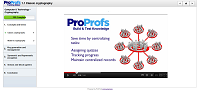
ProProfs Training Maker is an online tool to develop e-training courses by incorporating training materials like PPTs, PDFs, Docs, Pictures, Videos, Quizzes, YouTube videos etc.
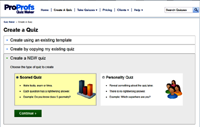
Since the Training Maker also includes the Quiz Maker, we have found it easy to create assessments and attach them to our e-courses. Besides this, there are a numbers of key features within Training Maker which you can use to create e-training courses.

5) What are the key features?
Well, our use of the features vary with the requirements of each course but on a broader scale the key features are:
• Reporting & Tracking: We use this to track and capture the information of learners taking our courses. The information can be the name, email, phone as well as the data of individual course takers through which we check compliance issues and defaulters.
• Embedding YouTube Videos & Web links: Since today’s learners want their classes to be more interactive, we import YouTube videos and other web content, through ProProfs platform, to enhance our training course. These training courses can be easily embedded on our website www.uwinpro.com and added to the existing content in our website
• Use Existing Material: We like that we are able to create courses using our own existing training materials such as PDFs, PPTs, videos and documents. We also use the existing quizzes in Quiz Maker as it helps in creating assessments quickly.
• Mobile Compliance: With more and more learners using smartphones to access the training programs, all of our course are accessible from any mobile device by leveraging the in built HTML5 conversion in ProProfs.

6) Can you give a few examples of successful implementation?
We have successfully developed few of our SAP training courses and Quizzes, which are also embedded on our website. Visit http://www.uwinpro.com/interactive.html and http://www.uwinpro.com/quiz.html for more details.
7) What is the future of online training? How do you think it can be improved?
With the upsurge in smartphones and tablets, a geographically dispersed workforce prefers online training rather than the traditional brick-and-mortar classroom. Online training courses are ideal for a geographically-dispersed workforce, as they can take the training from anywhere, anytime and also saves companies the costs on transportation, lodging and trainer fees. Companies have realized this and many are rapidly adopting online training programs to train their employees.
Moreover, online training has become a better, cheaper and faster way of spreading theoretical knowledge and technical know-how for companies as well as educators. So, I think that online training will become the primary channel to teach and share knowledge in the coming years.
The improvement has to be on the interaction side – many learners are still not used to interactive online training and may have some initial learning curve with certain features like online whiteboard. In terms on improvement in Training software, we would like to incorporate advanced security features so that multiple instructors from different parts of the world can securely create courses together and collaboratively.
1) Can you tell us briefly about your company and your relation to e-learning?
We at UWINPro (www.uwinpro.com) are one of the leading IT Training providers in Canada. We offer Online Training programs to our globally located corporate clients in the fields of SAP, UNIX and ERP courses. We have been focusing on SAP courses like SAP CRM, SAP HANA, SAP BOBJ, SAP ECC, SAP SRM etc.

2) In what ways have you used e-learning while developing your online training programs?
We are using elearning to offering online access to training courses. Currently we are using ProProfs (http://www.ProProfs.com/training) for developing our e-learning courses. To create a comprehensive and an engaging learning experience we use different components inside the courses such as PPTs, Videos, Mind maps, Flash cards, Quizzes and Surveys. These courses can then be accessed by our learners anytime / anywhere at their own convenience.
We use multiple ProProfs products such as Training Maker, Quiz Maker, Survey Maker and Flashcards to create elearning courses.

3) Do you think that online training still has many hurdles to overcome? For instance can online assessments, which are a major part of online training, be trusted?
Most of the online training software do not work across multiple devices, so a learner using a laptop might be able to access the training program, while someone trying to access the same training program from an iPad might not. A successful online training program must take into account that learners are geographically dispersed and use different devices.
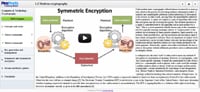
As for online assessments, they are an integral part of online training without which you cannot test the learning of trainees. Again, online assessments need to be device compliant as well and there are a number of ways in which you can make online assessments secure. You can use privacy control features such as password, availability protection & ID verification. You can also prevent cheating in online assessments through settings available, for example features such as timed assessments, question pooling, randomized question order, answer shuffling and more. With the help of technology, it’s possible to make online assessments completely secure.
4) What is ProProfs Training Maker?
ProProfs Training Maker is an online tool to develop e-training courses by incorporating training materials like PPTs, PDFs, Docs, Pictures, Videos, Quizzes, YouTube videos etc.
Since the Training Maker also includes the Quiz Maker, we have found it easy to create assessments and attach them to our e-courses. Besides this, there are a numbers of key features within Training Maker which you can use to create e-training courses.
5) What are the key features?
Well, our use of the features vary with the requirements of each course but on a broader scale the key features are:
• Reporting & Tracking: We use this to track and capture the information of learners taking our courses. The information can be the name, email, phone as well as the data of individual course takers through which we check compliance issues and defaulters.
• Embedding YouTube Videos & Web links: Since today’s learners want their classes to be more interactive, we import YouTube videos and other web content, through ProProfs platform, to enhance our training course. These training courses can be easily embedded on our website www.uwinpro.com and added to the existing content in our website
• Use Existing Material: We like that we are able to create courses using our own existing training materials such as PDFs, PPTs, videos and documents. We also use the existing quizzes in Quiz Maker as it helps in creating assessments quickly.
• Mobile Compliance: With more and more learners using smartphones to access the training programs, all of our course are accessible from any mobile device by leveraging the in built HTML5 conversion in ProProfs.
6) Can you give a few examples of successful implementation?
We have successfully developed few of our SAP training courses and Quizzes, which are also embedded on our website. Visit http://www.uwinpro.com/interactive.html and http://www.uwinpro.com/quiz.html for more details.
7) What is the future of online training? How do you think it can be improved?
With the upsurge in smartphones and tablets, a geographically dispersed workforce prefers online training rather than the traditional brick-and-mortar classroom. Online training courses are ideal for a geographically-dispersed workforce, as they can take the training from anywhere, anytime and also saves companies the costs on transportation, lodging and trainer fees. Companies have realized this and many are rapidly adopting online training programs to train their employees.
Moreover, online training has become a better, cheaper and faster way of spreading theoretical knowledge and technical know-how for companies as well as educators. So, I think that online training will become the primary channel to teach and share knowledge in the coming years.
The improvement has to be on the interaction side – many learners are still not used to interactive online training and may have some initial learning curve with certain features like online whiteboard. In terms on improvement in Training software, we would like to incorporate advanced security features so that multiple instructors from different parts of the world can securely create courses together and collaboratively.
Friday, September 21, 2012
Saturday, August 18, 2012
Interview with Ashleigh Lincoln, Ultralingua: Innovators in E-Learning Series
What role can online dictionaries play in e-learning? Finding just the right word to use, or understanding the true meaning of a word is often a matter of context as well as denotative meaning. Dictionaries can fall short because they do not always adequately present the full spectrum of meaning(s), and they are not flexible enough to engage deep learning. To offer a solution, Ultralingua combines technology with a philosophy of rich context and situated learning to build language knowledge and skills. Because Ultralingua offers monolingual and bilingual dictionaries, they support communication across cultures and nationalities. Welcome to an interview with Ashleigh Lincoln, Ultralingua.
1. What is your name and your relation to elearning?
Ashleigh Lincoln, marketing and communications coordinator. E-learning embodies what our company, Ultralingua, is all about. We provide accurate, simple and accessible education on the web.
Ashleigh Lincoln, marketing and communications coordinator. E-learning embodies what our company, Ultralingua, is all about. We provide accurate, simple and accessible education on the web.

2. What is
Ultralingua? What does it do? What
makes it special?
Ultralingua is a software company that makes monolingual and
bilingual dictionaries for people who love languages. Our dictionaries come
with advanced reference and learning tools, developed to address the verb
conjugation, vocabulary memorization, and grammatical challenges language
learners face. Ultralingua is not your average software company. We have a
passion for making easy and accurate software that people love to use. We take
every user comment seriously, and use feedback to make Ultralingua dictionaries
the best they can be.
3. What are the
learning theories that underlie the instructional strategy of Ultralingua?
At Ultralingua,
we believe technology can be a great asset to language learners, as long as
they pick tools to help them learn rather than shortcuts to get around the
challenge of learning. If a language learner is motivated to learn a new
language, they already have taken the first necessary step. We aim to make our
dictionaries the ultimate reference tool for people who are committed to
learning a language and have the motivation necessary to learn a new language.
Our software contains multiple translations with context and usage examples so
learners can distinguish between word choices themselves.
4. How
effective is the strategy that you use? Is Ultralingua equally effective with
everyone? What are the conditions that are required for learning to be optimal?
Language learners need context in order to choose the right
word, and our dictionaries were designed to make that context accessible.
Ultralingua is effective because we include so many additional tools and
resources with our dictionaries. We believe the key to learning a new language
this day in age, is balancing technology with teacher and native speaker
interaction. If the learner has that fundamental motivation, and possesses an
app like Ultralingua to use as a reference on them at all times, they have a
recipe for success.
5. Who has used
Ultralingua? Do you have any examples?
Generally our users are people in the process of learning
one or more languages. These users vary from students in high school language
classes, graduate and undergraduate college students majoring or minoring in a
language, teachers and professors, students and workers abroad, bilingual
people, language translators, homeschoolers, and self-language learners.
Ultralingua actively communicate with the Ultralingua users
and have been fortunate enough to interview a handful of them. Our users vary
across the world from a farmer from California who needed to improve his
Spanish speaking abilities, to an Esperanto-speaking world traveler, to a young
man studying abroad in France needing a fast and easily-accessible bilingual
dictionary. To check out some of their stories, visit our blog at
http://blog.ultralingua.com/.
6. What are
your plans in the future?
We just completed a complete redesign of our two most
popular products: Ultralingua for iOS and Ultralingua online dictionary.
Thursday, August 09, 2012
Interview with Mike Sommer, Digital Backpack, Innovators in E-Learning Series
The beauty of mobile learning is that it allows you to access content any time, anywhere. However, there can be a few bumps in the road. It can be very tedious to download content in a way that allows you to listen or view the material, even if you're not online. In addition, downloading can be cumbersome if you have to go through several different apps and portals. If you're enrolled in an online program, your downloads may take quite a bit or time, and you could probably benefit from a streamlined way to access your course materials. Further, you may wish to take courses from several universities at the same time for a complete list of online accredited colleges, many of them requiring multiple apps and digital content.
Welcome to an interview with Mike Sommer, who, with the team at Digital Backpack, has developed an integrated function / Mobile Application Management (MAM) for downloading, access, storage.
1. What is your name and company affiliation?
Mike Sommer, CEO of Digital Backpack.
2. What is Digital Backpack? How does it work?
Digital Backpack helps your organization capitalize on mobile freedom by providing you with an efficient and secure way to share, manage, and upload company-branded private apps and digital content on to your audience’s devices. We do this by focusing on managing content and not the device through a super app called the Backpack.

Designed to be easy to use, scalable, and efficient, we connect businesses with employees and school administrators with students through a Mobile Application Management (MAM) platform called the Backpack.
The Backpack is a secure “super app” that sits on a mobile device – whether it’s a smartphone or tablet, and powered by iOS or Android. Through an online, cloud-based Dashboard, an administrator can upload, manage, and share apps and digital content right to the Backpack using push technology. You’ll even get detailed analytics that will show you how the content you’re publishing is being used.
3. What can Digital Backpack be used for ? what kinds of files? Does it interface with iTunes and other digital repositories such as Amazon?
Within the client Dashboard we are able to manage, push, remove Audio, Video, Flash, and PDF documents.
Instead of integrating with third party stores like iTunes and Amazon for digital resources like audio, video and other documents we provide your own private network that you have full control over.

4. How can Digital Backpack be used in conjunction with e-learning?
Coming from an Online Learning background we understand the importance of SCROM based courses for tracking student results. Since Android allows for the use of Flash we are not only able to leverage content within LMS systems yet we can also allow e-learning experts to push flash based lessons right into a students Backpack.
5. I have a Windows phone and an iPhone. Will Digital Backpack work with them?
Our infrastructure is designed to roll out to a variety of devices as the market evolves and matures. Our next release will include iOS and as Windows 8 gains market share we will look to build a Backpack for these devices also.
6. What do you think is the future of mobile content? Will there be more or less?
I believe that the future of mobile will be more of a concierge service. Instead of 200 apps on each device and a one size fits all to corporate app deployment I see focused and user specific material being delivered as it is needed.

With the ability to push and then remove digital content the end user can have relevant and timely information available at the right time vs all the information all the time. As digital technology evolves we are able to store more and more information in the palm of our hands and in essence our digital devices are cluttered. We believe that when you have a managed Backpack that holds relevant information at the time you need it you are more likely to use it.
To use the analogy of a hiker. You do not carry a full loaded suitcase with you that has everything in it when you are going for an afternoon day hike. The same is with mobile content. Take what you need and leave the rest behind. You can always access it if you need to but it should not be the focus of your day.
Wednesday, July 18, 2012
Nominated for Most Fascinating Blog of 2012

Online creative writing programs are found in many online courses and programs. Ranging from autobiography, poetry, fiction, and creative non-fiction, creative writing in hybrid, face-to-face, and 100% online courses is very popular. You may wish to look in collegefinder.net.
Other creative writing examples include "Tear-Down of the Murder-Suicide House" and "The Killer of Lover's Lane, or, the Ten-Mile-Flats Murder: Transgressions of Closure."
Thursday, June 21, 2012
Interview with Jaley B, Silver Medalist, Adobe Youth Voices Aspire Award
Welcome to an interview with Jaley Bruursema, one of the winners of the first-ever Adobe Youth Voices Aspire Awards. Jaley B, age 14, and a student at Augustus H. Burley Elementary School in Chicago, IL, won a Silver Award for Narrative Video. Jaley's project, Gone, was created in conjunction with co-authors Anna Gould, Teagan Letscher, Elyssa Saldana, and Avery Weiland. The students were provided with professional-grade tools and were encouraged to make compelling digital media projects that spoke to the issues they most cared about.
1. What is your name and what is your Aspire Awards project? My name is Jaley B. The Aspire Awards project I worked on with a group is called Gone (It is in the narrative section).
2. Please describe your project. What is it? What is the purpose? The project is a story in stop motion addressing the issue of child soldiers in Africa. There is no talking but music accompanies the motion and in between scenes are slides reading the written pieces of the story you are watching. The purpose of this project is to inform viewers about child soldiers.
3. What do you hope that people will learn from your Aspire Awards project? What are your primary goals for the project?
I hope that people take away a thirst to help. As a group, we wanted the video to be horrifying enough to feel compassion and sympathy for these children, but not gruesome, so that audiences have no need to look away. We also wanted to demonstrate the great losses and sadness that happens in this situation but leave viewers with a sense of hope and a sense of obligation to donate money, protest, and do anything they can to recover areas that are influenced by this devastation. Of course it would be nice to win the competition, but it would be far better to lose and have a bunch of people do something than to win and have no one do anything.
4. What do you hope people will learn from your project and ultimately do? I hope that they will be adequately informed and that they will not just walk away and think about the issue but walk away and do something about it.
5. Describe the digital aspects of your project -- what kinds of video, audio, and graphics did you create? Where did you display them? Any social media sites? (Facebook, Google sites, Tumblr, Flickr, Orkut, blogs, your school's website, podcast sites, etc.?) We took a LOT of photos and piecing them together on the computer was a big portion of the project. Some had to be longer than others for a dramatic effect. We did not create any graphics digitally but we did traditionally. All the artwork that appears is something we made with paper. For our audio we used general tracks from Garageband and downloaded free instrumental and choral songs from the internet. We displayed our video on a school media gallery website and at Adobe’s TechXpo.
6. How will you use the Aspire experience to do more things? What are your next steps? The Aspire experience has given me a background in creating media that many people will view within a deadline. It has given me a little glimpse into what the world of professional media looks like. Now, going into high school and possibly doing more high quality media projects like Gone I’ll know what I’ll be doing. I am not entirely sure what my next steps will be but this project has been very fun to create and exciting to watch grow and I will definitely explore creating more media and media like this in the future.
1. What is your name and what is your Aspire Awards project? My name is Jaley B. The Aspire Awards project I worked on with a group is called Gone (It is in the narrative section).
 |
| Silver Award for Narrative Video: Gone Jaley Bruursema, Anna Gould, Teagan Letscher, Elyssa Saldana, Avery Weiland |
3. What do you hope that people will learn from your Aspire Awards project? What are your primary goals for the project?
I hope that people take away a thirst to help. As a group, we wanted the video to be horrifying enough to feel compassion and sympathy for these children, but not gruesome, so that audiences have no need to look away. We also wanted to demonstrate the great losses and sadness that happens in this situation but leave viewers with a sense of hope and a sense of obligation to donate money, protest, and do anything they can to recover areas that are influenced by this devastation. Of course it would be nice to win the competition, but it would be far better to lose and have a bunch of people do something than to win and have no one do anything.
4. What do you hope people will learn from your project and ultimately do? I hope that they will be adequately informed and that they will not just walk away and think about the issue but walk away and do something about it.
5. Describe the digital aspects of your project -- what kinds of video, audio, and graphics did you create? Where did you display them? Any social media sites? (Facebook, Google sites, Tumblr, Flickr, Orkut, blogs, your school's website, podcast sites, etc.?) We took a LOT of photos and piecing them together on the computer was a big portion of the project. Some had to be longer than others for a dramatic effect. We did not create any graphics digitally but we did traditionally. All the artwork that appears is something we made with paper. For our audio we used general tracks from Garageband and downloaded free instrumental and choral songs from the internet. We displayed our video on a school media gallery website and at Adobe’s TechXpo.
6. How will you use the Aspire experience to do more things? What are your next steps? The Aspire experience has given me a background in creating media that many people will view within a deadline. It has given me a little glimpse into what the world of professional media looks like. Now, going into high school and possibly doing more high quality media projects like Gone I’ll know what I’ll be doing. I am not entirely sure what my next steps will be but this project has been very fun to create and exciting to watch grow and I will definitely explore creating more media and media like this in the future.
Monday, June 18, 2012
Interview with Anny Liu, Adobe Aspire Award Winner
Welcome to an interview with Anny Liu, one of the winners of the first-ever Adobe Youth Voices Aspire Awards. Liu, age 17, and a student at Balboa High School in Redwood City, CA, won a Silver Award for Animation. Her project, LOOK, was created in conjunction with her co-author Janice Lee.
Here is the text of E-Learning Queen's interview with Anny Liu.
1. What is your name and what is your Aspire Awards project?
My name is Anny Liu, and my Aspire Awards project is titled "LOOK". It's basically about how a conversation between two friends awakened a bunch of little creatures/spirits that represent the creativity that is put into designing everyday objects.
Here is the text of E-Learning Queen's interview with Anny Liu.
1. What is your name and what is your Aspire Awards project?
My name is Anny Liu, and my Aspire Awards project is titled "LOOK". It's basically about how a conversation between two friends awakened a bunch of little creatures/spirits that represent the creativity that is put into designing everyday objects.
 |
| LOOK Adobe Youth Voices Aspire Award Silver Award: Animation Janice Lee and Anny Liu, Balboa High School |
2. Please describe your project. What is it? What is the purpose? This project is actually a collaboration with a few friends. We all thought that people usually think of art only in the spectrum of "fine art" and do not see how artistic elements can be found in almost everything around us. We hope to express that with "LOOK," and inspire people to look at the world around them. Using little cute creatures popping out of common objects and such, we tried to do that in a fun and interesting way so the viewers will smile and make their own realizations instead of us preaching to others about our ideals of art.
3. What do you hope that people will learn from your Aspire Awards project? What are your primary goals for the project?
I hope that people will learn to appreciate the work and thought put into making everything around them beautiful. And I wish to show through the video that even mundane things actually are designed by someone. The video doesn't try to enforce any type of thinking to the viewers, but it would be great if it made them happy or inspired them to look at the world with a fresh perspective.
4. What do you hope people will learn from your project and ultimately do?
Just "LOOK" :)
5. Describe the digital aspects of your project -- what kinds of video, audio, and graphics did you create? Where did you display them? Any social media sites? (Facebook, Google sites, Tumblr, Flickr, Orkut, blogs, your school's website, podcast sites, etc.?)
The videos were shot in HD with a flipcam. Since about half of the footage were picked spontaneously around the city and we wanted as much footage as possible to choose from, the camera had to be pretty mobile. The audio was actually a song that was made by Can Nguyen, who makes awesome electronic music and kindly let us use his track in our video. The creatures in the video were created in Adobe Illustrator and then placed into the footage with Adobe After Effects in 3D space, after I did some 3D camera tracking of the footage. It was a bit laborious, but the outcome was pretty neat. We shared the video on Facebook, Twitter, and other social networking sites to gain publicity. Thanks to the support of my friends, although "LOOK" was put up on the website many weeks later than the other videos, we still managed to generate a good amount of votes.
3. What do you hope that people will learn from your Aspire Awards project? What are your primary goals for the project?
I hope that people will learn to appreciate the work and thought put into making everything around them beautiful. And I wish to show through the video that even mundane things actually are designed by someone. The video doesn't try to enforce any type of thinking to the viewers, but it would be great if it made them happy or inspired them to look at the world with a fresh perspective.
4. What do you hope people will learn from your project and ultimately do?
Just "LOOK" :)
5. Describe the digital aspects of your project -- what kinds of video, audio, and graphics did you create? Where did you display them? Any social media sites? (Facebook, Google sites, Tumblr, Flickr, Orkut, blogs, your school's website, podcast sites, etc.?)
The videos were shot in HD with a flipcam. Since about half of the footage were picked spontaneously around the city and we wanted as much footage as possible to choose from, the camera had to be pretty mobile. The audio was actually a song that was made by Can Nguyen, who makes awesome electronic music and kindly let us use his track in our video. The creatures in the video were created in Adobe Illustrator and then placed into the footage with Adobe After Effects in 3D space, after I did some 3D camera tracking of the footage. It was a bit laborious, but the outcome was pretty neat. We shared the video on Facebook, Twitter, and other social networking sites to gain publicity. Thanks to the support of my friends, although "LOOK" was put up on the website many weeks later than the other videos, we still managed to generate a good amount of votes.
6. How will you use the Aspire experience to do more things? What are your next steps? I learned a lot through the Aspire project, and I will definitely keep in touch with all the amazing people I have met and worked with. My next steps are college and then into the real world, hopefully I will be able to work in a media-related field because I really enjoy the type of work and being with other amazing people who share my interest.
************************
Free download for E-Learning Queen readers: E-Learning Success: From Courses to Careers
Friday, June 08, 2012
Interview with Dantorie Reeves, Adobe Youth Voices Aspire Award Finalist
Welcome to an interview with an Adobe Youth Voices Aspire Award finalist, Dantorie Reeves, age 16, from Mt. Pleasant High School, San Jose, California. Adobe Youth Voices aims to empower youth in underserved communities around the globe with real-world experiences and 21st century tools to communicate their ideas, exhibit their potential, and take action in their communities. You can vote until June 8.
1. What is your name and what is your Aspire Awards project? My name is Dantorie Reeves and I have two projects up for awards. One of the projects is a documentary called Martha's Soup Kitchen and the other one is an animation called The Ball Game.
 |
| Dantorie Reeves, Aspire Award project |
2. Please describe your project. What is it? What is the purpose? Well, [for Martha’s Soup Kitchen] my project was basically a couple of my classmates and I volunteering at a soup kitchen by serving drinks ,cleaning up, and also getting to know some of the clients. The purpose of my film was to open my community's eyes so that they can see that it doesn't take much to give back or help out our community or people that are less fortunate then us.
3. What do you hope that people will learn from your Aspire Awards project? What are your primary goals for the project?
I hope that people will learn that anybody can help other people. You don't have to be rich or even an adult because I'm not rich and I'm only a sixteen year old high school student. My primary goal is to get lots more people involved in the community and help get the hungry feed.
4. What do you hope people will learn from your project and ultimately do? I hope that people would ultimately just stop avoiding the homeless and hungry people and start trying to help them instead because even the littlest thing might help.
5. Describe the digital aspects of your project -- what kinds of video, audio, and graphics did you create? Where did you display them? Any social media sites? (Facebook, Google sites, Tumblr, Flickr, Orkut, blogs, your school's website, podcast sites, etc.?) On this film we used Adobe Premiere Pro and After Effects to make the words in the background. After we finished the film I put it on Facebook, twitter, the school website. It is also on YouTube and our podcast on channel 28.
6. How will you use the Aspire experience to do more things? What are your next steps? This experience was really great so I am going to take this and hopefully make even better films. I loved seeing something that I made in a theater shown on a big screen [at the year-end event] and I really enjoyed watching films made by other students.
Free Resources for Community-Building / Youth Activities / Teacher Materials
Are you interested in activities that you can implement in your own community or school? Check out Good Deeds Society activities! They are available free and can be downloaded and shared.
E-Learning Success: From Courses to Careers -- 400-page e-book version totally free.
Printed library / personal copy version also available.
Kindle version here.
The Adventures of Tinguely Querer -- NEW reviews
Sunday, June 03, 2012
Interview with Aashita Jadhav, School in Mobile, Innovators in E-Learning Series
Mobile learning via smartphone has been a possibility for learners since the earliest smartphones (T-Mobile Sidekick was an early example), but the the recent explosion in apps, access, and the essential ubiquity of mobile devices, there is a growing demand for instructional content that meshes with the learner's lifestyle and learning habits. In a smartphone world, developers can no longer simply try to make their content mobile-friendly (early example: smartphone science class). Developers have to think of the mobile environment first, and then make it also accessible via laptop. The best schools now must incorporate new strategies for delivering m-learning. One innovator in mobile learning is Aashita Jadhav, whose SchoolinMobile.org has developed a platform to enable expanded access to instructional content that is both engaging and effective.
What is your name and
relation to elearning / mlearning?
My name is Aashita Jadhav,
the founder of the SchoolinMobile.org
What is School in
Mobile?
School in Mobile ( SchoolinMobile.org)
is a FREE educational platform (accessible by web and as an FREE Android App)
OUR MISSION - Every
Student in the world to have access to learning material, the green way.

School in
Mobile provides the following benefits:
•
Fast - Students can learn a chapter in less
than 30 minutes including test.
•
Useful - Helps students pass the STAR test and
thus helps improve the school rating.
•
Fun - Students get cool badges for getting
good score from the quiz.
•
Green - As the content is in digital format ,
it helps the environment.


What needs does School in
Mobile address?
I consider that we are
fortunate to be at the time of three big revolutionary shifts - -
mobile, social and cloud. Every industry is trying to make the best use of
these advancements. School in Mobile is helping the Education sector with this
shift to make learning an engaging process.
Students have been caring
heavy textbooks around for decades. Today technological advancement make it
possible to change this.
School in Mobile provide
ease of access , speed of completing a chapter and finally helps them pass the
grade tests.
What kinds of devices does
School in Mobile work on?
School in Mobile is
practically available on all devices.
•
A FREE Android app is already present on Google marketplace.
•
For all other devices ( including Apple devices) ,
it can be accessed through the web link
•
We just launched FREE Chrome Web
Store app
What are the underlying
learning strategies and philosophies in School in Mobile?
School in Mobile is not
just provider of content in form of books or videos.
It is an end-to-end
platform for student to learn as well as test their knowledge.
Proven research shows that
students learn by going through summary notes and retain the knowledge for
longer duration.
School in Mobile provides
•
Ready to use summary notes in text as well as movie
format.
•
Once the students have studied a chapter at school.
They can revise it on School in Mobile in less than 30 minutes including quiz
test.
•
Engagement is increased by this quick and easy
tool. Also the cool badges which students get from test makes it fun.

How can you overcome the
problems of access to the cloud? What happens when students do not have wifi
access to the cloud or wifi connectivity?
Currently School in Mobile
is available on the cloud and accessible everywhere. We are working on the next
phases to make it easy to download on the device making it available without
wifi connectivity. This is crucial for developing countries.
What are the next steps
for School in Mobile?
The steps are really exciting for us.
We are working
on enhancing the platform by several ways like
•
Making more grades, subjects and chapters
available
•
Add capability to login using facebook and google
accounts
•
Open the platform to allow teacher add content. We
are partnering with more teachers . Any teacher can reach us at info@schoolinmobile.com
Also we are working to
deploy this to other countries.

How can students and
teachers try out School in Mobile?
You can download the
Android App from Google marketplace.
OR
Access the web version ( for all devices including Apple) from our website ( SchoolinMobile.org)
Subscribe to:
Posts
(
Atom
)