Friday, May 12, 2023

History of Oil-Finders Friday: South Texas Serpentine Plugs

 The 1915 headlines read, ‘Oil in an Igneous Rock,” which certainly piqued the curiosity of oil finders, used to displaying their porous sandstone and limestone cores, stained with oil, in their office display cases.


But, in South Texas, they had done it. They had found oil in a green igneous rock they dubbed “serpentine,” even though it was actually an altered tuff resulting from underwater volcanic eruptions.


Udden, J. A., and Bybee, H. P., and others, 1916

The adventure had started a year earlier. In 1914, Fritz Fuchs, a rancher deep in south Texas near the small town of Thrall, decided to drill a water well for his cattle. He did not encounter water, but at about 300 feet, he brought up a strange mix of oil, salt water, and what appeared to be weathered igneous rock, green in color. Mystified, he called the University of Texas geology department to see if they could shed light. The result was a well drilled in February 1915, which was the discovery well for the Thrall field, and the first of many so-called “serpentine plugs.”

At least one study has pointed out that the deposition of the tuffaceous mounds occurred in conjunction with submarine volcanic vents which emitted volcanic ash which then was deposited in the form of mounds, which subsequently altered to palagonite. The volcanic activity occurred with the deposition of chalk and marl of the upper Austin and lower Taylor Groups, which served as both source and seal. 


Interaction between the submarine volcanic system and carbonates

It turns out that all along a belt of volcanic activity, there were similar submarine volcanic eruptions and they became perfect reservoirs for oil generated in the adjacent source rocks. The stratigraphic traps were found in the porous zones of tuff, and also in porous zones in the surrounding carbonates, and in traps in sands draping over the serpentine plug, and in fracture porosity in the carbonates near the plugs (Loucks, 2022).

The wells could be incredibly prolific, with a feature covering less than 10 acres producing 100,000 barrels. Others were not as prolific. However, by 1986, more than 47 million barrels had been produced (Matthews, 1986).

The serpentine plugs are found associated with the volcanic centers that align with the pre-Tertiary Balcones and Luling regional fault and fracture systems. Some of the minerals in the tuffaceous mounds are magnetic, resulting in magnetic anomalies. 

Some of the minerals in the tuffaceous mounds are magnetic, resulting in magnetic anomalies. While the first oil-rich serpentine plug was discovered by accident, science was used to discover dozens of the features scattered along the belt of pre-Tertiary-age submarine volcanic activity. The fact that the features tended to be shallow and of dramatically different lithology than the surrounding carbonates, and that were often oil seeps, made it possible to use new methods, which included surface geochemistry, in which soil samples were taken, and plants observed to see if they were affected by hydrocarbons in the soil. Second, newly developed magnetometers were used. Most were truck-mounted, and they were able to detect anomalies by means of differences in the magnetic field.

Source: Loucks, 2022

The features were small, and it took a lot of patience to find them, but when they did, the wells could be extremely prolific. Ranging from just a few feet deep, to 5,000 feet deep, the wells were inexpensive to drill.

Today, with high-resolution drone-mounted magnetometers, and highly accurate surface geochemistry, it’s possible to revisit a fascinating play, which to this day is one of the few areas of the world where oil is found in igneous rocks.

I love this play, and I’m thrilled to have an original copy of the November 25, 1916 Bulletin of the University of Texas published by the Bureau of Economic Geology and Technology which is dedicated to the Thrall Oil Field. 

References

Loucks, R. G., R. R. Reed (15 April 2022) Implications for carbonate mass-wasting complexes induced by volcanism from Upper Cretaceous Austin Chalk strata in the Maverick Basin and San Marcos Arch areas of south-central Texas, USA. Sedimentary Geology. Vol 432. 


Matthews, T. F. (1986) The Petroleum Potential of "Serpentine Plugs" and Associated Rocks, Central and South Texas. Baylor Geological Studies Bulletin, Spring 1986.  


Udden, J. A., and Bybee, H. P., and others, 1916, The Thrall Oil Field, by J. A. Udden and H. P. Bybee [and] Ozokerite from the Thrall Oil Field, by E. P. Schoch [and] The Chemical Composition of the Petroleums Obtained at Thrall, Texas, by E. P. Schoch and W. T. Read: University of Texas, Austin, Bureau of Economic Geology and Technology, Bulletin 66, 93 p.

Friday, May 05, 2023

History of Oil Finders Friday: Dunkirk Black Shale Gas Well, 1825, in Fredonia, New York

In the 1820s in Fredonia, New York, William Aaron Hart, a local gunsmith long curious about the gas seeps emanating from the nearby Canadaway Creek, decided to investigate. According to a historical report, he first tested the gas by collecting it in a flipped-over washtub, inserting a gun barrel in a hole, and then lighting the gas as it flowed through the gun barrel.  


Encouraged, Hart started to investigate the origin of the gas seeps, and soon found that they were coming from what he referred to as “slaty rock,” which was later classified as the Dunkirk shale, an upper Devonian black shale, typified by prominent and numerous joints and fracture networks. Early geologists such as Lewis Caleb Beck (1798-1853) studied not only the geology and mineralogy, but the surrounding vegetation as well. 

The Dunkirk shale is a very low-permeability source rock which reached the oil window for hydrocarbon generation during the Permian.  Heat flow occurred at the same time that the tectonic events were propagating the joints throughout the Devonian section in the Finger Lakes District (Lash, 2014). In other words, Gary Lash and his fellow researchers found that petroleum generation was a joint-driving mechanism, due to thermally-driven phase change.

Randy Blood, who studied under Gary Lash, has continued to do extensive fieldwork and to make further connections between thermal maturation and the development of massive joint systems which create a robust and persistent gas reservoir and migration pathway. The exploration implications are significant. 

Gas generation from the upper Devonian black shales resulted from the desorption of methane from the surface of residual organic material (kerogen and bitumen) and clay minerals, principally illite. Production, however, depends the size, frequency, and interconnectedness of natural jointing.  

After continuing to investigate and experiment, in 1825 Hart drilled a 27-foot hole into the rock, and encountered gas that would flow at a rate sufficient for him to invent and implement a small pipeline (first made of bamboo) and to use the gas in gas lamps, first in farms, a mill, and later in a hotel and a lighthouse. 

Several years later, Preston Barmore, a creative engineer unfazed by what might happen as one ramped up the production volumes of natural gas, decided to drill a well to 127 feet in depth, and, when frustrated by the low volume of gas, decided to ignite the gas, causing downhole explosions (Martin, etal, 2008). This early version of fracing was highly effective. 

Within a few years, hundreds of wells were drilled in the shallow Dunkirk shale, and pipelines were constructed to distribute the gas to street lamps, making Fredonia one of the first towns in the world to have gas street lamps (Martin, et al, 2008). Other pipelines were built in western and upstate New York, including ones constructed of hollowed-out tree logs, used for transporting produced salt water to evaporation ponds.

Whether or not the shallow, low-volume gas reservoirs of the Dunkirk shale might still have economic potential given current regulatory frameworks is something to be pursued. Because there were so many active gas seeps in the past, it might be worthwhile to conduct airborne surveys to detect methane and to see if there are any concentrations around natural seeps. There could be local uses for low-volume gas for innovative geologists and engineers today as well as almost 200 years ago. 


References 

Blood, R., and Lash, G. (2019). Horizontal Targeting Strategies and Challenges: Examples from the Marcellus Shale, Appalachian Basin, USA. Conference: Unconventional Resources Technology Conference (URTeC),2019 - Denver, CO. https://www.researchgate.net/publication/334812445_Horizontal_Targeting_Strategies_and_Challenges_Examples_from_the_Marcellus_Shale_Appalachian_Basin_USA 

Lash, G., Loewy, St., and T. Engelder (2004). Preferential jointing of Upper Devonian black shale, Appalachian Plateau, USA: evidence supporting hydrocarbon generation as a joint-driving mechanism. Geological Society of London. Special Publications. Vol. 231:1, p 129-161. 

Lash, G. G., and E. P. Lash (2014) Early History of the Natural Gas Industry, Fredonia, New York. Search and Discovery Article. August 29, 2014. https://www.searchanddiscovery.com/pdfz/documents/2014/70168lash/ndx_lash.pdf.html  

Lash, G., and E. Lash (May 2015) The Unsung “Father of the Natural Gas Industry” AAPG Explorer. May 2015. https://explorer.aapg.org/story/articleid/19706/the-unsung-father-of-the-natural-gas-industry 

MacDonald, Ronald (2002) Application of Innovative Technologies to Fractured Devonian Shale Reservoir Exploration and Development Activities, Proceedings of the Forty-First Annual OPI Conference, Ontario Petroleum Institute, November 4-6. 

Martin, J P., Hill, D. G., Lombardi, T. E., Nyahay, R. (2008). A Primer on New York’s Gas Shales. New York State Geological Association: NYSGA Online. https://www.nysga-online.org/wp-content/uploads/2019/06/NYSGA-2008-A1-A-Primer-on-New-Yorks-Gas-Shales.pdf


Tuesday, March 28, 2023

Interview with Maureen Mahoney, Director of Online Learning with the National Speakers Association

Welcome to an interview with Maureen Mahoney, a multi-faceted professional who has experience and training in broadcast production, improvisation comedy, and virtual training programs. 

What is your background?

My background is a little all over the place but I have found that my career has really come full circle thanks to the advancements of technology! I graduated from Loyola University New Orleans with a major in Broadcast Production and a minor in History.  Post-graduation and thanks to Hurricane Katrina I was forced to relocate back to my home state of Texas, landing a job in Midland-Odessa as a local TV News Producer. After that experience, found myself in the Insurance industry, working with advisors, helping them build their brand and ran sales and marketing trainings.  After rising through the ranks and a move to Chicago, I found myself in the eLearning industry, building interactive experiences for advisors and running virtual training programs.  Outside of work, I was formally trained in improvised comedy at The Second City & iO Chicago Training Centers performing with my improv group over the last several years around the country.  All of these experiences have been instrumental in my current position as the Director of Online Learning with the National Speakers Association! 


How did you come to be interested in topics of professional and personal well-being?  What are some of the hidden issues that can block people without their being aware of the root cause? (ex. attention deficit disorder, Postpartum depression, dyslexia, etc.) 

This is actually an area I am super passionate about. I was diagnosed with ADHD when I was around 6 or 7 years old.  This was in the late 80’s/early 90’s and there wasn’t a lot of information back then.  Growing up I was always told to take my meds and I would grow out of it.  No one ever explained what ADHD was or what some of the symptoms were that I was experiencing.  I was just told that I was different and that I qualify for special testing privileges.  Once I graduated college, I stopped talking my medication because, “I’m an adult now! I’ve been cured!”

It wasn’t until 8 years ago that I reached a breaking point.  Nothing was working in my life personally or professionally.  At work, it felt like I couldn’t please anyone. I kept getting told I wasn’t working hard enough, I talk too much, I was told not to share personal information about myself, I was told, “You may want to keep the fact that you have ADHD to yourself because your team will look down on you,” I was even told to change the look on my face. Spoiler alert, these are all ADHD symptoms (Maybe not the look on my face!). 

I finally started to see a therapist. I knew something was wrong, but I didn’t know what it was! It felt like a bit of a failure on my end that I needed a therapist but she said something to me that made sense. “When a business is failing, you hire a consultant to work with you to get things back on track.  How is this different?” As I started building my relationship with my therapist, it was very hard at first.  She would ask me questions that I didn’t like.  She was telling me things about my situation that I thought she was dead wrong about.  I stuck with her though.  One day she suggested I get back on my medication. I was reluctant cause I thought I outgrew ADHD! As soon as I got back on my medication, everything changed. It was this ah-ha moment that I need this to function.  Soon, things started falling into place.

While yes, getting back on my medication was step one, it wasn’t until I started working at the National Speakers Association that I really started to embrace my ADHD.  I was meeting incredibly successful people who speak on ADHD, meeting experts with PhD’s on it.  I realized that I knew absolutely nothing about this disorder, and I have it! 

When it comes to these hidden disorders of ADHD, dyslexia, post-partum, etc., they are so much more common than you think and there are many people who have these challenges and they don’t even know they have it.  Or like me, they’ve been told to hide it, or they know they have it but have found a survival method to live with it.  The reality is we are human, and we need to embrace our differences and our challenges. The future can be an amazing place! These days, there are so much more resources, education, and technology around these things that can dramatically improve your life.

Just like anything else, you just need to do the work. It’s your responsibility to educate yourself. We learned this lesson over the pandemic.  Change doesn’t happen overnight.  It’s a trial-and-error period that I like to call “growing pains.” Some days you are on top of the world and some days feel like a failure.  It’s not a failure, its just a growing pain!  If you can commit to learn or implement one new thing a week to better your life, that’s a pretty big toolbox you built in just one year! 

How can a person turn what they had considered a disadvantage to an advantage? 

I am a glass half full kinda gal. I think you can spin any disadvantage into an advantage with the right mindset. You need to focus on what YOU can control.  There are so many things out of our control especially when we are living in a time where it seems like we keep losing so much of our control! You don’t have control over the weather, but you can control what you wear when you go outside.  You can’t control what’s going on in politics, but you can control how you vote.  There are probably things going on at your organization that seem doom and gloom that you can’t control.  You can control the way that you show up every day and your attitude.  Take a deep breath and be present with yourself in that feeling of disadvantage and ask yourself:

What are the things I cannot control?

What are the things I CAN control?

Out of the things you said that you can control, assess the situation.  Is there a way that you can help? How can you fill a void that needs to be filled? Perhaps you just need to stay out of the situation entirely and take yourself out of it.  There is always some kind of way forward.

Please recommend a book that you have really enjoyed. 

Surprisingly my favorite book that I’ve read lately is, Doris Kearns Goodwin’s “Team of Rivals: The Political Genius of Abraham Lincoln.” I have found this to be so incredibly relevant in my professional and personal life, especially if you are in a leadership role at your organization. Learning about how Lincoln handled his strong minded cabinet with opposing views, big egos, in a life or death situation is truly remarkable. So many lessons and insights came out of that book for me!


Tuesday, March 14, 2023

Interview with Thomas Fink: Poet, Essayist, Literary Critic, and Abstract Painter

Welcome to an interview with Thomas Fink, whose latest collection of poetry, Zeugma, a fascinating title for a rhetorical term that refers to a single word that links disparate ideas ("she broke his glass sculpture and his heart").  It is a great pleasure to have the chance to learn more about his background and some of the ideas that inform his poetics, criticism, and art.  In addition to his artistic and scholarly work, Fink has supported publishers and writing programs such as the Marsh Hawk Press

What is your name and background?

I’m Thomas Fink, a professor of English at City University of New York’s LaGuardia Community College for the past 41 years. I’ve published twelve books of poetry and two books of criticism about contemporary poetry, as well as a recent book on teaching college students to interpret poetry. I “moonlight” as an abstract painter.

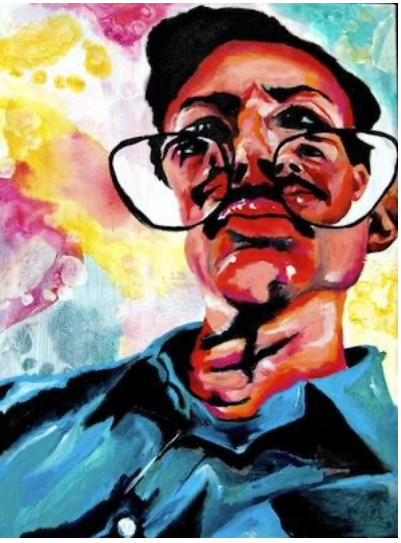
Portrait of Thomas Fink by Maya D. Mason

When did you become interested in experimental or avant-garde poetry?

When I graduated from Princeton University in 1976 and was just about to enter the MA and PhD program at Columbia University, a high school friend gave me John Ashbery’s Self-Portrait in a Convex Mirror as a present. At first, I found the book infuriating, but eventually, it opened me up to a wide range of avant-garde poetry, and I wrote the third doctoral dissertation (after David Shapiro and Donald Revell) on Ashbery’s work. 

What makes a poem experimental or avant-garde... especially in 2023? 

I’ve given up trying to answer that question! For one thing, if I were to try to apply it to my own poetry-writing process, writer’s block would set in and persist indefinitely. The innovative practices and procedures that have been around since World War II or even before are still viable but can hardly be called avant-garde any longer. Some proponents of what is labeled Conceptual poetry perceive their poetics as a replacement for those earlier practices, which they consider exhausted and not worth “repeating.” I don’t agree. Others believe that particular kinds of politicizing of poetry, whether tied to formal choices or not, are the most authentic, useful avant-garde gestures. Sometimes I find that this approach produces poetry that is both intellectually and aesthetically compelling.   

Please tell us a bit about your collection, Zeugma.  What is the main focus?

I didn’t set out to have a single focus in Zeugma. But in her Foreword, Patricia Carlin finds that the title, which implies the yoking together of disparate things, is enacted in the book itself and hence serves as a focus to represent “the fragmented, unstable, and confusing contemporary scene” (9). It would be hard not to view “Bewilderness,” the opening poem, as a reflection on the pandemic, and individual poems surely have references, sometimes oblique and sometimes not, to extremism in the Republican Party. 

Zeugma

I think everyone will recognize the allusion in the title of “November 7, 2020.” A bunch of poems are written in a hybrid form that I came up with called “Sonnina”; it’s a cross between a sonnet and a sestina. Also, there are continuations of long-running series: “Yinglish Strophes,” which uses an approximation (and often an exaggeration) of Yiddish-inflected English syntax to air topics such as intergenerational differences/connections in a family and perspectives forged by immigration, “Goad,” which actually reflects the theme implied in its title, and “Dusk Bowl Intimacies,” which registers both displacements and quests for individual security. The verse-play, “Who My People Are,” may also reflect some concerns of the three series I’ve mentioned. 


Tuesday, December 27, 2022

A Conversation with Rochelle Owens about Patterns of Animus (2022)

 Audio Recording of interview with Rochelle Owens over Patterns of Animus: http://www.zenzebra.net/audio/rochelle-2022-12-07.mp3 

Rochelle Owens Patterns of Animus
Rochelle Owens:  Patterns of Animus

Speaking to Rochelle Owens is always a pleasure because she sheds insight on her work and philosophical underpinnings. She also explores the ideas that inform her poetry as well as her plays.

Welcome to an interview with Owens, where she reads from her new long poem, “Patterns of Animus,” and chats with Susan Nash about her work and interests now and in the past. “Patterns of Animus” appears in her collection of the same name, which also contains a series of essays written about her earlier work. To purchase Patterns of Animus or to read free on Kindle, click here.


Post settings Labels podcast,rochelle owens,poetry, No matching suggestions Published on 12/22/22 1:08 PM Links Location Options Post: EditChanges saved

A Conversation with Rochelle Owens on The Aardvark Venus (2020)

 Audio Recording:  http://www.zenzebra.net/audio/rochelle-2022-12-08.mp3

Rochelle Owens has been writing and publishing poetry since the early 1960s, and now her early work is available together with recent work (from 2020) in a single volume, The Aardvark Venus: Selected Poems 1961 - 2020. 

Welcome to an interview with Rochelle Owens, who chats with Susan Nash about her work, the philosophical ideas that have influenced her. 


To purchase a perfect-bound paper copy, or to read it on Kindle, please click here


The Aardvark Venus, by Rochelle Owens


Thursday, September 15, 2022

Assessment in Moodle 4.0: So Much New Potential

Moodle allows you to bring together assessment, content, collaboration all in one place. In the video below, I discuss the kinds of popular assessments and assessment strategies in this brief video. This includes multiple choice quizzes to use with your smartphones, tablets, laptops; self-grading assessments, short answers, essays, and collaborative workshops. All are available with Moodle mobile. 

assessments with Moodle 4.0
Check out the video 

The key is following good instructional design so that you are aligning the assessments with the content and learning objectives. Moodle assessments are perfect for the courses set up for self-registration, on-demand content and assessment with automatic generation of certificates and badges upon successful completion of the assessment. The following book shows you how to incorporate activities (resources) and also popular plugins. 

Moodle 4 E-Learning Course Development, 5th Edition / Packt Publishing

Link to the book: 

https://www.amazon.com/Moodle-Learning-Course-Development-instructional/dp/180107903X/ref=sr_1_1?crid=Y4IM6SMS4SNU&keywords=moodle+4+e-learning+course+development&qid=1663258878&sprefix=moodle+%2Caps%2C108&sr=8-1 


Monday, September 12, 2022

Interview with Claudia Ruiz-Graham, Co-Founder, Imaged Reality, on using Virtual Reality for Training, Field Work, and Team Building

 Welcome to an interview with Claudia Ruiz-Graham, founder of Imaged Reality (https://www.imagedreality.com/). Imaged Reality develops immersive technologies with applications to Earth Sciences in Energy, Mining, Engineering and Academia. With their technology, customers can create digital reservoir atlases and virtual core stores in immersive and collaborative environments, integrating data across different scales. This leads to improved interpretations and a better integration between multi-disciplinary teams, resulting in better decision-making, risk reduction and increased capital return.

Lively discussion of the amazing world of virtual reality and geology

Stratbox, available in Desktop and VR, is a SaaS (Software as a Service) platform for collaborative data integration in 3D space. It allows users to study and interpret reservoir analogues using 3D outcrop models, integrating data from regional to pore scale in a single 3D environment, in which users can collaborate remotely from anywhere. Imaged Reality offers customers “on demand” access to curated collections of digital outcrops from around the world which serve as reservoir analogues. Stratbox is also used as the software of choice in instructor-led virtual geology courses.


Stratbox Core Explorer is a web-based platform that enables customers on-demand access to their internal collections of core images and automated integration of related data such as thin sections, metadata, etc. Users can collaborate to create core descriptions and participate in virtual core workshops from any location.
The team at Imaged Reality is working with multinational companies and universities in the UK, US, Europe and Latin America. They have facilitated ground-breaking virtual field trips for Shell, the Norwegian Petroleum Directorate (NPD), Staatsolie, and Ecopetrol. They are also proud to work with Plymouth University, Louisiana State University, Texan A&M, and University College of Dublin. Our team is a mix of Industry and gaming technologies experts. We are starting our second funding round, we would like to invite investors, customers, technology partners and industry experts who want to work with us, to help people understand the Planet better. In this interview, Susan Nash and Claudia Ruiz-Graham also discuss how the Stratbox platform can be incorporated with a learning management system such as Moodle to make it possible not only to have the immersive training experience, but also to incorporate assessments to earn credentials, certifications, college credit, and more. In addition to Imaged Reality, please check out Susan Nash's new book, Moodle 4.0 E-Learning Course Development for guidelines for creating courses that build in virtual worlds, in an easy-to-access framework that incorporates assessments and repositories of supporting material
.

Effective E-Learning with Virtual Learning Environments

 Virtual learning environments take advantage of all modalities of online instruction, ranging from listening to recorded lectures to interacting in real-time in a 3D immersive environment.  Perhaps the most flexible virtual learning environment now is Moodle, particularly with Moodle 4.0's new capabilities. Please check out Moodle 4.0 E-Learning Course Development

https://youtu.be/ft8003rMjag


There are a number of ways in which virtual learning environments are the most effective path forward for training, primarily when there are health, safety, logistics, and cost issues.

When cohorts and distributed teams must be trained together over a multi-week or month period, collaborative virtual learning is extremely effective. It's often good to couple the virtual learning environment with a learning management system (LMS) such as Moodle or Canvas to integrate assessment and to provide calendars, student success apps such as check-ins and notices, and "did you know" and "check your knowledge" informal engagers. 

https://youtu.be/zaVosvdIco4


For pointers on how to develop and effective elearning course that follows instructional design principles, please check out the highly rated Moodle 4 E-Learning Course Development

Thursday, July 14, 2022

Interview with Ian Wild on Effective E-learning: From 3D Immersive Training to Fearless Physics and Math

Welcome to an interview with Ian Wild, AVEVA, who shares his experiences with Moodle and discusses how to design effective, interactive learning experiences that are effective across the board -- from math and physics, to complex immersive 3D training environments. Some of his many publications can be found through his LinkedIn site: https://www.linkedin.com/in/iandavidwild/

Ian and I have an interesting chat about what it takes to be effective when using a VLE (Virtual Learning Environment) such as Moodle to work with all kinds of learners and their learning goals. Augmented Reality in Training: Ian specializes in developing plugins to create 3D learning environment that can be used to simulate real-world locations and thus provide authentic training experiences in ways that reduce risk and allow real-time collaboration and training.

There is a link on the "Unified Learning" platform that covers augmented learning (https://www.aveva.com/en/products/unified-learning/) In addition, here is a free plugin that will allow you to experiment with augmented reality in Moodle: Wavefront renderer plugin, https://moodle.org/plugins/mod_wavefront.
Fearless Physics and Math? Ian shows us how this is possible in a completely different type of training and tutoring. Here Ian uses Moodle and Moodle plugins to create an environment where young math students can gain confidence as they work through the levels and successfully pass through the competency frameworks.

**** 
 Just released!! Moodle 4.0 Learning Course Development (Packt Publishing) -available via Packt (subscription) or via Amazon Author interview: Susan Smith Nash for Packt Publishing

Monday, July 11, 2022

Interview with Stephen Downes on E-Learning and Connectivism

Welcome to a conversation with Stephen Downes, National Research Council of Canada. Stephen has been at the forefront of innovative approaches to learning and e-learning for many years, having invented and launched, among other things, the game-changing concept, the MOOC.

Stephen Downes works with the Digital Technologies Research Centre at the National Research Council of Canada specializing in new instructional media and personal learning technology. His degrees are in Philosophy, specializing in epistemology, philosophy of mind, and philosophy of science.

Today, we talk about where we are with e-learning and how connectivism works in learning.  How and where are connections made that result in learning? We address those questions and more in this video interview

If you'd like to read and listen to more, please start by visiting Stephen Downes's website:  http://www.downes.ca . 

Then, be sure to subscribe to the free daily news aggregator and place for helpful insights and opinions: OL Daily https://www.downes.ca/news/OLDaily.htm

**** 

Just released!! Moodle 4.0 Learning Course Development (Packt Publishing) -available via Packt (subscription) or via Amazon. 

For more interview videos, visit Relatecasts: E-Learn Chat and Life Edge (here is a link with data scientist Sashi Gunturu). 

Interview conducted by Susan Smith Nash. 

Saturday, July 09, 2022

How will Moodle 4.0 affect Human Logic and other Moodle Partners?

 Moodle 4.0 has been released and it represents a tremendous breakthrough. The upgrade has focused on improving the user experience while keeping the best of the legacy resources and activities, as well as the overall framework. 

The result is a dynamic, revitalized platform that can energize learning programs so that students are more engaged and more likely to succeed. It's also a big "plus" for certificate programs and applied learning because bridging theory and application is easier than ever. 


Moodle 4.0 offers an almost infinite range of new opportunities for interaction, assessment, and commercialization of training and education

What does Moodle 4.0 mean to award-winning Moodle partners such as Human Logic? Human Logic, based in Dubai, United Arab Emirates, has earned a great reputation for corporate e-learning as well as providing integrated solutions for universities and technical institutes. 

The first thing that the new interface assures is that students can more easily keep track of their work, see what is coming up, and to interact with their fellow students, collaborators, and instructors. That is a very important aspect, particularly in highly technical collaborative training for industries such as energy, manufacturing, and supply chain management. 

The new interface and user experience (upgraded dashboards, redesigned mobile interface, etc.), is fantastic for young learners because it makes it easier for them to work with their parents and tutors as well as their core teachers. 

Finally, the fact that Moodle is open source means that it's possible to customize solutions so that they align with the specific goals and mission of the organization and the learners. 

Please stay tuned! This will be one of many articles about the fantastic capabilities in Moodle 4.0! 

Susan Nash

Susan Smith Nash, Ph.D. 


Friday, April 29, 2022

The Renaissance: New Ideas

The Renaissance (1450 – 1600) marked the flowering of culture, science and ideas about the nature of humanity that occurred in Europe, starting in Italy, spread throughout Europe. Characterized by philosophy, art, architecture, and literature, the Renaissance was a cultural revolution fueled by wealth from trade and new technology, along with political consolidations. It began in Italy in the 15th century (the “Quattrocento”) where the wealth banking family, the Medicis, became great patrons of art and learning. 


The Big Question: 

How did the philosophical ideas of Humanism reinforce the cultural and scientific revolution of the Renaissance?


See:  The Philosophical Foundations of Humanism

 During the Middle Ages, Aristotelianism reigned. It was a nice, orderly way of thinking of the world. Everything was in its right place, and there was always balance, equilibrium, and symmetry. Perhaps nowhere was this more evident than in Aristotle’s book, Categories, from his Organon. The Renaissance embraced the structure and symmetry of Aristotle as a way of creating beauty, instead of enforcing order in the world and structure, as it was used in the Middle Ages. The renewed emphasis on the philosophy of the Classics allowed investigation into representation of the phenomenal world, which is to say during the Renaissance, it was now acceptable to explore the natural world, and to ask questions about his forms and functions. Finding new ways to represent the natural world was also encouraged, which meant that the Renaissance brought together art, science, philosophy in new ways. As a result, we see the development of 3-dimensional art on a 2-dimensional canvas (thanks to, for example, linear perspective converging on a vanishing point where there are orthogonals, such as large tiles in the floor in a painting). 


Read: Defining Humanism in the Renaissance

Overview: Humanism represented a change of focus. Instead of simply seeking to define the right place of everything within a rigid hierarchy, Renaissance thinkers began to focus on the human being, and human potential for achieving great things, and finding a moment of unity with the good and the beautiful. There was a renewed interest in the philosophical writings of the ancient Greeks, primarily Plato and Aristotle.  In addition to exploring the philosophy of the Classics, the Renaissance thinkers also studied their buildings, sculptures, and other works of art. 


Foundational Humanism

Petrarch: Considered the key philosophical figure in the Renaissance, Petrarch, who was Italian, was driven by the idea of the quest for the ideal. For Petrarch, there was no conflict between realizing human potential and having religious faith. Petrarch was very interested in the ancient Greeks and Romans, and the classics, not just in terms of art and architecture, but also poetry, philosophy, and lost works. He invented the sonnet form, and he wrote love poems for Laura, although he had very little real contact with her in real life. His poetry and prose championed realism and empirical knowledge. 


Giovanni Pico della Mirandola: His “Oration on the Dignity of Man” is considered the Manifesto of the Renaissance. Pico resurrected humanism of ancient Greek philosophy, including Aristotle and Plato. His ideas mainly based on Plato. Through mental struggle, ascends great chain of being towards the angels and communion with God – unity which is very Platonic. 


Thomas More:  Wrote Utopia, an example of an ideal world which represents humanistic philosophy. In it, each person has a place in society that corresponds with their true nature and abilities, and there is communal ownership of property.  


Montaigne:  Michel Eyquem de Montaigne, Lord of Montaigne, was one of the most important philosophers of the French Renaissance.  His essays were explorations of his own thoughts and attitudes, and he mulled over the prevailing philosophies and reflected upon the novelties of the times, such as the tales of travel in the Americas. 


Reformation

Luther: Faith and the Individual

Martin Luther, a German professor, was famous for his “95 Theses” which rested on the main concepts that the Bible is the core authority and that individuals can be saved (achieve salvation) only by faith and not by deeds. The “95 Theses” were published in 1517, and unleashed the Reformation, a religious schism which broke with the Catholic Church and repudiated the pope’s authority, rejected the validity of the sale of indulgences. Instead, he promoted “The Priesthood of All Believers.” Luther was excommunicated in 1521 at the Diet of Worms, after which he used the printing press to create pamphlets that explains the new doctrine.


Calvin:  Break Away from Hierarchy 

John Calvin, a French Protestant, believed in predestination and the omnipotence of God. Calvin was a stern believer in the power of God’s word and the responsibility of individuals to learn to read the Bible directly and to obey the word of God, without intermediaries (priests, bishops, etc.).  The core concept of Calvinism is that God selects those who, through grace, are made capable of believing in God, which is the route to salvation (not deeds, or purchasing indulgences). It was very anti-authoritarian, and was not welcome among the priests, kings, popes, bishops, and others who had benefited from a belief system that gave them privilege, power, and authority. 


The Middle Way

Henry VIII, miffed at Pope Clemente’s refusal to annul his marriage to Catherine of Aragon, decided to create a religion that maintained hierarchies and the divine rights of kings, but which eliminated the Pope. That church was The Church of England, and it instantly made enemies of both Protestants (Calvinists, etc.) and Catholics. Henry VIII sought to replace both with his Church of England, and he did so by burning Calvinists at the stake for heresy, and beheading Catholics.  


Reflect:

That was impressive! What impresses you most? Please list the first thoughts that you have.


Expand: Machiavelli’s The Prince (1532): The End Justifies the Means


Dedicated to his patron, Lorenzo de Medici, The Prince (1532, but written earlier) contains advice to the prince about how to acquire and maintain power. Much of the focus is on the psychology of the subjects, and so it is often considered a practical guide into the psychology of leadership, and the dynamic between the leader and followers. 


Machiavelli first defines principalities, types of armies, and then moves into the character and behavior of the prince. Written in a pragmatic style, with a tone of scientific inquiry, some of the passages seem almost satirical, such as when Machiavelli concludes that it is better for the Prince to be feared than loved by his subjects, better to be cruel than merciful, but is a good idea to launch large projects in order to create a positive reputation. Enormously influential, but not at all an antidote to political hot water, Machiavelli was accused of conspiracy and tortured in 1513.  


Later, Machiavelli wrote The Prince as well as historical and literary works.  The main point of The Prince is that almost any tactics can be justified in achieving the overall goal (creating a stable princedom), and if the populace is treacherous, then treachery on the part of the leader is justified.  The book was condemned by Pope Clement VIII, but nevertheless became widely adopted and studied. 


Explore:  Scientific Revolution

Francis Bacon: The Scientific Method

Francis Bacon (1561 – 1626) was determined to invent a scientific method based on experimentation rather than parsing scriptures for evidence of natural law. He wanted to bring to light all the things that were previously hidden or unknown, and to do it for the good of humanity. His most important scientific writings were in essence writings in the philosophy of science. His book, “Novum Organum Scientiarum” (The New Scientific Method) lays out procedures for scientific investigation. 


Galileo:  The World Is Round, Despite Orthodoxy

1543):  Born in Poland, Copernicus was an astronomer who developed a celestial model which placed the sun in the middle of the planetary system (instead of Earth at the center). The heliocentric solar system was described in “On the Revolutions of the Heavenly Spheres.” Copernicus was considered heretical by the Roman Catholic Church. 


Galileo (1564 – 1642) was convicted of heresy for his belief that the world is not flat, and barely escaped being burned at the stake, although he did spend time in prison. He was most famous for his work in astronomy and math, and his assertion that the Earth is not flat. 


Discuss:  Similarity and Differences

Discuss the ways in which humanistic philosophy found its way into science, art, literature, and philosophy. What were the similarities and differences across the areas of study? 


Check your knowledge Quiz (5 questions):


1.  The great patron of the arts in Quattrocento Italy was

a) Giovanni de Medici (correct)

b) Pope Clemente VII

c) Niccolo Machiavelli

d) Pantagruel, as chronicled by Rabelai


2.  Machiavelli asserts in The Prince that mercenaries are

a) essential for defense

b) dangerous and can leave one vulnerable (correct)

c) expensive and wasteful

d) useful because they bring new ideas


3)  Copernicus devised a heliocentric planetary model which asserted that 

a) the moon was at the center, and the “Prince of Tides”

b) the planets have moons, and the moons are sometimes more important than the planets themselves

c) the sun is at the center, and the planets rotate around it (correct)

d) the earth is flat


4)  Humanistic thought in the Renaissance includes all except the following:

a) a return to Classical models

b) the human being has infinite possibilities of self-actualization

c) human accomplishment should be celebrated, and it brings together science, literature, politics, architecture, art, and more

d) Literacy is dangerous and all serious works of science, politics, and literature should be written in Latin (correct) 


Glossary

Heliocentric planetary system: developed by Copernicus. The planets rotate around the sun. 


Reformation:  The reaction and reorganization of the church based on Martin Luther’s 95 Theses (written in 1517) which criticizes the Roman Catholic Church. 


Quattrocento:  The 1400s (15th century) in Italian


Petrarchan sonnet: a sonnet form popularized by Petrarch, consisting of an octave with the rhyme scheme abbaabba and of a sestet with one of several rhyme schemes, as cdecde or cdcdcd


Elizabethan sonnet: a type of sonnet much used by Shakespeare, written in iambic pentameter and consisting of three quatrains and a final couplet with the rhyme scheme abab cdcd efef gg.


Vanishing point: the point at which receding parallel lines viewed in perspective appear to converge


Linear perspective: a type of perspective used by artists in which the relative size, shape, and position of objects are determined by drawn or imagined lines converging at a point on the horizon.


Orthogonal line: A related term, orthogonal projection, describes a method for drawing three-dimensional objects with linear perspective. It refers to perspective lines, drawn diagonally along parallel lines that meet at a so-called "vanishing point." Such perspective lines are orthogonal, or perpendicular to one another.


Key Takeaways

Upon successful completion of this lesson, you will be able to 


1. Define humanism in the Renaissance

2. Explain the political philosophy of Machiavelli in The Prince

3.  List important works of philosophy in the Renaissance

4.  Identify key scientific works in the Renaissance

5.  Describe utopian writing in the Renaissance and its impact


Lesson Toolbox

Renaissance Links


Encyclopedia Britannica:  Renaissance art and architecture. https://www.britannica.com/event/Renaissance  


Metropolitan Museum of Art: Renaissance. 

https://www.metmuseum.org/toah/keywords/baroque-art/


History.com: Renaissance Art: http://www.history.com/topics/renaissance-art


Art Institute of Chicago: Arms, Armor, Medieval, and Renaissance http://www.artic.edu/aic/collections/armor 


Virtual Uffizi Gallery / Florence. https://plus.google.com/u/0/+UffiziFlorence 


Art Museums: Where to see Renaissance Art. https://www.italian-renaissance-art.com/Art-Museums.html 


Renaissance Inventions: http://www.inventionware.com/renaissance-inventions/ 


More, Thomas. Utopia. https://www.gutenberg.org/files/2130/2130-h/2130-h.htm 

Machiavelli, Niccolo.  The Prince. http://www.gutenberg.org/ebooks/1232 


Grotius.  The Rights of War and Peace. http://www.gutenberg.org/ebooks/46564  


Cortes, Hernan. Letters to Emperor Carlos V. https://archive.org/stream/lettersofcorts01cortuoft/lettersofcorts01cortuoft_djvu.txt  


Lope de Vega. Comedias: El remedio en la desdicha; El major alcalde, el rey. http://www.gutenberg.org/ebooks/28408


Calderon de la Barca.  La Vida Es Sueño. https://www.gutenberg.org/files/2587/2587-h/2587-h.htm 

Garcilaso de la Vega. The works of Garcilaso de la Vega. http://www.gutenberg.org/ebooks/49410 

Montaigne, Michel.  Essays. http://www.gutenberg.org/files/3600/3600-h/3600-h.htm 

Shakespeare, William. The Tempest. http://www.gutenberg.org/ebooks/2235 

Petrarch. Sonnets. Triumphs and other Poems. http://www.gutenberg.org/ebooks/17650 

Sir Philip Sidney. Astrophel and Stella. https://archive.org/details/sirpshisastroph00sidngoog 


-- Susan Smith Nash, Ph.D.
Susan Smith Nash, Ph.D.


Blog Archive